

Flux core welding demands precise control over every aspect of the process to achieve strong, defect-free joints. A fundamental decision welders face is whether to push or pull the gun—a choice that directly influences penetration depth, arc stability, and slag behavior.
For those tackling repairs on heavy equipment, fabricating structural components, or practicing in a home shop, understanding this technique ensures consistent results and minimizes rework.
In flux core welding, the pull method dominates for good reason, but specific scenarios might call for pushing. I’ll discuss the performance differences, backed by quantifiable data on arc characteristics and weld outcomes, to help you make informed decisions on the job.
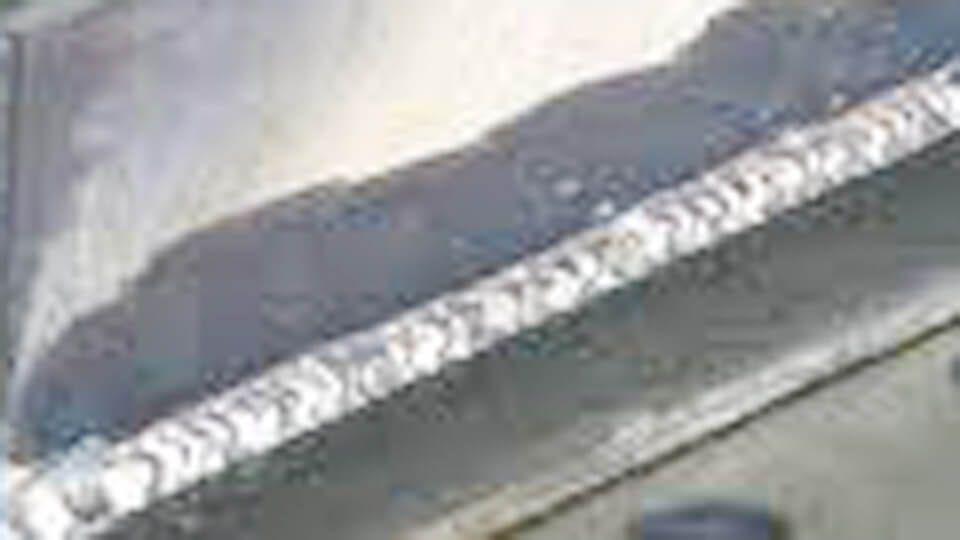
Photo WeldDotCom
Flux Core Welding Fundamentals
Flux core arc welding (FCAW) uses a tubular wire electrode filled with flux compounds that generate shielding gas and slag during the arc.
This process excels in high-deposition applications, such as welding thick mild steel plates or contaminated surfaces, where it outperforms solid-wire MIG in tolerance to rust and mill scale.
Self-shielded flux core wires operate without external gas, making them ideal for outdoor work in windy conditions, while gas-shielded variants (often called dual-shield) add CO2 or argon-CO2 mixes for deeper penetration and cleaner beads.
The wire’s flux core produces slag that protects the molten pool but requires removal after cooling. Electrode classifications like E71T-11 indicate all-position capability (7), tensile strength (1), and usability (T-11 for self-shielded).
Wire diameters range from 0.030 inches for thinner materials to 0.045 inches for heavier stock, with amperage scaling accordingly.
For instance, a 0.035-inch wire typically runs at 120-200 amps for 1/4-inch plate, delivering deposition rates up to 8 pounds per hour—far higher than stick welding’s 2-3 pounds.
Polarity is critical: self-shielded FCAW uses DC electrode negative (DCEN) for shallower penetration and higher deposition, while gas-shielded prefers DC electrode positive (DCEP) for deeper fusion.
Joint preparation involves beveling edges on materials over 1/4 inch thick to ensure full penetration, with a 60-degree included angle common for butt joints. Travel speed, typically 8-12 inches per minute, balances heat input to prevent burn-through or lack of fusion.
Push vs. Pull: Technique Definitions and Mechanics
Pushing involves angling the gun forward, directing the wire toward the direction of travel, with the arc force propelling slag and spatter ahead of the puddle. This creates a wider, flatter bead profile, often with less penetration but smoother appearance in clean conditions.
Arc length shortens slightly, promoting stability at higher voltages (18-22 volts for 0.035-inch wire), but risks slag rolling under the arc if not managed.
Pulling, or dragging, points the gun backward, pulling it away from the completed weld. The arc digs deeper into the base metal, pushing slag behind the puddle for easier removal. This yields narrower, convex beads with superior fusion, especially on thicker sections.
Contact tip-to-work distance (CTWD) extends to 3/4-1 inch, compared to MIG’s 3/8 inch, to allow flux gases to form properly. Electrode extension beyond the nozzle affects voltage drop; excessive stickout reduces amps by 10-20% per additional 1/4 inch.
In performance terms, pulling increases penetration by 20-30% over pushing at identical settings, as measured in macro-etch tests on 1/4-inch mild steel. However, it generates more spatter—up to 15% higher—requiring robust fume extraction in enclosed shops.
Wire feed speed must align: for 0.035-inch self-shielded wire, 300-400 inches per minute correlates to 150-200 amps in pull mode, versus 250-350 ipm for push to maintain arc control.
The Performance Case for Pulling in Flux Core Welding
Industry standards, including those from the American Welding Society (AWS), recommend pulling for self-shielded flux core to mitigate slag entrapment—a defect that compromises weld integrity by creating voids.
Slag forms from flux residues and must stay atop the solidifying metal; pushing can trap it within the bead, reducing tensile strength by up to 15% in destructive testing.
Penetration profiles show pulling achieves 0.20-0.25 inches depth on 3/8-inch plate at 180 amps, versus 0.15-0.20 inches when pushing.
Arc stability benefits from the drag angle of 5-15 degrees, minimizing wander and undercutting. Deposition efficiency hits 85-90% with pulling, as less material is lost to spatter.
For vertical-up welds, pulling with a slight weave (1/8-inch side-to-side) controls puddle flow against gravity, preventing sagging. In horizontal fillets, it ensures toe fusion without rollover.
Quantitative data from manufacturer tests (e.g., Lincoln Electric’s NR-211 wire) confirms pulling reduces porosity rates to under 1% in contaminated environments, thanks to better shielding gas formation from the flux.
Material compatibility extends to carbon steels, where pulling handles higher carbon content (up to 0.30%) without cracking, by controlling heat-affected zone (HAZ) width to 0.10-0.15 inches.
When Pushing Might Outperform in Flux Core Applications
While pulling is the default, pushing offers advantages in select scenarios, particularly with gas-shielded wires or specific positions. For overhead welding, a 10-15 degree push angle stabilizes the arc against droplet detachment, reducing burn-through on thin gauges (16-20 gauge).
Bead appearance improves, with convexity dropping to 0.05-0.10 inches versus pulling’s 0.15 inches, aiding in cosmetic applications like automotive frames.
Pros include lower spatter (5-10% reduction) and easier visibility of the puddle leading edge, allowing finer control at slower travel speeds (6-8 ipm). Cons are pronounced: slag inclusion risks rise to 5-10% if the puddle advances too quickly, and penetration decreases by 15-25% on vertical-down passes.
For 0.045-inch dual-shield wire at 220 amps, pushing suits multi-pass caps on pipe joints, where it flattens the profile for better tie-in.
Decision framework: Opt for pushing if wind exceeds 5 mph (disrupting self-shielding) or when welding aluminum overlays with flux core variants, as it enhances cleaning action. Test on scrap: if macro sections reveal inclusions over 0.05 inches, revert to pulling.
| Aspect | Push Technique | Pull Technique |
|---|---|---|
| Penetration Depth (1/4-inch steel, 160 amps) | 0.15-0.20 inches | 0.20-0.25 inches |
| Slag Entrapment Risk | High (5-10%) | Low (<2%) |
| Bead Width | Wider (0.40-0.50 inches) | Narrower (0.30-0.40 inches) |
| Spatter Volume | Lower (10-15 g/min) | Higher (15-20 g/min) |
| Arc Stability (Voltage Variation) | ±1.5 volts | ±1.0 volts |
| Deposition Rate | 6-7 lbs/hour | 7-8 lbs/hour |
Optimizing Parameters for Push and Pull Techniques
Amperage ranges vary by wire diameter and technique. For self-shielded 0.030-inch wire, pull at 100-140 amps for 1/8-inch material, pushing at 80-120 amps to avoid overheating. Voltage adjusts: 16-18 volts for pull to maintain short arc, 18-20 for push to extend it.
| Wire Diameter | Technique | Amperage Range (Mild Steel) | Voltage | Wire Feed Speed (ipm) | CTWD (inches) |
|---|---|---|---|---|---|
| 0.030-inch | Pull | 100-180 | 15-20 | 200-500 | 3/4 |
| 0.030-inch | Push | 80-160 | 17-22 | 180-450 | 1/2-3/4 |
| 0.035-inch | Pull | 120-220 | 16-22 | 250-450 | 3/4-1 |
| 0.035-inch | Push | 100-200 | 18-24 | 220-400 | 3/4 |
| 0.045-inch | Pull | 150-250 | 18-25 | 150-350 | 1-1.25 |
| 0.045-inch | Push | 130-220 | 20-26 | 130-300 | 1 |
Position impacts: Reduce amps by 10-15% for vertical pull, 15-20% for overhead push. Travel speed influences heat: slower (8 ipm) for deeper penetration in pull, faster (12 ipm) for push to prevent slag overrun. Joint prep: V-grooves for pull maximize fusion; square edges suffice for push on thinner stock.
Material and Position Considerations in Technique Selection
Mild steel compatibility favors pulling for its tolerance to surface oxides, with penetration suiting 1/4-1/2 inch thicknesses.
On stainless, pushing with gas-shielded wire minimizes distortion by lowering heat input 10-15%. For cast iron repairs, pull ensures slag floats away, reducing cracking risks.
Flat and horizontal positions default to pull for efficiency. Vertical-down suits push for speed on thin sections, but vertical-up demands pull with reduced amps (e.g., 140 amps for 0.035 wire) to build shelf-like beads. Overhead: push dominates to counter gravity, with fast travel (15 ipm) preventing drips.
Failure causes tie to technique: undercut from excessive pull angle (>20 degrees), lack of fusion from pushing too fast. Correct by monitoring arc sound—a steady hiss indicates balance.
In shop practice, switching to push on a rusted trailer frame once prevented slag pockets in tight corners, but required post-weld grinding to verify integrity.
Another insight: on multi-pass grooves, alternate techniques—pull for root, push for cap—to optimize strength and aesthetics.
Troubleshooting Technique-Related Defects
Root causes of poor welds often stem from mismatched technique. Slag inclusion diagnoses as dark lines in radiographs, fixed by switching to pull and maintaining 10-degree drag. Porosity, from trapped gases, worsens with pushing; increase voltage 1-2 volts or clean base metal.
Undercut appears as grooves along toes, caused by high travel speed in pull—slow to 10 ipm. Burn-through on thin material (under 1/8 inch) signals over-amping in push; drop to 100 amps max. Arc instability, with popping, points to short CTWD in pull—extend to 1 inch.
Prevent by calibrating: use digital meters to verify amps match charts, and macro-etch test beads quarterly.
In one fabrication job, pushing on overhead beams led to inconsistent fusion until reverting to pull with parameter tweaks, highlighting the need for position-specific adjustments.
Wrapping Up
The verdict favors pulling for superior penetration and slag control in most flux core applications, especially self-shielded on mild steel. Reserve pushing for overhead or cosmetic needs where its flatter profile shines. This balanced approach maximizes weld performance without bias toward either method.
For advanced optimization, experiment with hybrid angles—5 degrees push in pull-dominant setups—to fine-tune deposition on high-carbon steels, potentially boosting efficiency by 10% in production runs.
Is flux core welding always DCEN polarity?
For self-shielded flux core, DCEN provides the shallow penetration and high deposition needed for outdoor repairs. Gas-shielded shifts to DCEP for deeper fusion in shop settings on thicker alloys.
What wire diameter works best for 1/4-inch steel in pull technique?
0.035-inch offers versatility, running 150-200 amps at 18-22 volts for solid penetration without excessive heat.
Can I use push technique outdoors with self-shielded wire?
Yes, but limit to calm conditions; wind over 5 mph disrupts shielding, increasing defects—stick to pull for reliability.
How does travel speed differ between push and pull?
Pull allows 8-12 ipm for depth; push requires 10-15 ipm to avoid slag overrun on flat welds.
What’s the impact of CTWD on arc in flux core?
Longer CTWD (1 inch) in pull reduces amps for control; shorter (1/2 inch) in push intensifies heat for thin materials.


