

Sparks were flying everywhere, the wire kept stubbing, and the bead looked nothing like it should. I was standing over a messy joint, helmet down, wondering why the weld sounded angry instead of smooth.
That was one of those moments where guessing settings just didn’t cut it, and I finally reached for a Flux Core MIG Welding Settings Chart to get things under control.
After years of burning wire on job sites and in cramped garages, I’ve learned most flux core problems come down to settings that are just a little off. Too hot and you blow through metal.
Too cold and the weld sits on top, weak and brittle. Dialing it in properly saves time, wire, and a lot of frustration—not to mention keeping you safer and your welds strong enough to trust.
I’ve made the mistakes so you don’t have to. Let me walk you through the setup that actually works, step by step, the same way I use it in the shop.
Getting Started with Flux Core MIG Welding
Flux core MIG welding, or FCAW (Flux-Cored Arc Welding), is my go-to process when I’m out in the field without shielding gas. It’s basically MIG welding but with a tubular wire filled with flux that protects the weld pool from contaminants. No gas bottle to lug around, which is huge for portability.
How it works is straightforward: your welder feeds the flux-cored wire through the gun, and an electric arc melts it along with the base metal. The flux inside the wire creates a slag that shields the molten pool and cleans up impurities.
I’ve used it on everything from rusty farm equipment to building custom gates, and it shines on thicker materials where you need deep penetration.
You’d pull this out when working outdoors—wind blows away gas shielding in regular MIG, but flux core handles it like a champ. Or if you’re on a budget, since skipping gas saves cash. It cuts down on setup time and gives you versatility for dirty or painted metals that would otherwise need heavy prep.
From my shop experience, start with a clean workspace but don’t sweat small rust spots; the flux eats through them.
Tip: Always test on scrap first. I once skipped that on a rush job and had to redo a whole seam because the wire was feeding inconsistently.
Decoding the Flux Core MIG Welding Settings Chart
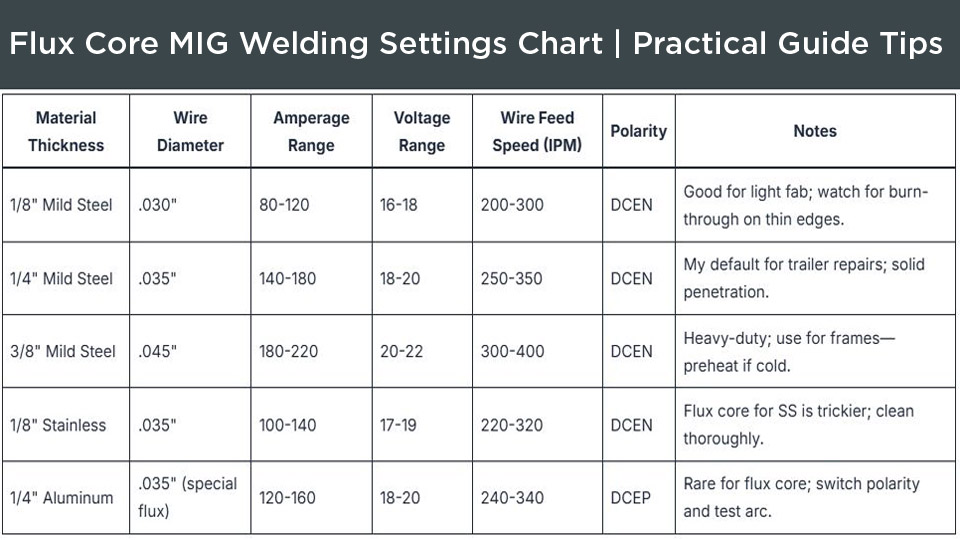
Every welder needs a reliable settings chart—it’s like your roadmap for amperage, voltage, wire speed, and more. Based on what I’ve dialed in over years of trial and error, here’s a breakdown tailored for common US machines like Lincoln or Miller models.
What it covers: Amperage for heat input, voltage for arc length, wire feed speed to match your pace, and polarity (usually DCEN for flux core).
How to use it: Match your wire diameter and material thickness to the chart, then fine-tune based on joint type. For example, on 1/4-inch mild steel, I aim for 140-180 amps with .035 wire.
When it’s essential: On jobs where consistency matters, like auto repairs or structural fab, to avoid weak welds that fail under load.
Why it pays off: Proper settings prevent issues like lack of fusion or excessive spatter, saving you filler metal and time.
Here’s a practical chart I’ve put together from shop-tested ranges. These are ballpark figures—always adjust for your specific welder and conditions.
| Material Thickness | Wire Diameter | Amperage Range | Voltage Range | Wire Feed Speed (IPM) | Polarity | Notes |
|---|---|---|---|---|---|---|
| 1/8″ Mild Steel | .030″ | 80-120 | 16-18 | 200-300 | DCEN | Good for light fab; watch for burn-through on thin edges. |
| 1/4″ Mild Steel | .035″ | 140-180 | 18-20 | 250-350 | DCEN | My default for trailer repairs; solid penetration. |
| 3/8″ Mild Steel | .045″ | 180-220 | 20-22 | 300-400 | DCEN | Heavy-duty; use for frames—preheat if cold. |
| 1/8″ Stainless | .035″ | 100-140 | 17-19 | 220-320 | DCEN | Flux core for SS is trickier; clean thoroughly. |
| 1/4″ Aluminum | .035″ (special flux) | 120-160 | 18-20 | 240-340 | DCEP | Rare for flux core; switch polarity and test arc. |
In my shop, I keep this laminated on the wall next to the welder. If your machine has digital readouts, cross-reference with the manufacturer’s manual, but trust your eyes on the bead— it should look like stacked dimes, not lumpy porridge.
Choosing the Right Flux Core Wire Diameter
Wire diameter is the foundation of your setup—get it wrong, and everything else fights you.
What it is: Flux core wires come in sizes like .030″, .035″, and .045″, measured in inches. Thinner for lighter work, thicker for beefier jobs.
How it affects your weld: Smaller diameters run cooler with less amperage, ideal for thin sheets to avoid warping. Larger ones carry more current for deeper penetration on thick plates.
When to pick each: Use .030″ for auto body panels or sheet metal under 1/8″—it’s forgiving for beginners. .035″ is my all-around favorite for most shop tasks, like welding brackets or pipes. Go .045″ for structural steel over 1/4″ where you need serious fill.
Why diameter matters: Mismatched size leads to poor arc stability. I remember a trainee using .045″ on thin gauge—he blew holes everywhere, and we spent the afternoon patching.
Shop tip: Store wires in a dry spot; moisture kills flux and causes porosity. If you’re switching diameters, swap contact tips too—wrong size pinches the wire and causes bird-nesting in the feeder.
Amperage and Voltage: Dialing in the Heat
Amperage controls your heat input, while voltage tweaks the arc characteristics—too low, and you get stubbing; too high, spatter city.
What they do: Amps melt the metal faster, voltage widens or lengthens the arc for smoother operation.
How to set them: Start at the low end of your chart’s range, weld a bead, and bump up if penetration’s weak. For .035″ wire on 1/4″ steel, I begin at 150 amps and 19 volts.
When to adjust: Thicker materials or vertical positions need more amps for gravity-defying welds. Colder shops? Crank it a bit to compensate.
Why fine-tune: Bad settings cause distortion—I’ve seen frames twist from overheating. It also affects rod burn-off rate; too hot, and you’re swapping spools constantly.
Anecdote: On a cold winter job fixing a snowplow, low amps gave me cold laps. Bumped to 170, and it fused perfectly. Lesson: Environment plays into settings.
Tip: Use a multimeter to check actual output if your machine’s old—dials wear out.
Material Compatibility and Filler Metal Choices
Not all flux core wires play nice with every metal—matching them right ensures strong, crack-free welds.
What to consider: Mild steel loves E71T-1 or E71T-11 wires for all-position work. For galvanized, self-shielding types reduce zinc fumes.
How compatibility works: The flux composition must match the base metal’s chemistry to avoid brittle welds. Stainless needs specific alloys like 309L flux core.
When to switch fillers: For repairs on unknown metals, test first. I use it on carbon steels mostly, but for alloys, consult the wire spec sheet.
Why it prevents problems: Wrong filler leads to hydrogen cracking. Seen it on high-strength steels—weld looks fine, fails later under stress.
Practical advice: In my fab work, I stock dual-shield wires for cleaner indoor jobs, self-shield for outdoors. Always degrease; oils contaminate the flux.
Joint Preparation for Optimal Flux Core Welds
Prep work is half the battle—skip it, and no settings chart saves you.
What it involves: Cleaning, beveling, and gap setting for the joint type (butt, lap, fillet).
How to do it: Grind off rust or paint within 1/2″ of the weld area. For thick plates, bevel edges at 30 degrees for better penetration.
When prep is crucial: On contaminated or thick materials to ensure fusion. Thin stuff? Just wipe down.
Why bother: Poor prep causes inclusions or lack of sidewall fusion. I’ve fixed many a weld that failed because someone thought flux core “forgives everything.”
Shop story: Prepping a rusted exhaust manifold, I ground too aggressively and thinned the metal—had to build it back up. Balance is key.
Tip: Use a wire brush attachment on your angle grinder for quick cleanups. For gaps over 1/16″, add backing if possible.
Step-by-Step Guide to Setting Up Your Flux Core MIG Welder
Let’s break this down like I’m showing you in the shop.
First, select your wire: Pick diameter and type based on material—say .035″ E71T-11 for mild steel.
Second, install the spool: Load it into the feeder, thread through the drive rolls, and set tension just enough to avoid slipping.
Third, set polarity: DCEN for most flux core—reverse leads if needed.
Fourth, dial in settings: Use the chart—150 amps, 19 volts, 300 IPM for starters.
Fifth, gas? None needed for self-shielding, but if dual-shield, set 20-25 CFH argon/CO2.
Sixth, test weld: On scrap, adjust until the bead is flat with good tie-in.
Seventh, weld the job: Maintain 3/8″ stick-out, 15-20 degree angle, steady travel speed.
Common tweak: If spatter’s bad, drop voltage; poor penetration, up amps.
From experience, this setup has saved me on mobile jobs—no fuss, quick starts.
Common Mistakes with Flux Core Settings and Fixes
Even pros slip up—here’s what I’ve seen and how to correct.
Mistake one: Too high amperage on thin metal. Fix: Drop to chart low end, use pulse if your machine has it. I burned through a toolbox once; now I always start conservative.
Mistake two: Ignoring wire feed speed. If too slow, arc stutters—match to amps for consistent puddle.
Mistake three: Wrong polarity. DCEP on flux core gives erratic arc; double-check leads.
Mistake four: Skipping anti-spatter spray. Flux core spatters more—spray the nozzle for easy cleanup.
Anecdote: A hobbyist friend cranked everything max for “more power”—ended with warped panels. Dialed back, and his welds improved overnight.
Tip: Log your successful settings in a notebook; reference for repeat jobs.
Pros and Cons of Flux Core MIG Compared to Other Processes
Flux core isn't always the answer—let’s weigh it against stick (SMAW) or gas MIG.
Pros: Portable, no gas, high deposition rates for fast work. Great for windy outdoors or dirty metals. Cheaper setup for beginners.
Cons: More spatter and slag cleanup than gas MIG. Fumes are heavier—need good ventilation. Not as clean for thin or cosmetic welds.
Compared to SMAW: Flux core is continuous, less start/stop, but stick is simpler for all-weather.
In my shop, I switch to flux core for quick repairs, gas MIG for precision fab.
Why choose it? For cost savings on big jobs—less filler waste.
Tip: If you’re new, practice flux core first; it builds skills for handling variables.
Safety Considerations When Tweaking Settings
Safety isn’t optional—wrong settings amplify risks.
What to watch: High amps increase heat, risking burns or fire. Unstable arcs cause flashes.
How to stay safe: Wear full PPE—helmet with proper shade (10-13), gloves, jacket. Ensure good ventilation for fumes.
When risks spike: Outdoor work with wind—flux smoke can build up.
Why prioritize: I’ve seen arc eye from skimping on helmets; it’s brutal.
Practical measures: Ground clamp securely to avoid shocks. Keep fire extinguisher handy for spatter.
Tip: Test settings away from flammables; adjust helmet sensitivity for flux core’s brighter arc.
Advanced Tips for Fine-Tuning in Real Jobs
Once basics are down, elevate your game.
For vertical welds: Lower amps 10-20%, use weave technique to fight gravity.
On galvanized: Remove coating first, or use low-fume wire—health first.
Multi-pass: Let cools between; prevents overheating.
From fabbing custom bumpers, I learned preheating thick stock evens heat distribution.
Tip: Monitor duty cycle—overheating machines lead to inconsistent settings.
Troubleshooting Bad Welds from Poor Settings
Bead looks ropey? Voltage too high—drop it.
Porosity? Moisture in wire or dirty metal—dry storage and clean prep.
Lack of penetration? Up amps, slow travel.
I’ve troubleshot hundreds: A pro welder I know had undercuts from fast speed—slowed down, perfect edges.
Tip: Photograph bad welds; compare to good ones for patterns.
Wrapping Up
I’ve covered the flux core MIG welding settings chart to the shop tricks that make the difference on real jobs. Thinking back to that trailer repair gone wrong, it’s clear how nailing these details turns frustration into smooth, reliable work.
You’re now armed with the know-how to pick the right wire, dial in amps and voltage without guesswork, and avoid the pitfalls that waste time and materials.
Whether you’re patching a fence as a hobbyist or running production in a shop, these insights mean stronger welds, less rework, and safer days. Always listen to the arc—it should sizzle steadily like frying bacon; any pops or hisses, tweak immediately.
FAQs
What settings should I use for flux core welding on 1/4-inch steel?
For 1/4-inch mild steel, go with .035″ wire at 140-180 amps, 18-20 volts, and 250-350 IPM wire speed on DCEN. Test on scrap, aiming for a flat bead with good fusion. If outdoors, self-shielding wire handles wind better.
Why is my flux core weld spattering so much?
Spatter often comes from high voltage or inconsistent wire feed. Drop voltage by 1-2 points, check drive roll tension, and clean the nozzle. Also, maintain 3/8″ stick-out—longer causes instability.
Can I use flux core wire in a regular MIG welder?
Yes, most MIG welders handle flux core by switching to DCEN polarity and skipping gas. Swap to knurled drive rolls for better grip on the tubular wire. Start with manufacturer-recommended settings and adjust.
What’s the best wire diameter for beginner flux core welding?
Start with .035″—it’s versatile for most thicknesses and forgiving. Avoid .030″ until you’re comfortable, as it runs cooler and needs precise control to prevent burn-through on thin stuff.
How do I fix porosity in my flux core welds?
Porosity usually means contaminants or moisture. Clean the metal thoroughly, store wire dry, and ensure good ventilation to avoid wind drafts. If persistent, try a different wire brand with better flux.


