

Are you struggling to get clean welds with your MIG welder? Do your welds look messy, or is the bead too thin or too thick? Many beginners face these problems, and the reason is often the wrong wire speed and voltage settings. Adjusting these two controls is the key to getting strong, neat welds.
But it’s not always easy to know what numbers to use. This guide will help you understand how wire speed and voltage work together, how to use charts, and how to adjust your settings for different metals and thicknesses.
You will learn why these controls matter, see real data, and discover tips even experienced welders sometimes miss. By the end, you’ll have the confidence to choose the right settings for every project.
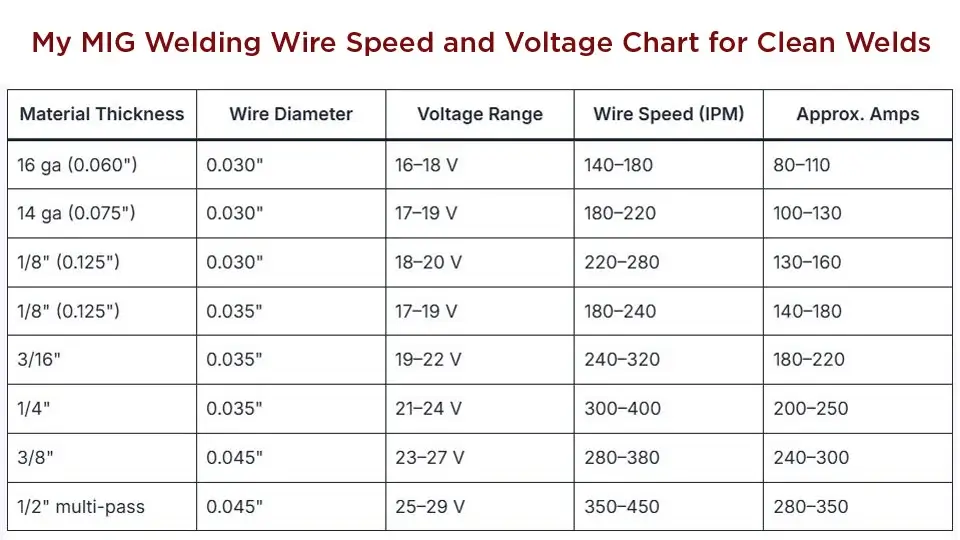
What Is Mig Welding?
MIG welding stands for Metal Inert Gas welding. It uses a spool of wire as the electrode. The wire feeds through a gun, melts, and joins metal pieces together. A shielding gas (usually argon or CO₂) protects the weld from air. MIG welding is popular because it’s fast, easy, and works on many metals.
Why do wire speed and voltage matter? They control how much wire melts and how hot the arc is. Choosing the right settings means you get strong, smooth welds without holes or weak spots.
Understanding Wire Speed And Voltage
Wire speed is how fast the wire feeds into the weld. It’s measured in inches per minute (IPM) or millimeters per minute (mm/min). Voltage is how much electrical energy goes through the arc. It affects how deep the weld penetrates.
If wire speed is too high, you get thick, messy welds and spatter. If wire speed is too low, the arc keeps breaking and your weld is weak. If voltage is too high, the weld can burn through the metal.
If voltage is too low, the weld won’t melt properly.
How Wire Speed And Voltage Work Together
Wire speed and voltage are linked. More wire speed needs more voltage. Less wire speed needs less voltage. Imagine baking a cake: you need the right balance of heat and ingredients. In MIG welding, the wire is your ingredient, voltage is your heat.
For example, welding thin sheet metal (like car body panels) needs low wire speed and low voltage. Welding thick steel pipes needs high wire speed and high voltage.
Typical Settings For Mig Welding
Most MIG welders let you set wire speed and voltage. Here are typical ranges:
- Wire speed: 50 to 700 IPM (1.3 to 18 m/min)
- Voltage: 14 to 28 volts
But the best settings depend on:
- Metal type (steel, aluminum, stainless)
- Thickness of metal
- Wire diameter
- Gas type
How To Read A Mig Welding Wire Speed And Voltage Chart
A wire speed and voltage chart shows recommended settings for different metals and thicknesses. These charts help you avoid guesswork.
A typical chart has columns for:
- Metal type and thickness
- Wire diameter
- Wire speed (IPM or mm/min)
- Voltage (volts)
- Shielding gas
Let’s see a sample chart for mild steel:
| Metal Thickness | Wire Diameter | Wire Speed (IPM) | Voltage (V) | Gas |
|---|---|---|---|---|
| 1/16″ (1.6 mm) | 0.023″ | 90-120 | 15-17 | CO₂ or Argon mix |
| 1/8″ (3.2 mm) | 0.030″ | 140-200 | 17-19 | CO₂ or Argon mix |
| 1/4″ (6.4 mm) | 0.035″ | 220-350 | 20-24 | CO₂ or Argon mix |
Use these numbers as a starting point. Adjust up or down depending on your weld quality and machine.
Factors That Affect Wire Speed And Voltage
Choosing the right settings is not only about following a chart. Real-world welding has many variables.
Metal Type
Different metals melt at different temperatures. Mild steel needs less voltage than aluminum or stainless steel. Aluminum welds need higher voltage and faster wire speed because it conducts heat quickly.
Metal Thickness
Thicker metal needs more heat and more wire. Thin metal needs less. Always match your settings to the material.
Wire Diameter
Thicker wire carries more current and melts more metal. For thin metal, use thin wire (like 0. 023”). For thick metal, use thicker wire (like 0. 035” or 0. 045”).
Shielding Gas
The gas affects arc heat and weld quality. Pure CO₂ gives deep penetration but more spatter. Argon/CO₂ mixes are cleaner. For aluminum, pure argon is used.
Machine Type
Some welders are “synergic,” meaning they set voltage automatically based on wire speed. Manual machines require you to set both.
Mig Welding Wire Speed And Voltage Chart For Different Metals
Here are sample charts for three common metals: mild steel, aluminum, and stainless steel.
Mild Steel
| Thickness | Wire Size | Wire Speed (IPM) | Voltage (V) | Gas |
|---|---|---|---|---|
| 0.8 mm (22 ga) | 0.023″ | 90-120 | 15-16 | 75% Argon/25% CO₂ |
| 1.6 mm (16 ga) | 0.030″ | 135-160 | 17-18 | 75% Argon/25% CO₂ |
| 3 mm (1/8″) | 0.035″ | 200-300 | 19-22 | 75% Argon/25% CO₂ |
| 6 mm (1/4″) | 0.045″ | 250-400 | 22-26 | 75% Argon/25% CO₂ |
Aluminum
| Thickness | Wire Size | Wire Speed (IPM) | Voltage (V) | Gas |
|---|---|---|---|---|
| 1.5 mm (1/16″) | 0.030″ | 190-250 | 18-21 | 100% Argon |
| 3 mm (1/8″) | 0.035″ | 250-350 | 21-24 | 100% Argon |
| 6 mm (1/4″) | 0.045″ | 350-500 | 24-28 | 100% Argon |
Stainless Steel
| Thickness | Wire Size | Wire Speed (IPM) | Voltage (V) | Gas |
|---|---|---|---|---|
| 1 mm (18 ga) | 0.030″ | 120-150 | 16-18 | 98% Argon/2% CO₂ |
| 2 mm (14 ga) | 0.035″ | 160-200 | 18-21 | 98% Argon/2% CO₂ |
| 4 mm (5/32″) | 0.045″ | 200-300 | 21-24 | 98% Argon/2% CO₂ |
How To Use The Chart For Your Welds
Charts are a starting point. But real welding needs adjustments. Here’s how to use the chart:
- Find your metal type and thickness.
- Select the wire diameter (match what’s in your welder).
- Set the wire speed and voltage as shown.
- Do a test weld on scrap metal.
- Check the weld. Is it strong, smooth, and neat? If not:
- For weak welds: Increase voltage or wire speed slightly.
- For too much spatter: Decrease wire speed or voltage.
- For burning through: Lower voltage.
- For poor penetration: Raise voltage.
Two non-obvious tips: Always check your machine’s power limits. Many small welders can’t handle thick wire or high voltage. Also, the wire speed knob may not match the chart exactly—use your ears and eyes. A steady, crackling sound means good settings.
Practical Examples And Mistakes To Avoid
Let’s look at two real situations:
Welding Thin Sheet Metal
Suppose you’re fixing a car panel (thin steel, 1 mm thick). The chart says 0.023″ wire, 100 IPM wire speed, 15 volts. If you use too much voltage, you’ll burn holes. If wire speed is too high, you get big blobs.
Best practice: Start low, weld a short bead, check the result, and adjust. Many beginners forget to test on scrap metal first.
Welding Thick Steel
If you’re welding a trailer frame (6 mm thick steel), use 0. 045″ wire, 300 IPM, 24 volts. If voltage is too low, the weld sits on top and doesn’t penetrate. If wire speed is too low, the arc flickers and breaks.
A common mistake is using thin wire for thick steel. It won’t work—use the wire size recommended.
Advanced Insights: Beyond The Chart
Charts help, but expert welders use extra tricks. Here are two advanced insights:
Wire stick-out (distance from the nozzle to the metal) affects the arc. Short stick-out gives more heat, long stick-out gives less. Adjust stick-out for tricky welds.
Travel speed (how fast you move the gun) changes the bead. Slow travel makes thick beads, fast travel makes thin beads. Practice to find your rhythm.
Another thing most beginners miss: ambient temperature. Cold metal needs more heat, so increase voltage slightly in winter or when welding outside.
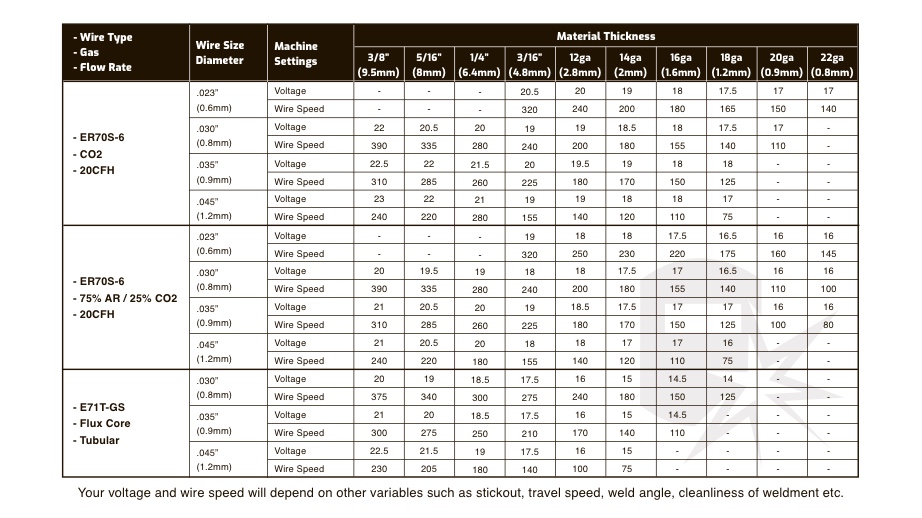
Credit: weldguru.com
Comparing Wire Speed And Voltage: How They Affect Weld Quality
Let’s compare two welds with different wire speed and voltage.
| Setting | Wire Speed | Voltage | Weld Result |
|---|---|---|---|
| Low | 80 IPM | 14 V | Poor penetration, weak bead, arc breaks |
| Medium | 150 IPM | 18 V | Strong, smooth bead, clean weld |
| High | 300 IPM | 24 V | Too much spatter, thick bead, risk of burn-through |
The best weld is usually with medium settings. Always check weld quality and adjust.
Tips For Setting Mig Wire Speed And Voltage
Here are practical tips to get the best results:
- Start with chart values, then adjust after a test weld.
- Listen to the arc. A steady “crackle” sound means good settings.
- Check bead shape. A flat, wide bead is ideal. Tall, narrow beads mean wrong settings.
- Use the right wire size. Don’t try thick metal with thin wire.
- Clean the metal before welding. Dirt affects arc stability.
- Keep wire stick-out short (about 1/2 inch).
- Use proper shielding gas. Wrong gas can ruin welds.
- Test on scrap before real work.
- Adjust travel speed. Don’t move too fast or too slow.
- Check machine limits. Don’t use settings your welder can’t handle.
Common Beginner Mistakes
Many beginners make these mistakes:
- Setting wire speed too high, making messy welds
- Using too much voltage and burning through thin metal
- Not matching wire size to metal thickness
- Ignoring the importance of shielding gas
- Forgetting to clean the metal
- Not doing test welds
Always check and adjust. Practice and patience make perfect welds.
How To Fine-tune Your Mig Settings
Even with charts, you need to fine-tune for your setup. Here’s a step-by-step process:
- Set wire speed and voltage as the chart says.
- Weld a short bead on scrap metal.
- Look at the bead:
- Flat, wide: Good.
- Tall, narrow: Too little voltage or wire speed.
- Spatter: Too much wire speed or voltage.
- Adjust one control at a time.
- Repeat until you get a strong, clean weld.
A non-obvious tip: If the arc is noisy and the gun jerks, reduce wire speed slightly. If the arc is weak and keeps breaking, increase wire speed.
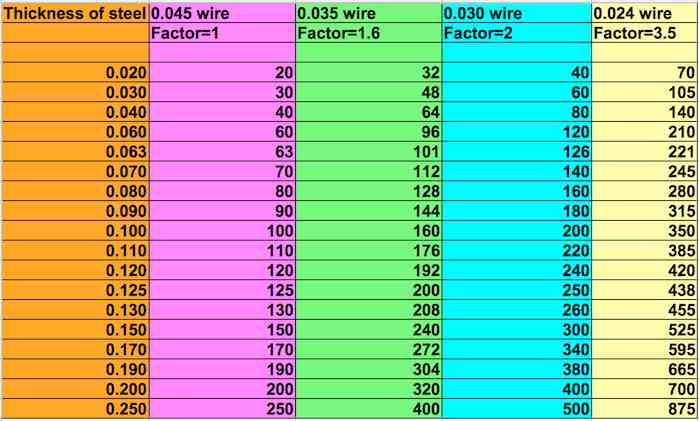
Credit: www.weldingtipsandtricks.com
What To Do If Your Welds Are Still Bad
If you follow the chart and tips but your welds are still bad, check these:
- Is your wire feeding smoothly? If not, check the spool and liner.
- Is your shielding gas flowing? If not, check the bottle and hose.
- Is your ground clamp tight and clean?
- Is your metal clean and rust-free?
- Are you using the right wire diameter for the metal?
Sometimes, the problem is not your settings but your equipment or technique.
Using Synergic Mig Welders
Synergic welders adjust voltage automatically as you change wire speed. This helps beginners. If you use a synergic welder, set wire speed, and the machine picks the voltage. You may still need to fine-tune.
Synergic welders are popular in modern workshops. They reduce errors and make welding easier for less experienced users.
Mig Welding For Different Applications
Wire speed and voltage charts are helpful for:
- Automotive repair: Thin metal needs careful settings.
- Construction: Thick steel needs high wire speed and voltage.
- Fabrication: Stainless steel and aluminum need special charts.
- DIY projects: Test and adjust settings as you work.
Always check your chart and adjust for your project.
Where To Find Mig Welding Wire Speed And Voltage Charts
You can find charts in your welder’s manual, online at welding forums, or from wire manufacturers. Some welding schools share charts for students.
Final Thoughts
Getting the right MIG welding wire speed and voltage is a skill you can learn with charts, practice, and patience. Use the charts as a guide, adjust for your project, and always check your weld quality. With time, you’ll get strong, clean welds every time.
Frequently Asked Questions
What Happens If I Set Wire Speed Too High?
If wire speed is too high, the weld will be thick, messy, and you’ll get lots of spatter. The arc may sound harsh, and the bead can sit on top of the metal instead of melting in. You may also see the wire “pushing” the gun back.
How Do I Know If My Voltage Is Too Low?
Low voltage causes weak, narrow beads. The weld won’t penetrate, and the arc can keep breaking. You may also see the bead sitting on top and not joining the metal properly. Try increasing voltage if you see these signs.
Can I Use The Same Chart For All Metals?
No. Each metal has its own melting point and needs different wire speed and voltage. Mild steel, aluminum, and stainless steel all need their own charts. Always use the chart for your metal type.
Why Does Shielding Gas Matter For Mig Welding?
Shielding gas protects the weld from air. Wrong gas can cause porosity, weak welds, or too much spatter. For steel, use a mix of argon and CO₂. For aluminum, use pure argon. Always check your chart and gas bottle.
How Do I Adjust Settings For Vertical Or Overhead Welding?
Vertical and overhead welds need slightly lower wire speed and voltage to avoid drips. Practice on scrap, and adjust settings to get a steady, controlled bead. Move the gun slowly and keep your arc stable.


