

Welding thin metal can be a nerve-wracking task, especially if you are new to the world of metalwork. The risk of burning holes, warping, or even ruining your project is high. When it comes to flux core welding, many people think it is only suitable for thick, heavy-duty jobs.
However, with the right approach and some practical tips, you can achieve clean, strong welds on thin metal using a flux core welder.
I’ll show you how to do it step by step, explain common mistakes, and help you make confident choices whether you are repairing car panels, making garden art, or fabricating light structures.
Understanding Flux Core Welding And Thin Metal
Flux core welding, or FCAW (Flux-Cored Arc Welding), uses a special wire filled with flux. This wire melts to create the weld, and the flux forms a protective gas to shield the weld pool from contamination. Unlike MIG welding, you do not need an external gas cylinder, making it more portable and cost-effective.
Welding thin metal (generally 1/16 inch to 1/8 inch or about 1.5 mm to 3 mm) is challenging because it heats up quickly and can burn through easily. This is especially tricky with flux core, which runs hotter than MIG welding. That is why understanding the process, equipment, and technique is crucial.
Why Choose Flux Core For Thin Metal?
Some people may wonder why use flux core at all. Here are a few reasons:
- No gas needed: You can weld outdoors where wind might blow away shielding gas.
- Better penetration: Flux core welders can join even slightly rusty or dirty metal.
- Affordable: Entry-level machines are usually cheaper than MIG setups.
However, you must adjust your technique to avoid burn-through and get a clean finish.
Choosing The Right Equipment And Materials
Before you start, your welder setup matters as much as your technique. Here is what you need to consider:
Picking The Right Welder
For thin metal, a 110V flux core welder is usually enough. Look for a machine with adjustable voltage and wire speed. Too much power will make burn-through more likely.
| Welder Feature | Why It Matters | Recommended for Thin Metal? |
|---|---|---|
| Voltage Control | Allows precise adjustment of heat | Yes |
| Wire Speed Control | Controls how fast wire feeds into weld | Yes |
| Duty Cycle | Limits continuous welding time | Medium (short welds are OK) |
| Amperage Range | Lower settings help avoid burn-through | Yes, look for low-end amps |
Selecting The Right Wire
Use .030-inch (0.8 mm) flux core wire for thin metal. Thicker wires (.035 or .045) carry too much heat and are better for thick steel. Brands like Lincoln Electric and Hobart have good quality wire.
Preparing The Metal
A clean surface is essential. Remove any paint, rust, oil, or dirt. Use a wire brush or grinder. Even though flux core is more forgiving, a clean joint still welds better and reduces spatter.
Safety Gear
Never skip safety. You need:
- Auto-darkening welding helmet (shade 10 or higher)
- Welding gloves
- Long sleeves and pants (cotton or leather)
- Closed-toe boots
- Safety glasses
Flux core welding creates a lot of smoke and sparks, so work in a well-ventilated area and protect yourself from burns and fumes.
Setting Up Your Welder For Thin Metal
Getting the settings right is half the battle. Here is how to dial in your machine:
Voltage And Amperage
Set your voltage and amperage to the lowest possible settings that still get good fusion. Thin metal does not need much heat. Most machines have charts inside the cover to guide you.
Wire Speed
Start with a medium wire speed. Too slow, and your arc will be unstable. Too fast, and the wire will push into the weld pool, causing spatter.
Polarity
Flux core wire needs DCEN (Direct Current Electrode Negative). This is different from MIG welding, which often uses DCEP (Direct Current Electrode Positive). Check your manual and make sure the cables are set correctly.
Test On Scrap
Always test your setup on a piece of scrap metal with the same thickness as your project. This helps you fine-tune settings before you work on the real piece.
Welding Techniques For Thin Metal
The way you move the gun and handle the weld makes a big difference. Here are key techniques:
Keep The Arc Short
Hold the nozzle close (about 1/4 inch or 6 mm) to the metal. A long arc increases heat and spatter, risking burn-through.
Move Fast And Steady
Thin metal heats up fast. Move your gun quickly but smoothly along the joint. Avoid stopping in one place, as this creates holes.
Use Stitch Or Tack Welding
Instead of running a long bead, use short welds (stitches):
- Weld for 1-2 seconds, then stop.
- Let the metal cool for a few seconds.
- Weld another short stitch, overlapping the previous one.
Repeat until the joint is done. This reduces heat buildup and warping.
Backing Bars
If possible, place a copper backing bar behind your weld. Copper absorbs heat and prevents burn-through, but does not stick to steel. Aluminum can also work in a pinch.
Pull, Don’t Push
With flux core, always pull (drag) the gun, not push. This gives better penetration and cleaner welds.
Joint Preparation And Design
Proper joint design is often overlooked, but it is critical with thin metal.
Overlap Joints
Where possible, use lap joints—one piece overlaps the other. These are easier to weld without burning through.
Tightly Fit Joints
Thin metal should fit tightly. Gaps make burn-through more likely. If there is a gap, use a backing bar or fill it with extra tacks before welding the whole seam.
Clamp Everything
Use clamps or magnets to hold your pieces steady. Movement during welding can create uneven welds and increase the chance of holes.
Clean Edges
Cut edges cleanly with a shear or fine grinder. Jagged edges catch heat and can melt away faster.
Practical Tips For Better Welds
Here are some extra tips that make a real difference:
- Preheat in cold weather: If working outside, slightly warm the metal with a heat gun to prevent condensation and porosity.
- Short wire stick-out: Keep only about 1/4 inch (6 mm) of wire sticking out from the nozzle.
- Control your angle: Hold the gun at a 10-15 degree angle back from vertical. Too steep, and the weld can pile up or undercut.
- Use both hands: Steady your gun with both hands, especially for precise work.
- Watch the puddle, not the arc: Focus on the molten pool. It tells you if the weld is going too fast, slow, or overheating.
- Clean between passes: If you do multiple stitches, remove slag after each one with a chipping hammer or wire brush.
- Practice first: Weld on scrap pieces before you tackle your real project.

Credit: www.youtube.com
Common Mistakes And How To Avoid Them
Welding thin metal with flux core is not forgiving of errors. Here are mistakes beginners often make:
Burn-through
This happens when the metal melts away, leaving a hole.
- How to avoid: Lower the voltage, move faster, and use stitch welds.
- If you burn through, let the area cool, then use a series of tacks to fill the hole.
Warping
Thin sheets can bend or twist from heat.
- How to avoid: Weld in short sections, let the metal cool, and use clamps.
- Alternate the position of your welds to spread heat evenly.
Excessive Spatter
Flux core is known for spatter, but too much makes clean-up difficult.
- How to avoid: Use correct settings and clean base metal.
- Anti-spatter spray helps, but do not spray where you will weld.
Poor Penetration
If your weld sits on top and does not fuse both pieces, it will be weak.
- How to avoid: Make sure your voltage is not too low. Watch for a flat, shiny bead with slight penetration into both pieces.
Dirty Welds
Slag inclusions or porosity weaken your weld.
- How to avoid: Clean between passes, and do not weld over slag. Make sure the wire is dry and stored properly.
Real-world Example: Repairing A Car Panel
Imagine you are patching a rust spot on a car door. The sheet metal is about 1 mm thick.
- Cut out the rust with a grinder.
- Prepare a patch of matching thickness, with clean, straight edges.
- Clamp the patch in place, with a copper backing bar behind.
- Tack weld the patch every inch, moving around to spread heat.
- Connect the tacks with short stitch welds, letting each cool before continuing.
- Grind smooth once finished, and inspect for holes or weak spots.
This method works for any thin sheet—appliances, ductwork, or small fabrication.
Essential Maintenance For Your Welder
Good equipment care keeps your welds consistent:
- Check the liner: The wire feed liner should be clean and free of kinks.
- Change contact tips: Worn tips cause arc instability—replace as needed.
- Store wire properly: Keep flux core wire dry; moisture can cause porosity.
- Clean your gun: Remove spatter from the nozzle and tip after every job.
When To Avoid Flux Core On Thin Metal
While flux core is very versatile, there are limits. If your metal is less than 1 mm thick, or you need a perfect cosmetic finish (like on show cars), flux core may not be ideal. MIG with gas or TIG welding gives more control in those cases.
Also, some metals (aluminum, stainless steel) need special flux core wires, and results may vary. Always check manufacturer guidelines.
Comparing Flux Core Vs. Mig For Thin Metal
Here is a quick side-by-side look at the main differences:
| Feature | Flux Core | MIG |
|---|---|---|
| Shielding | Internal flux, no gas needed | Requires gas tank |
| Setup cost | Lower | Higher |
| Spatter | More | Less |
| Outdoor use | Excellent | Poor (wind blows gas away) |
| Control on thin metal | Requires more skill | Easier |
Cost And Efficiency: What To Expect
Welding thin metal with flux core is cost-effective. A basic machine costs $100-$300, and wire is about $10-$15 per spool. You save money by not needing shielding gas.
However, factor in extra time for cleaning spatter and possible grinding if cosmetic appearance is important. For most practical projects, flux core is a solid, budget-friendly choice.
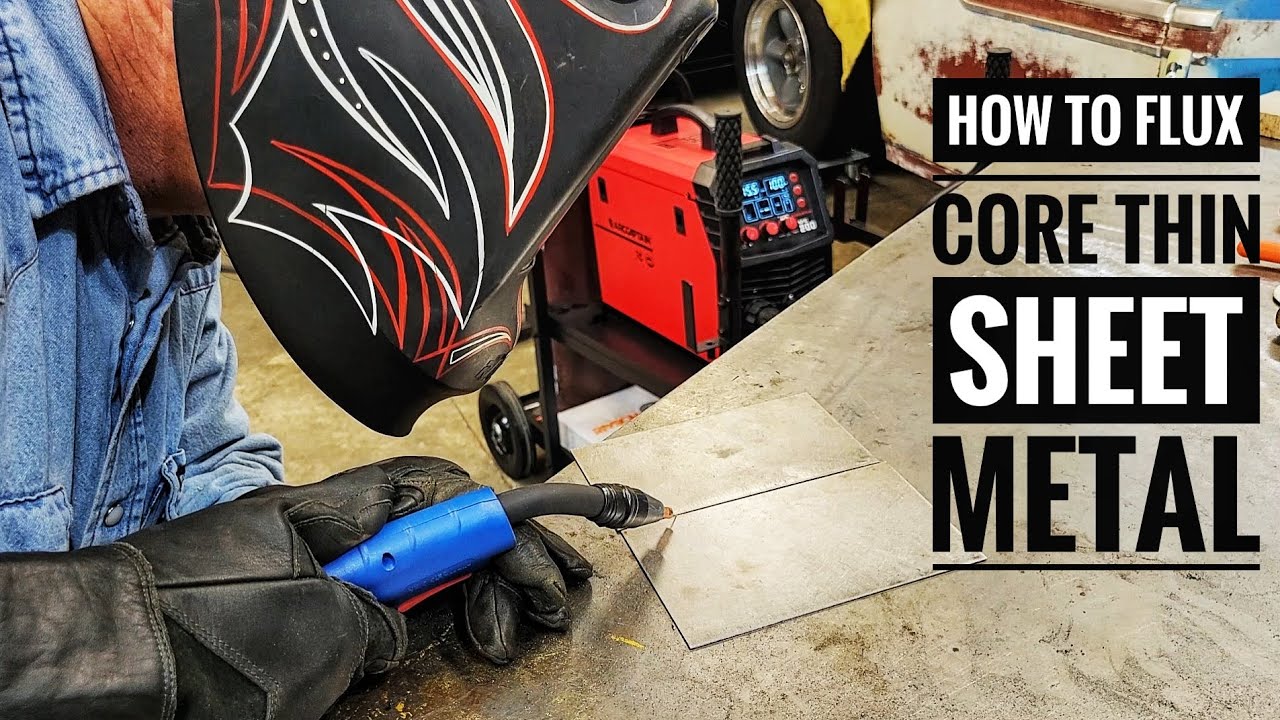
Credit: www.arccaptain.com
Advanced Tips: Going Beyond The Basics
Once you get comfortable, try these advanced tricks:
- Pulse your trigger: Instead of holding the trigger continuously, use short bursts. This keeps heat down and improves control.
- Skip welding: For long seams, weld a few inches, then move to another area. Come back later to fill in the gaps.
- Use thinner wire: Some machines accept .023-inch wire—this gives even more control but may be harder to find in flux core.
- Pre-form your joint: Slightly bend overlapping sheets to improve contact and reduce gaps.
Summary Table: Key Steps And Common Errors
To make things clearer, here is a quick summary:
| Step | Key Action | Common Mistake | Solution |
|---|---|---|---|
| Preparation | Clean metal, fit joints tightly | Leaving rust/paint | Brush/grind before welding |
| Welder Setup | Low voltage, correct wire size | Too much heat | Test on scrap first |
| Welding | Short stitches, move fast | Long, slow beads | Stitch/tack technique |
| Finishing | Remove slag, grind smooth | Welding over slag | Clean after each pass |
Wrapping Up
Welding thin metal with flux core can seem tough at first, but with the right approach and a bit of patience, you can achieve strong, neat results.
Remember to start with good preparation, adjust your machine carefully, and use stitch welding to control heat. Soon, you will be making repairs and building projects with confidence.
Frequently Asked Questions
What Is The Thinnest Metal You Can Weld With Flux Core?
You can usually weld down to about 1 mm (0.04 inch) with flux core, but it takes skill and careful settings. Thinner than that, and burn-through is very likely. For extremely thin sheets, consider MIG with gas or TIG welding.
How Do You Prevent Burn-through On Thin Metal?
Use low voltage and amperage, keep your wire speed moderate, and use short stitch welds. Let the joint cool between stitches. A copper backing bar can also help absorb heat and prevent holes.
Is Flux Core Welding Strong Enough For Automotive Repairs?
Yes, flux core welds are strong when done correctly. They can be used for car panels, frames, and general repairs. However, for cosmetic areas where appearance matters, you may need extra grinding and finishing.
Can You Weld Galvanized Thin Metal With Flux Core?
It is possible, but galvanized coatings release toxic fumes when welded. Always grind off the coating in the weld area and work in a well-ventilated space. Wear a respirator if possible. Never weld indoors without proper airflow.
What Is The Best Flux Core Wire Size For Thin Metal?
The best wire size is .030 inch (0.8 mm). It offers a good balance of control and penetration. Some advanced welders use .023-inch wire for extra-thin sheet metal, but it is less common and not always available in flux core.


