
Thin auto body panels will humble you fast. One second the bead looks decent, and the next you’ve blown a hole straight through the metal, warped the panel, or created enough spatter to ruin hours of prep work.
Learning How to MIG Weld Auto Body Panels took me more patience than heavy fabrication ever did, because sheet metal reacts completely differently once heat starts building up.
On automotive panels, every setting matters — voltage, wire speed, gas flow, even how long you stay in one spot. Too much heat and the panel distorts. Too little and the weld won’t hold during grinding or vibration.
I learned pretty quickly that rushing these welds usually means more body filler, more sanding, and sometimes cutting the patch back out and starting over.
The good news is that MIG welding body panels gets much easier once you understand heat control and proper tack-welding technique. With the right approach, you can make smooth, solid repairs that barely need cleanup and actually last without cracking later on.
I’ll break down the exact setup, welding pattern, and heat-management tricks that make thin sheet metal far less frustrating to weld. Here’s the method that finally stopped me from chasing burn-through and warped panels every time I pulled the trigger.
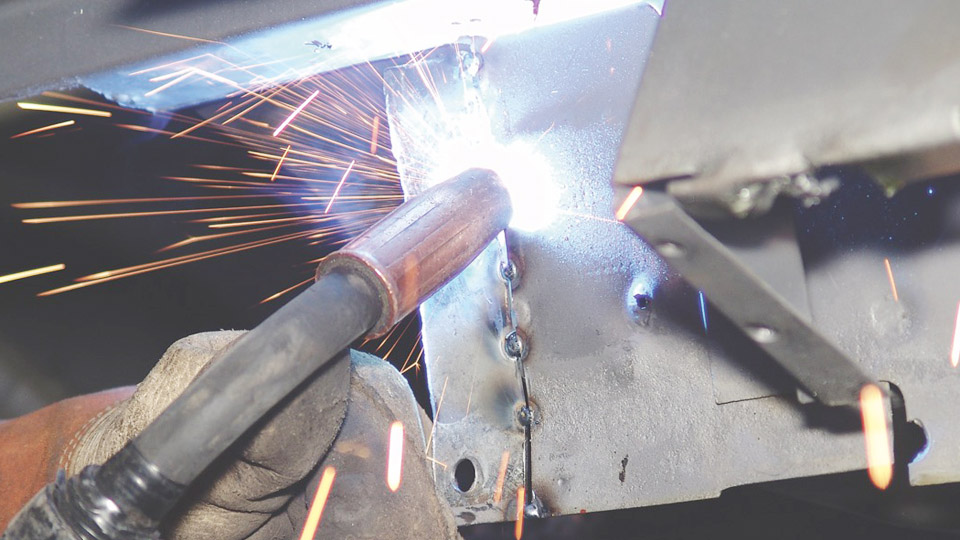
Image by musclecardiy
Why MIG Welding Suits Auto Body Panels
MIG (Gas Metal Arc Welding or GMAW) shines on thin automotive sheet metal because it offers speed, good control with the right settings, and a relatively clean process compared to stick. The continuous wire feed lets you work fast once dialed in, which matters when you’re tacking panels in place.
That said, it’s easy to overheat the material. Auto body steel conducts heat quickly, and excess heat causes distortion, burn-through, and weak spots.
The goal is always enough penetration for strength without turning the panel into a heat sink that pulls out of shape. I’ve seen plenty of first-timers chase holes with filler rod—don’t be that person.
Key advantages for bodywork:
- Fast travel speeds with proper technique
- Lower spatter with good gas and wire
- Easier to learn than TIG for beginners
- Affordable for home shops with 110V or 220V machines
Limitations to watch:
- Higher heat input than TIG on very thin stuff
- Requires clean metal and good fit-up
- Gas shielding can be tricky outdoors
Essential Equipment and Setup for Body Panel Welding
Start with a reliable MIG machine. For most DIY and small shop work, a 140-200 amp unit handles body panels well. Machines like the Millermatic series or similar US-market models with synergic or auto-set features simplify things.
Wire selection is critical. For 18-22 gauge panels, I prefer 0.023″ or 0.024″ solid wire (ER70S-6 is a solid all-around choice). It melts at lower heat inputs, giving better control and less distortion.
0.030″ works if that’s what you have, but you’ll run cooler settings and shorter bursts. Avoid 0.035″ on the thinnest panels—it pushes too much metal and heat.
Shielding gas: Go with C25 (75% argon / 25% CO2). It produces a stable arc, nice bead profile, and minimal spatter on thin metal. Flow rate around 15-20 CFH. Pure CO2 is cheaper but spatterier and harsher. Flux-cored wire skips the gas bottle but usually creates more cleanup on visible bodywork.
Machine settings basics (approximate for 18-20 gauge):
- Voltage: 14-17V (start low)
- Wire speed: Match to voltage for short-circuit transfer
- Inductance (if available): Higher for softer arc on thin metal
Always test on scrap of the same thickness. Many modern machines have charts or auto settings—use them as a starting point, then fine-tune.
Preparing Auto Body Panels: The Foundation of Strong Welds
Bad prep ruins more welds than bad technique. Rust, paint, oil, and mill scale must go.
Grind or sand both sides of the joint area back at least 1-2 inches. I use a 40-60 grit flap disc, then finish with a finer grit for a clean surface. Wipe with acetone or brake clean right before welding—contaminants cause porosity and weak fusion.
Fit-up matters enormously on thin metal. Gaps larger than 1/16″ invite burn-through. Use clamps, magnets, or temporary screws to hold panels tightly. For patch panels, a slight overlap or flange helps. If you have access, back the weld area with a copper or aluminum chill bar to absorb heat and prevent holes.
Pro tip from the shop floor: Drill small holes or use factory spot weld locations when replacing large panels. It gives you reference points and natural heat distribution spots.
Step-by-Step: How to MIG Weld Auto Body Panels
Safety first. Fresh air, proper respirator (fumes from zinc coatings on galvanized panels are nasty), welding helmet with good auto-darkening lens, gloves, and fire-resistant clothing. Keep a fire extinguisher handy—sparks love to hide in crevices.
Tack it in place. Set your machine a bit hotter than final settings. Make small tacks every 1-2 inches, alternating sides and ends of the panel. Let it cool between clusters. This minimizes pull and distortion.
Stitch or skip weld. Never run a continuous bead on thin body panels. Weld 1/2″ to 1″ segments, skip ahead, and come back after cooling. This is the single biggest trick for controlling heat.
Gun technique. Use a push angle (10-15 degrees) for better shielding and flatter beads on sheet metal. Keep stickout around 3/8″ to 1/2″. Too long and the arc gets unstable and cold; too short and it overheats.
Travel speed and puddle control. Move fast enough that the puddle doesn’t grow large. Listen for that steady “bacon frying” sound of a good short-circuit arc. If it crackles harshly, adjust settings.
Post-weld. Let everything cool naturally. Hammer and dolly as needed while warm to shrink and straighten. Grind welds flush carefully—don’t overheat with the grinder.
Optimal Settings and Adjustments for Different Gauges
Settings vary by machine, but here’s what works in real shops:
- 22-24 gauge (very thin): 0.023″ wire, 13-15V, lower wire speed. Very short bursts.
- 18-20 gauge (most common): 0.023″-0.030″ wire, 15-17V. Wire feed adjusted for crisp arc.
- 16 gauge and up: You can open up settings and run slightly longer beads.
Watch your puddle. It should tie in nicely on both sides without blowing out the back. If you’re burning through, drop voltage 0.5-1V or increase travel speed. If no fusion, increase heat slightly but shorten dwell time.
Many welders swear by running settings similar to vertical-up even on flat panels—it encourages faster movement and less heat buildup.
Common Mistakes and How to Fix Them
Burn-through: Usually too much voltage/wire speed or slow travel. Fix by lowering heat and using stitch technique. Backing bars help tremendously.
Warping and distortion: Excessive continuous heat. Alternate sides, weld small areas, and use clamps or bracing. Hammering while warm straightens a lot.
Porosity: Dirty metal, wrong gas flow, or drafts blowing away shielding. Clean better and shield the area if welding outside.
Undercut or weak beads: Wrong gun angle or too fast travel. Practice on scrap until the bead wets in smoothly.
Spatter everywhere: Gas flow off, wrong polarity, or dirty contact tip. Clean consumables regularly.
I’ve made every one of these mistakes over the years. The difference now is I catch them early and adjust on the fly.
Joint Types and Techniques for Auto Body Work
Butt joints: Most common for panel replacement. Excellent fit-up required. Bevel edges slightly if needed for better penetration.
Lap joints: More forgiving on fit-up. Common for floor pans or inner structures. Watch for rust trapping between layers.
Plug welds: Great for replicating factory spot welds. Drill holes and fill them—settings a bit hotter for good fusion to the back piece.
For edges and corners, slow down slightly and use a slight weave if the machine allows, but keep heat in check.
Material Considerations: Steel, Galvanized, and Aluminum
Most auto panels are mild steel, sometimes galvanized for corrosion resistance. Galvanized requires extra ventilation—the zinc fumes are toxic. Grind the coating off the weld area when possible.
Aluminum body panels (newer vehicles or restorations) need different settings, pure argon, and usually 0.030″ aluminum wire. TIG often works better there, but MIG pulse machines handle it well.
Always match filler to base metal. ER70S-6 handles most mild steel bodywork perfectly.
Grinding, Finishing, and Making It Look Factory
A good MIG weld on body panels should require minimal grinding. Build it up just slightly proud, then use a flap disc or grinding wheel carefully. Finish with 80-120 grit, then body filler if needed for perfect contours.
Don’t grind too aggressively—you’ll thin the panel and create heat distortion all over again. I prefer to planish with a hammer and dolly first whenever possible.
Safety and Shop Practices That Matter
Beyond basic PPE, watch for:
- Galvanized fume exposure (zinc oxide sickness)
- Fire hazards in vehicle interiors
- Proper grounding to avoid arc wandering
- Ventilation—weld outside or use strong exhaust
Keep your workspace organized. A cluttered bench leads to dropped tools, tipped bottles, or bad ground connections.
Advanced Tips from Years on the Bench
- Use magnets or spot weld pliers to hold patches perfectly.
- For large panels, weld in a cross pattern—center out or alternating corners.
- Pulse MIG (if your machine has it) is a game-changer for thin metal—lower average heat with great control.
- Keep multiple contact tips and nozzles handy; they wear fast on bodywork.
- Practice “stacking dimes” or controlled tacks on scrap until muscle memory kicks in.
Reflection on Mastering MIG for Auto Body Panels
After hundreds of panels, the real skill isn’t in running one perfect bead—it’s managing heat across the entire repair while maintaining alignment and strength. You’ve now got the settings, techniques, and awareness of pitfalls that separate frustrating rework from clean, professional results.
Focus on preparation, short controlled welds, and patience with cooling cycles. Test everything on scrap first. Your welds will improve dramatically, and so will your finished projects.
One pro-level tip I’d give any welder: Slow is smooth, smooth is fast. Rushing heat input on thin panels always costs more time in the end. Take the extra minutes to tack, cool, and alternate—you’ll spend far less time straightening and filling later.
FAQ
What’s the best wire size for MIG welding 18-20 gauge auto body panels?
0.023″ or 0.024″ solid wire is ideal. It allows lower heat input and better control than thicker wires, reducing burn-through and distortion while still providing good penetration.
How do I prevent warping when welding large body panels?
Use stitch welding with short segments, alternate sides frequently, allow full cooling between passes, and clamp or brace the panel securely. Hammer and dolly while the metal is still warm to shrink it back into shape.
Should I use flux core or gas MIG for car bodywork?
Gas MIG with C25 mix is far superior for visible body panels. It produces cleaner welds with less spatter and easier cleanup. Flux core works in a pinch but requires more grinding and can trap slag.
Can I MIG weld galvanized steel panels?
Yes, but grind the coating off the weld zone and use excellent ventilation. The zinc fumes are hazardous. After welding, treat the area with a rust preventative.
What voltage and wire speed should I start with for thin sheet metal?
Begin around 14-16V with wire speed matched for a stable short-circuit arc. Test on scrap and adjust—listen for the frying sound and watch for a small, controlled puddle. Fine-tune from there.


