

When you start learning MIG welding, one question comes up quickly: *What is the best gas to use for MIG welding?* This is not a simple answer. The right gas depends on the metal you are welding, the thickness, the welding position, and the finish you want.
Choosing the correct gas makes the difference between strong, clean welds or weak, messy results. Many beginners think all gases are the same, but even small changes in gas mixture change the way your weld looks and performs.
This article will guide you through all the key gases used in MIG welding, explain their differences, and show you how to pick the best one for your project. You’ll learn why some gases are perfect for steel but not for aluminum, how gas affects spatter and penetration, and which mixtures are best for indoor or outdoor jobs.
I’ll also cover cost, safety, and common mistakes. By the end, you’ll know exactly which gas to choose for your next weld, whether you are a hobbyist or a professional.
What Is Mig Welding?
MIG welding stands for Metal Inert Gas welding. It is also called GMAW (Gas Metal Arc Welding). In MIG welding, a wire electrode feeds through a welding gun, and an electric arc melts the wire, joining it to the metal. A shielding gas flows around the weld to protect it from air. If air touches the weld, it can cause porosity, weak spots, and rust.
The shielding gas is crucial. It stops oxygen, nitrogen, and water vapor from entering the weld pool. Each gas changes how the arc behaves, how the metal melts, and how much spatter you get.
MIG welding is popular because it is fast and easy to learn. Compared to stick welding, MIG produces cleaner welds with less slag. Many beginners start with MIG because the process is simple: pull the trigger, and the wire and gas flow automatically.
Another important point is that MIG can be used for many metals—steel, aluminum, stainless steel, and copper. The choice of gas makes MIG flexible for different jobs. For example, car repair shops use MIG for bodywork and frames because it can weld thin and thick metals.
MIG welding also allows you to weld in different positions—flat, vertical, overhead, or horizontal. The shielding gas helps keep the weld pool protected, even when gravity is not on your side. For outdoor work, wind can blow away the gas, so welders use higher flow rates or special mixtures.
Non-obvious insight: MIG welding is not just for professionals. Many hobbyists use MIG for home repairs, art projects, and small fabrication. The right gas can make a big difference in results, even for simple jobs.
Why Is Shielding Gas Important?
Many beginners overlook the role of shielding gas. They may focus on wire speed or voltage, but gas is just as important. Here’s why:
- Protects the weld: The gas keeps air away from the molten metal, preventing contamination.
- Controls penetration: Different gases change how deep the weld goes into the metal.
- Affects spatter: The right gas can reduce spatter, saving cleanup time.
- Improves appearance: Some gases produce smoother, shinier welds.
- Changes mechanical properties: The gas impacts strength and hardness.
If you choose the wrong gas, you may see holes, cracks, or weak spots. For example, welding aluminum with the wrong gas can ruin the job.
Shielding gas is also important for safety. Without proper shielding, the weld can absorb oxygen and nitrogen from the air. This leads to porosity (tiny holes inside the weld) and weak joints. In some cases, the weld can fail under stress, causing accidents.
Gas choice affects more than just quality. It impacts how easy it is to weld. For example, pure argon gives a calm arc, making it easier for beginners to control. CO2, on the other hand, can make the arc more aggressive and harder to handle.
Non-obvious insight: Many beginners do not realize that gas flow rate matters. Too low, and air will mix with the gas. Too high, and turbulence can pull air in. The ideal flow rate is usually 15–20 cubic feet per hour (CFH) for indoor jobs.
Credit: www.millerwelds.com
Common Shielding Gases Used In Mig Welding
Let’s look at the main gases used in MIG welding. Each has unique properties.
Argon
Argon is the most common shielding gas for MIG welding. It is inert, meaning it does not react with the metal or the arc. Argon produces a stable arc, low spatter, and smooth welds.
- Used for: Aluminum, stainless steel, and thin carbon steel
- Benefits: Clean welds, good arc stability, minimal spatter
- Drawbacks: Expensive compared to other gases
Argon is preferred for non-ferrous metals like aluminum because it protects the weld pool without causing any reactions. The arc is soft and easy to control, which is helpful for thin materials.
For stainless steel, argon gives a shiny, smooth finish and prevents oxidation. When welding thin steel, argon helps prevent burning through the metal.
Example: If you are repairing an aluminum bike frame, pure argon will give you a clean, strong weld. The result is a shiny bead with almost no spatter.
Carbon Dioxide (co2)
CO2 is popular because it is cheap and effective. It is not inert, but it works well for welding steel. CO2 produces deeper penetration but more spatter than argon.
- Used for: Mild steel, thick sections
- Benefits: Deep penetration, low cost
- Drawbacks: More spatter, rougher welds
CO2 is often used in structural welding, such as building frames or heavy machinery. It provides more heat, which helps weld thick sections quickly. However, the high spatter means more grinding and cleaning.
Example: If you are welding a thick steel fence post, CO2 will penetrate deep and fuse the metal well. The downside is you will need to clean up spatter afterward.
Non-obvious insight: CO2 can cause more fume and smoke. If you weld indoors, make sure to ventilate the area to avoid breathing problems.
Argon-co2 Mix
Most welders use a mixture of argon and CO2. The most common mix is 75% argon / 25% CO2. This combines the best of both: smooth welds and deep penetration.
- Used for: Mild steel, general fabrication
- Benefits: Good balance of penetration and appearance
- Drawbacks: Slightly more expensive than pure CO2
The argon-CO2 mix is popular for general metalwork because it gives a smooth arc and a cleaner finish than pure CO2. It also reduces spatter, saving time on cleanup.
Example: If you are making a steel workbench, the 75/25 mix will give you strong, neat welds with minimal cleanup.
Argon-oxygen Mix
Adding a small amount of oxygen (1-5%) to argon improves arc stability and penetration. This mix is used for stainless steel or special applications.
- Used for: Stainless steel, special jobs
- Benefits: Stable arc, better penetration
- Drawbacks: Can cause oxidation if used incorrectly
Argon-oxygen mixes are used in industries where high strength and appearance are needed, such as food processing equipment.
Example: For welding stainless steel pipes, argon with 2% oxygen gives a stable arc and a shiny weld.
Non-obvious insight: Using too much oxygen can cause rust and weaken the weld. Always use the recommended percentage.
Argon-helium Mix
Helium raises the heat in the arc, making it useful for thick aluminum or copper. Mixing argon with helium gives a hotter arc and faster welding.
- Used for: Aluminum, copper, thick materials
- Benefits: Higher heat, faster welds
- Drawbacks: Helium is expensive
Helium is lighter than air, so it rises quickly. For outdoor jobs, you may need to use higher flow rates. Argon-helium mixes are common in aerospace and shipbuilding.
Example: Welding a thick aluminum boat hull with argon-helium mix will help the heat penetrate deep, making a strong weld.
Argon-co2-oxygen Mix
Some industries use a triple mix: argon, CO2, and oxygen. This is common in automotive or robotic welding.
- Used for: High-speed welding, automation
- Benefits: Stable arc, fast welding, good penetration
- Drawbacks: Complex to control, expensive
Triple mixes are used in factories where speed and consistency are important. The mix allows for rapid welding without sacrificing quality.
Example: Robotic welding of car frames often uses argon-CO2-oxygen for efficiency and strength.
Comparison Of Mig Welding Gases
To help you choose, see this comparison of the main MIG welding gases:
| Gas Type | Penetration | Spatter | Arc Stability | Cost | Best For |
|---|---|---|---|---|---|
| Argon | Low to Medium | Low | Excellent | High | Aluminum, Stainless Steel |
| CO2 | High | High | Good | Low | Mild Steel |
| Argon-CO2 (75/25) | Medium | Medium | Very Good | Medium | General Steel |
| Argon-Oxygen | Medium | Low | Excellent | High | Stainless Steel |
| Argon-Helium | High | Low | Good | Very High | Aluminum, Copper |
Notice how each gas affects the weld differently. Argon gives a smooth appearance, CO2 offers strength, and mixes balance cost, penetration, and quality. If you’re unsure, start with the argon-CO2 mix—it works for most steel projects and offers a good compromise.
How To Choose The Best Gas For Mig Welding
Picking the best gas depends on four main factors:
- Material Type
- Thickness
- Welding Position
- Desired Finish
1. Material Type
The metal you are welding is the most important factor.
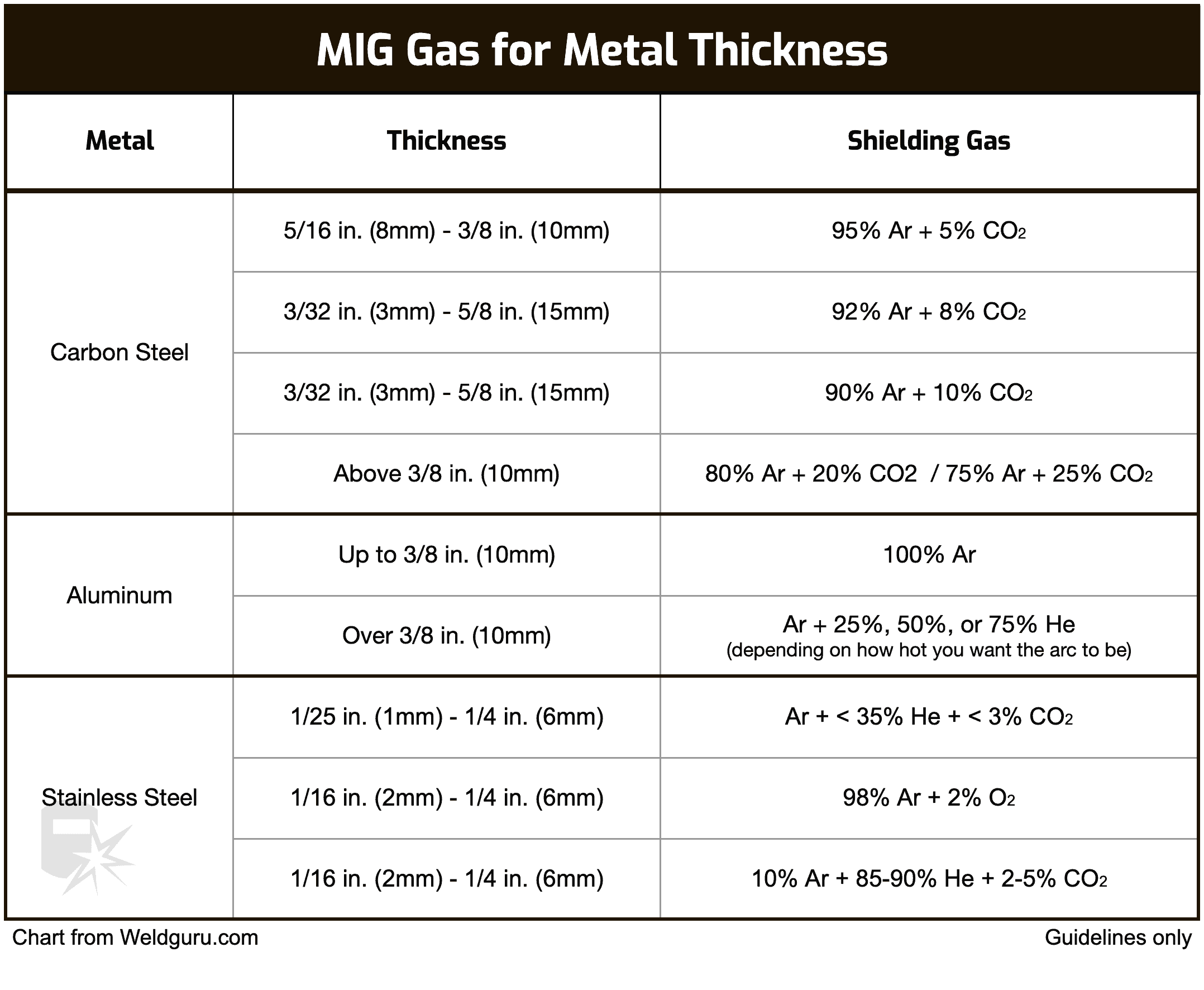
- Mild steel: Argon-CO2 mix (75/25) is best. Pure CO2 works for thicker steel.
- Stainless steel: Use argon with a small percentage of oxygen (1-2%) or CO2.
- Aluminum: Pure argon or argon-helium mix is ideal.
- Copper: Argon-helium mix helps with heat.
Using the wrong gas can cause defects. For example, CO2 is not suitable for aluminum; it will cause oxidation.
If you are unsure about the metal, check the manufacturer’s recommendations. For unknown alloys, start with an argon-based mix and test on scrap pieces.
2. Thickness
Thicker metals need more heat and penetration.
- Thin metals (<3 mm):Argon or argon-CO2 mix gives smooth welds.
- Thick metals (>3 mm): CO2 or argon-helium mix boosts penetration.
For thin metal, too much heat can burn holes or warp the material. For thick metal, low heat means poor fusion and weak joints.
Example: Welding sheet metal for car repairs—use argon-CO2 mix. For heavy equipment, pure CO2 or argon-helium is better.
3. Welding Position
The position affects the gas choice.
- Flat position: Any gas is suitable.
- Vertical/Overhead: Argon-CO2 mix is preferred for better control and less spatter.
Welding overhead or vertically is tricky. The weld pool wants to drip due to gravity. A stable arc and low spatter help keep the weld neat and strong.
Non-obvious insight: For out-of-position welding, lower heat input helps prevent the weld pool from falling. Argon-based mixes offer more control.
4. Desired Finish
Some projects need shiny, smooth welds. Others focus on strength.
- Appearance: Argon or argon-CO2 mix is best.
- Strength/Penetration: CO2 or argon-helium mix works well.
If the weld will be visible or painted, choose a gas that gives a smooth finish. If strength is the main goal, deeper penetration is more important.
Example: For decorative railing, use argon-CO2. For structural beams, CO2 may be better.
Detailed Look At Each Mig Welding Gas
Let’s go deeper into each gas option.
Pure Argon
Pure argon is used mostly for non-ferrous metals like aluminum and copper. It creates a stable arc and clean welds. Argon is inert, so it does not react with the metal. This means almost no contamination.
- Example: Welding a 2 mm aluminum sheet with pure argon will result in a shiny, smooth weld with low spatter.
- Data: Argon is 38% heavier than air, so it covers the weld well.
Non-obvious insight: Pure argon can cause arc wandering if used on steel. This is why argon is rarely used alone for steel welding.
Argon is also used for TIG welding. In MIG, it is ideal for thin, non-ferrous metals. For thicker aluminum, adding helium increases heat and helps penetration.
Pure Co2
CO2 is active, not inert. It provides deep penetration, which is great for thick steel. However, it creates more spatter and rougher welds.
- Example: Welding a 6 mm steel plate with CO2 gives strong, deep welds but requires extra cleanup for spatter.
CO2 is often used in construction and heavy industry because it is cheap and effective. The arc is hotter, so it melts thick metal quickly. The downside is more cleanup and rougher welds.
Non-obvious insight: CO2 can cause “finger-like” penetration—deep at the center but shallow at the edges. This can be risky for joints where edge fusion matters.
Argon-co2 Mix
The 75/25 argon-CO2 mix is a favorite for hobbyists and professionals. It gives a smooth, stable arc and reduces spatter. The weld bead is neat, making it easy to paint or polish.
- Example: Building a steel frame for a trailer with argon-CO2 mix results in strong, clean welds. You spend less time grinding off spatter.
This mix is also forgiving for beginners. The arc is easy to control, and the weld pool is stable. You can use this mix for most steel projects.
Argon-oxygen Mix
Argon-oxygen mixes are mainly for stainless steel. The small amount of oxygen helps the arc stay stable and improves penetration.
- Example: Fabricating stainless steel kitchen equipment with argon-oxygen mix results in shiny, food-safe welds.
Too much oxygen can lead to rust or weak welds. Always check the mix percentage. For most jobs, 2% oxygen is enough.
Argon-helium Mix
Helium makes the arc hotter, useful for thick, non-ferrous metals. Argon-helium mixes are used in aerospace, shipbuilding, and electrical work.
- Example: Welding thick copper bus bars with argon-helium mix ensures full penetration and a strong joint.
Helium is expensive, so only use it when needed. For thin aluminum, pure argon is usually enough.
Argon-co2-oxygen Mix
Triple mixes are for high-speed, automated welding. The arc is stable, and penetration is good.
- Example: Car factories use triple mixes to weld frames quickly and consistently.
The mix is complex and costly, but it improves productivity. For manual welding, simpler mixes work fine.
Credit: weldguru.com
Cost, Safety, And Practical Tips
Cost
Argon and helium are more expensive than CO2. Mixes cost more than single gases. If you are on a tight budget, pure CO2 is cheapest but needs more cleanup.
Tip: Buy gas in larger cylinders to reduce cost per cubic foot. Compare suppliers for best prices.
Safety
Always use proper ventilation. Some gases can displace oxygen and cause breathing problems. Never weld in a closed area without airflow.
Tip: Check for leaks with soapy water. Gas leaks are dangerous and expensive.
Common Mistakes
- Using the wrong gas for the metal—causes weak welds or contamination.
- Setting the flow rate too high or low—leads to porosity.
- Not cleaning the metal before welding—affects gas protection.
- Welding outdoors with light gases—wind can blow away the gas.
Non-obvious insight: Always store gas cylinders upright and secure them. Never lay them flat; leaks are harder to spot and can cause accidents.

Credit: www.youtube.com
Final Advice And External Resource
Choosing the best gas for MIG welding is about balance—quality, strength, appearance, and cost. Start with argon-CO2 for steel, pure argon for aluminum, and adjust as needed for your project. Test on scrap metal before welding the real piece.
If you want deeper guidance, the [American Welding Society](https://www.aws.org/) offers detailed charts and advice.
With the right gas, your welds will be strong, clean, and professional. Don’t be afraid to experiment and learn. The best welders keep improving their technique and always check their gas choice before starting.


