
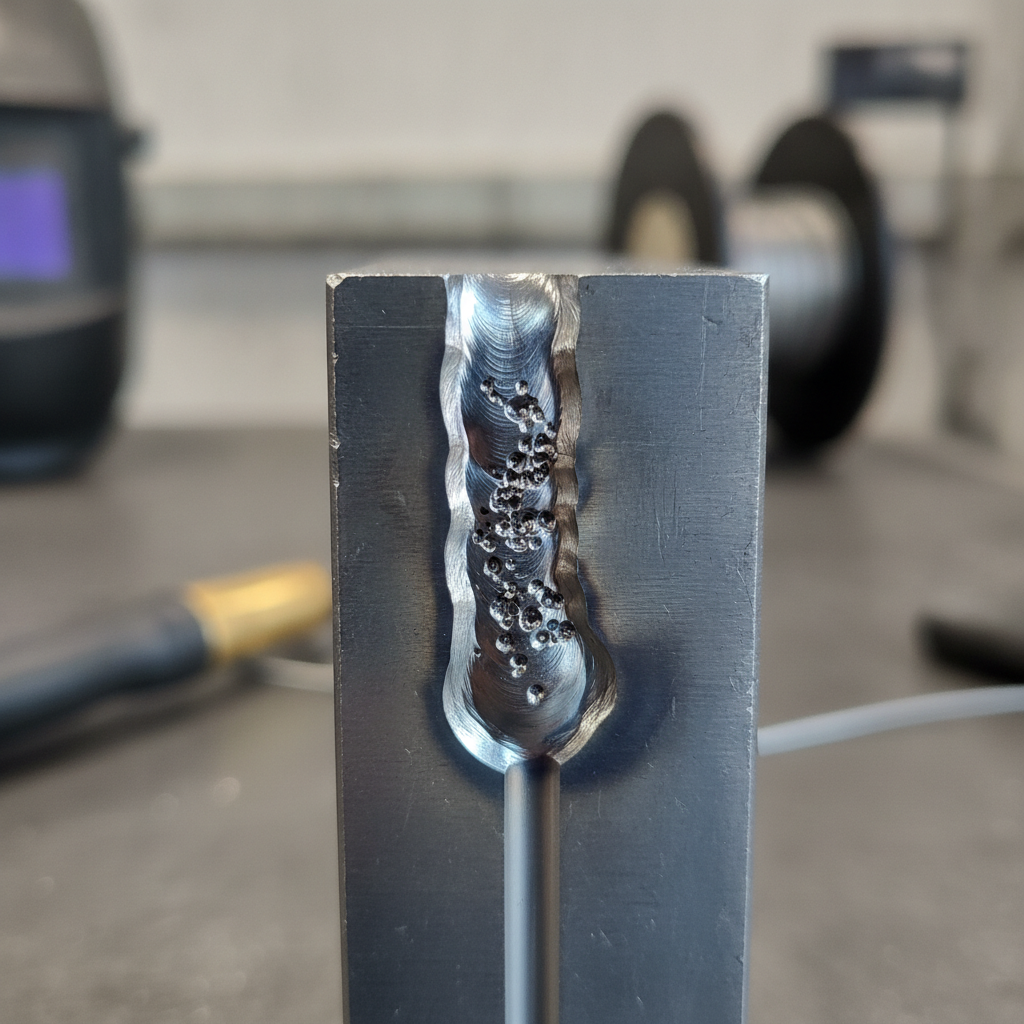
Porosity in MIG welds is one of the most frustrating problems a welder can face. You run a bead that looks clean from the outside, then grind it down or break it apart and find it riddled with holes. This article explains exactly why porosity happens, what causes it in specific situations, and how to fix it — whether you’re troubleshooting a one-off problem or dealing with it consistently across multiple welds.
Quick Answer
Porosity in MIG welds is almost always caused by gas contamination in the weld pool. The most common culprits are insufficient shielding gas coverage, surface contamination on the base metal, a damaged or leaking gas line, incorrect wire, or poor technique. Identifying which factor is responsible is usually straightforward once you know what to look for.
What Porosity Actually Is (And Why It Matters)
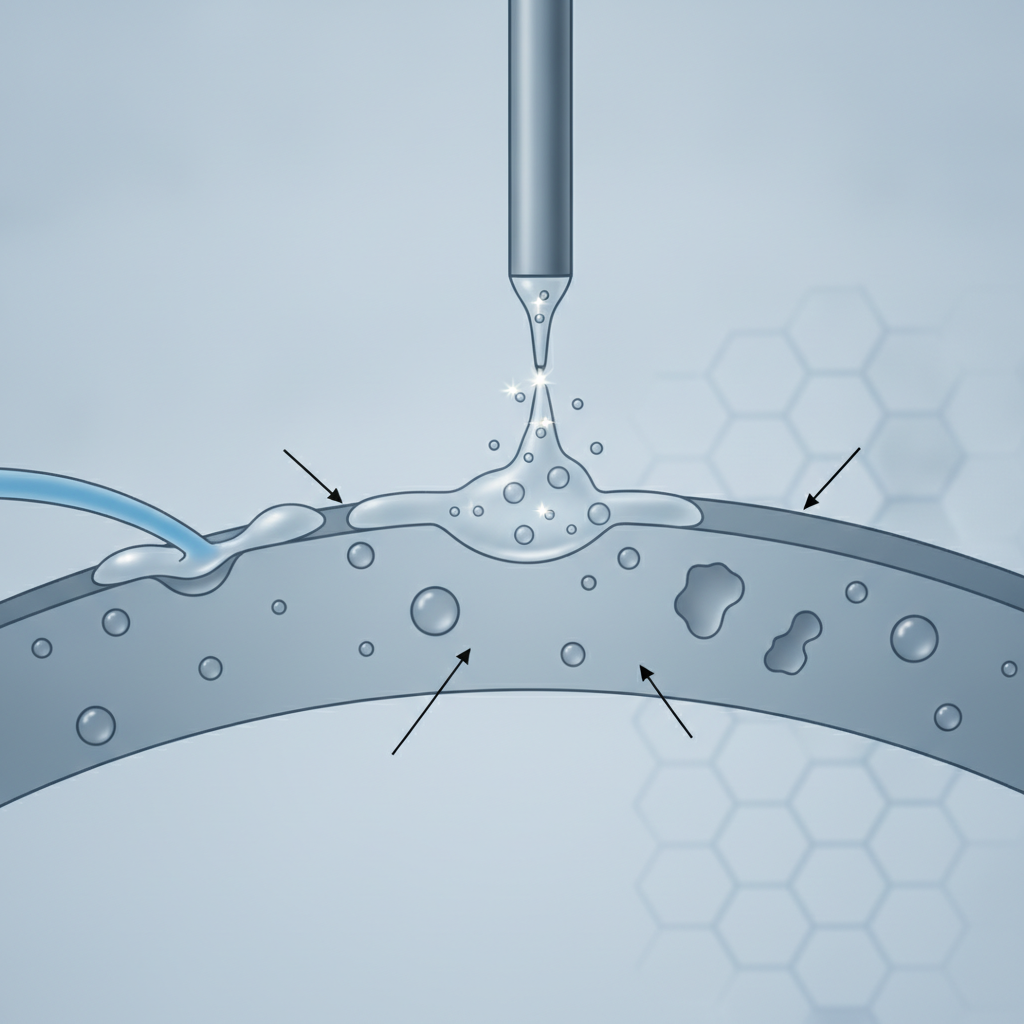
Porosity refers to gas pockets or voids trapped inside a solidified weld. This also connects naturally with tig welding hard tips better. As the weld pool cools and solidifies rapidly, any gas that hasn’t escaped gets locked in place, forming bubbles ranging from microscopic to clearly visible.
These voids weaken the weld structurally. A porous weld has less cross-sectional material carrying the load, which reduces tensile strength, fatigue resistance, and ductility. In critical applications — pressure vessels, structural steel, automotive frames — porosity can cause weld failure under stress.
There are two main types:
– Surface porosity — visible pits or craters on the weld face
– Subsurface porosity — internal voids only revealed by grinding, cutting, or radiographic testing
Surface porosity is easier to catch. Subsurface porosity is more dangerous because it goes undetected without inspection.
The Most Common Causes of Porosity in MIG Welding
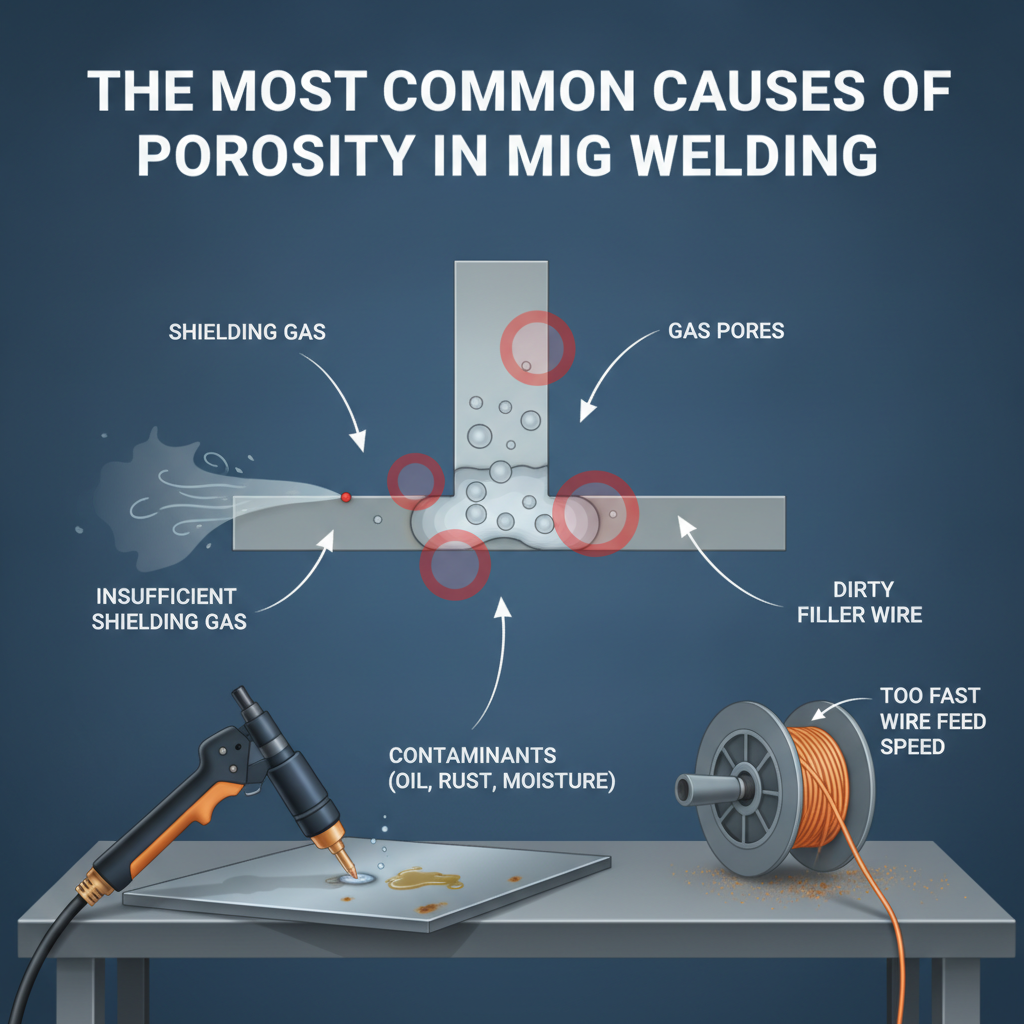
1. Shielding Gas Problems
This is the number one cause. MIG welding relies on shielding gas to protect the molten weld pool from atmospheric nitrogen, oxygen, and hydrogen. If that protection fails even briefly, atmospheric gases get absorbed into the pool and create porosity.
Common shielding gas failures include:
– Low gas flow rate (typically should be 15–25 CFH for most applications)
– Gas flow rate set too high, causing turbulence that pulls in outside air
– Leaking gas hose, fitting, or regulator
– Blocked or damaged MIG gun nozzle
– Drafts or wind displacing the gas shield outdoors or near fans
– Empty or near-empty cylinder with pressure too low to maintain consistent flow
A quick check: hold your hand near the nozzle and feel for consistent airflow. Inspect fittings with soapy water to find leaks. Confirm your regulator is reading accurately.
2. Contaminated Base Metal
Oil, grease, paint, rust, mill scale, moisture, and galvanized coatings all introduce hydrogen or other gases into the weld pool. Hydrogen is particularly problematic — it dissolves readily into molten steel but has very low solubility in solid steel, so it escapes violently during solidification and creates voids.
The fix is simple but often skipped: clean the base metal thoroughly before welding. Use a wire brush, angle grinder, or flap disc to remove rust and mill scale. Wipe down with acetone or a dedicated weld cleaner to remove oil and grease. Never weld over galvanized or zinc-coated steel without proper preparation and ventilation — the zinc vaporizes and causes severe porosity along with toxic fumes.
3. Contaminated or Wrong Filler Wire
MIG wire that has been sitting exposed to moisture, oil from your hands, or shop contaminants will introduce hydrogen into the weld. This also connects naturally with mig welding 304 stainless steel. Rusty wire is a common culprit that’s easy to overlook.
Always store wire in a sealed container or bag when not in use. If the wire has visible surface rust or feels gritty, replace it. Using the wrong wire classification for your base metal can also cause metallurgical incompatibility that contributes to porosity.
For mild steel, ER70S-6 is the most forgiving choice because its higher silicon and manganese content helps deoxidize the weld pool. ER70S-3 is cleaner but less tolerant of surface contamination.
4. Incorrect Shielding Gas Mixture
Using the wrong gas mix for your wire and base metal combination causes porosity. For mild steel MIG welding, a 75% Argon / 25% CO₂ (C25) mix is the most common and versatile choice. Pure CO₂ works but produces a rougher arc and more spatter. Pure argon is not suitable for steel MIG welding — it produces an erratic arc and significant porosity.
For stainless steel, a tri-mix of argon, helium, and CO₂ or a 98% Ar / 2% CO₂ mix is standard. Using the wrong gas for stainless or aluminum will almost certainly cause porosity.
5. Poor Technique and Travel Speed
Moving too fast doesn’t give the gas enough time to escape the weld pool before it solidifies. Moving too slow can cause excessive heat buildup and turbulence. Both can contribute to porosity.
A work angle that’s too steep can also disrupt gas coverage. Keeping the gun angle between 5–15 degrees from vertical (push or drag depending on your preference) maintains consistent shielding.
Stickout length matters too. Excessive contact tip-to-work distance (CTWD) beyond about 3/4 inch reduces shielding gas effectiveness and increases the chance of atmospheric contamination.
6. Voltage and Wire Feed Speed Settings
Voltage that’s too low creates a cold, erratic arc that doesn’t properly wet out the weld pool, trapping gas. Voltage too high can create excessive spatter and turbulence. Both extremes increase porosity risk.
| Parameter | Too Low | Too High |
|---|---|---|
| Voltage | Cold arc, poor fusion, trapped gas | Turbulence, spatter, porosity |
| Wire Feed Speed | Burn-back, arc instability | Excessive spatter, cold weld |
| Gas Flow (CFH) | Insufficient coverage | Turbulence draws in air |
| Travel Speed | Excessive heat, turbulence | Gas can’t escape before solidification |
Dial in your settings using the manufacturer’s chart on the welder or the wire manufacturer’s recommendations, then fine-tune from there.
How to Systematically Diagnose the Problem
When porosity keeps appearing despite your efforts, work through this checklist in order:
1. Check your gas supply — verify cylinder pressure, flow rate at the gun, and inspect all connections for leaks
2. Inspect the nozzle and contact tip — spatter buildup inside the nozzle restricts gas flow; clean or replace it
3. Examine your wire — look for rust, oil, or moisture; check the wire spool for contamination
4. Prep the base metal — grind, brush, and degrease the weld zone
5. Check your environment — eliminate drafts, fans, or open doors near the work area
6. Verify gas mixture — confirm the cylinder label matches what your process requires
7. Review your technique — check gun angle, stickout, and travel speed
8. Adjust machine settings — verify voltage and wire feed speed are within the recommended range for your wire diameter and material thickness
In most cases, the problem is found within the first three steps.
Porosity Patterns That Point to Specific Causes
The location and pattern of porosity can tell you a lot about the source:
– Scattered porosity throughout the weld — typically shielding gas failure or contaminated base metal
– Porosity at the start of the weld — gas flow hasn’t stabilized; try pre-flow or pause briefly before moving
– Porosity at the end of the weld — crater porosity from rapid cooling; use crater fill function or slow your stop
– Linear porosity along the weld centerline — often hydrogen-related contamination from the wire or base metal
– Porosity only on certain joints — contamination specific to that material or location
FAQ
Can porosity be fixed after welding?
Yes, but it requires removing the affected area. Grind or gouge out the porous section until you reach clean, solid metal, then reweld. Simply welding over porosity doesn’t fix it — the voids remain underneath. For structural or code-compliant work, repairs must meet the same inspection standards as the original weld.
Does porosity always mean the weld will fail?
Not always. Minor scattered porosity in non-critical applications may be acceptable depending on the applicable code or standard. AWS D1.1 (structural steel), for example, specifies maximum allowable porosity limits by size and frequency. However, in pressure-rated, load-bearing, or safety-critical applications, porosity is generally cause for rejection and repair.
Why do I only get porosity when welding outside?
Wind is almost certainly disrupting your shielding gas. Even a light breeze of 4–5 mph can completely strip gas coverage from the weld pool. Use a welding screen, windbreak, or switch to a flux-core wire (FCAW) process when welding outdoors, as it doesn’t rely on external shielding gas.
Can the wrong contact tip size cause porosity?
Indirectly, yes. An oversized contact tip causes poor electrical contact, which creates an erratic arc. This arc instability can disrupt the gas shield and cause inconsistent fusion — both of which contribute to porosity. Always match contact tip size to your wire diameter precisely.
Is porosity more common with thinner or thicker material?
Thin material is generally more forgiving in terms of porosity from technique errors because you’re moving faster and the weld pool is smaller. Thick material welded with multiple passes is more susceptible because each pass introduces more opportunity for contamination, and interpass cleaning becomes critical. Porosity in root passes on thick material is especially problematic because it’s buried under subsequent passes.
Why does my weld look fine on the surface but have internal porosity?
The outer surface cools and solidifies first, sealing over gas pockets that haven’t fully escaped. This is common when travel speed is slightly too fast or when there’s mild contamination that doesn’t produce enough gas to break the surface. Grinding or bend testing will reveal it.
Does shielding gas pressure matter, or just flow rate?
Flow rate (measured in CFH or L/min) is what matters at the nozzle, not cylinder pressure. Cylinder pressure simply tells you how much gas remains. Your regulator converts cylinder pressure to a usable flow rate. A regulator that’s damaged or freezing up (common with CO₂ cylinders in cold weather) can cause inconsistent flow even when the cylinder is full.
Final Thoughts
Porosity almost always has a fixable cause. Start with the basics — gas coverage, clean metal, and wire condition — before adjusting machine settings or technique. Most experienced welders find that 80% of porosity problems trace back to shielding gas issues or surface contamination. Fix those two things first, and you’ll eliminate the problem in the majority of cases. When porosity persists after addressing the obvious causes, use the pattern and location of the voids to guide your diagnosis rather than guessing.


