
An AWS welding chart is a reference tool based on the American Welding Society’s classification system. It helps welders identify filler metals, electrodes, and wires by their coded designations. Each code tells you the tensile strength, welding position, flux type, and current requirements of the consumable. Reading the chart correctly ensures you match the right filler metal to your base material and process.
Whether you’re a beginner welder or an experienced fabricator, understanding AWS welding charts can save you time, prevent costly mistakes, and help you choose the right filler metal for any job. This article breaks down how AWS classification systems work, how to read electrode and wire charts, and how to apply that knowledge in real welding situations.
What AWS Classification Actually Means
AWS stands for the American Welding Society, the organization that sets welding standards across North America and beyond. Their classification system assigns alphanumeric codes to every filler metal, electrode, and welding wire.
These codes aren’t random. Each letter and number in the designation tells you something specific about that consumable. Once you learn the pattern, you can decode any AWS-classified product without needing to look it up every time.
The most commonly referenced AWS specifications include:
– AWS A5.1 – Carbon steel covered electrodes (Stick/SMAW)
– AWS A5.18 – Carbon steel filler metals for GMAW and GTAW
– AWS A5.20 – Carbon steel electrodes for FCAW
– AWS A5.4 – Stainless steel covered electrodes
– AWS A5.9 – Stainless steel filler metals for GMAW and GTAW
How to Read a Stick Electrode (SMAW) Chart
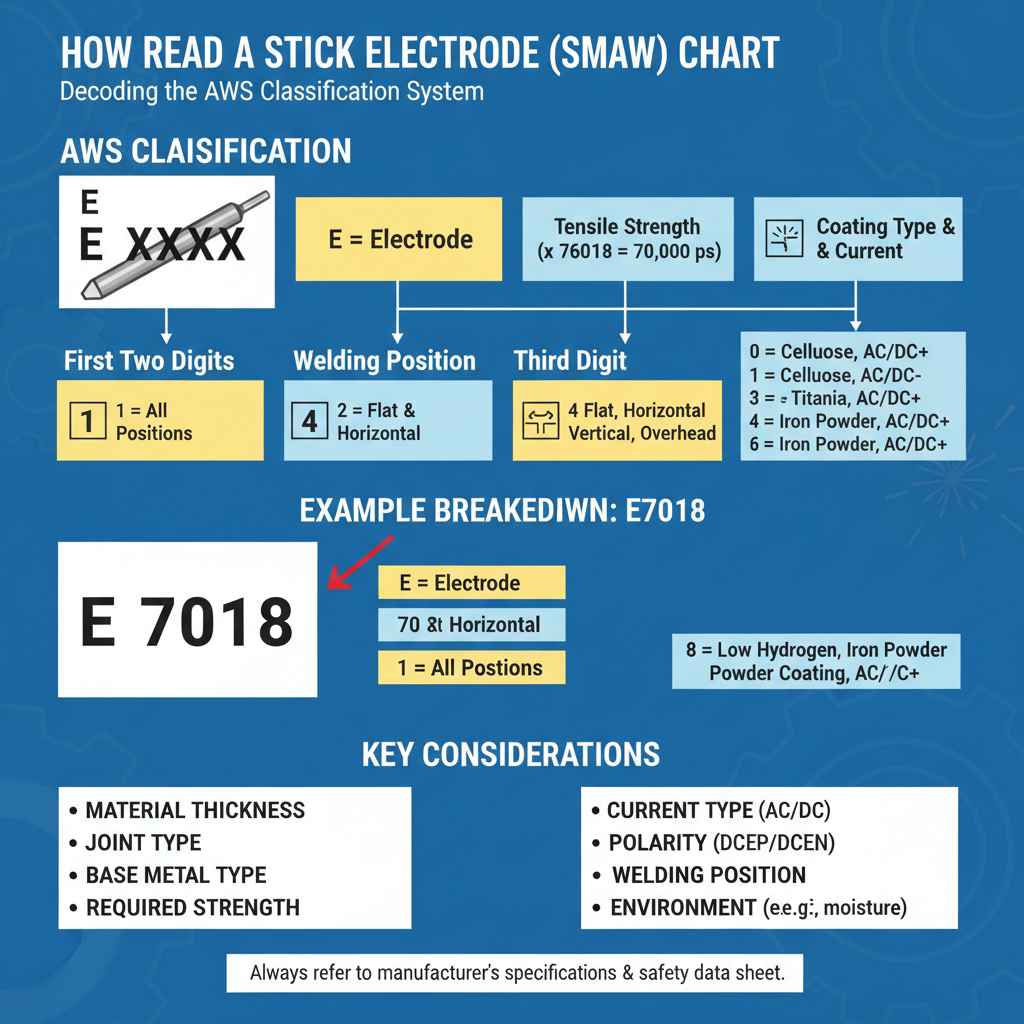
Stick electrodes follow the E-XXXX format. The “E” stands for electrode. The numbers that follow carry specific meaning.
Take E6013 as an example:
| Code Part | Meaning |
|---|---|
| E | Electrode |
| 60 | Minimum tensile strength: 60,000 psi |
| 1 | All-position welding (flat, horizontal, vertical, overhead) |
| 3 | AC or DC current; rutile flux coating |
A 1 in the third position means the electrode works in all positions. A 2 means flat and horizontal only. The last digit indicates flux coating type and compatible current settings.
In practice, E6010 and E6011 are deep-penetrating electrodes ideal for dirty or rusty steel. E7018 is a low-hydrogen electrode used where stronger, cleaner welds are required, such as structural steel applications.
Reading MIG Wire (GMAW) Classifications
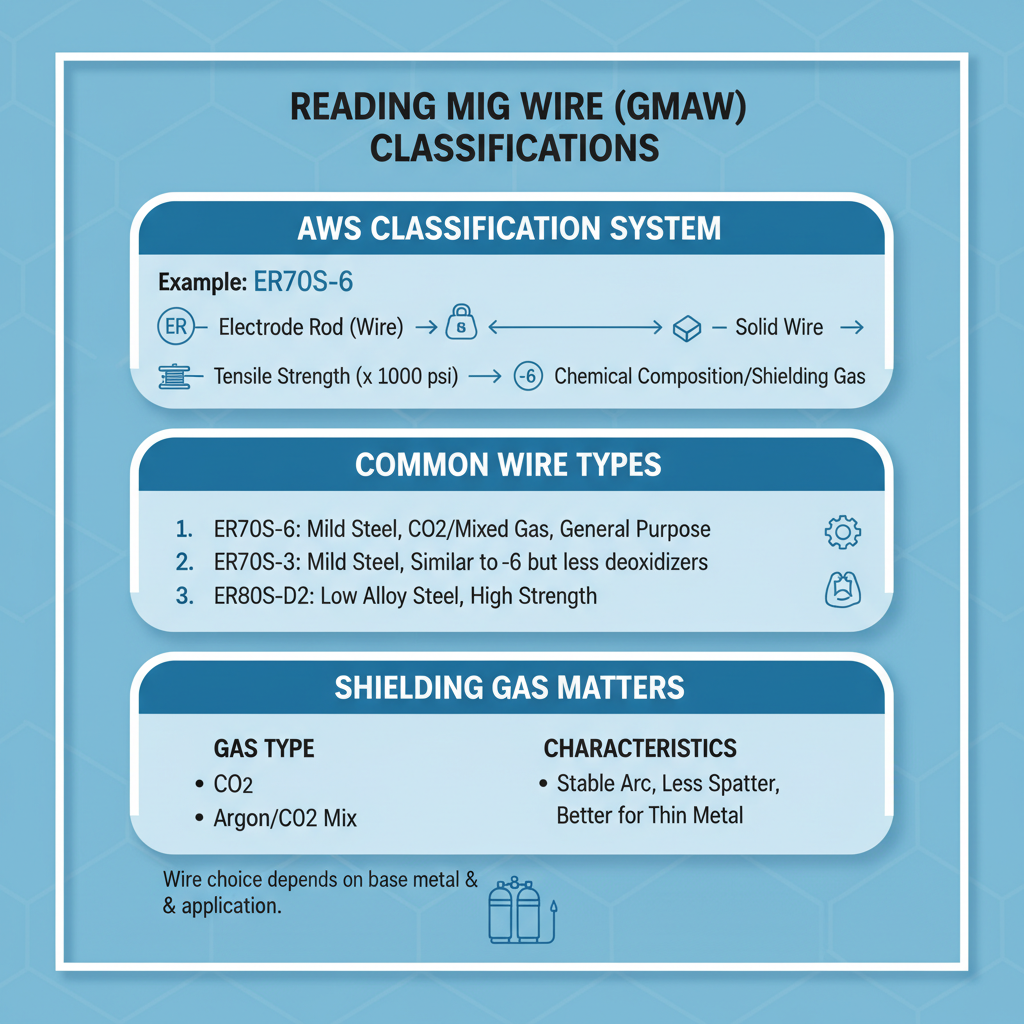
MIG wire follows the ER-XXX-X format. “ER” means the wire can be used as either an electrode or a filler rod.
Take ER70S-6 as a common example:
| Code Part | Meaning |
|---|---|
| ER | Electrode/Rod |
| 70 | 70,000 psi minimum tensile strength |
| S | Solid wire |
| 6 | High silicon and manganese deoxidizer content |
The number after the dash tells you the chemical composition of the wire. ER70S-6 has higher deoxidizers than ER70S-3, making it better suited for welding on mill scale or slightly contaminated steel. Field experience shows that ER70S-6 is the most widely used MIG wire in general fabrication for exactly this reason.
Flux-Core Wire (FCAW) Chart Breakdown
Flux-core wire uses a slightly different format. A typical designation looks like E71T-1C.
| Code Part | Meaning |
|---|---|
| E | Electrode |
| 7 | 70,000 psi tensile strength |
| 1 | All-position capable |
| T | Tubular (flux-core) |
| 1 | Usability and performance designator |
| C | Requires CO₂ shielding gas |
The shielding gas suffix is critical. A C means CO₂ only, an M means mixed gas (typically 75/25 Argon/CO₂), and some wires are self-shielded with no gas required. Using the wrong shielding gas with a flux-core wire will directly affect weld quality and mechanical properties.
TIG Filler Rod (GTAW) Classifications
TIG filler rods use the same ER prefix system as MIG wire. For carbon steel, ER70S-2 is a popular choice because its triple-deoxidized formula handles contaminated base metals well.
For stainless steel, you’ll encounter designations like ER308L, ER309L, and ER316L. These numbers correspond to the stainless steel alloy family:
– ER308L – Used to weld 304 stainless steel
– ER309L – Used for dissimilar metal welds (stainless to carbon steel)
– ER316L – Used for 316 stainless, offering better corrosion resistance in marine and chemical environments
The “L” suffix means low carbon content, which reduces the risk of carbide precipitation and intergranular corrosion after welding.
Matching Filler Metal to Base Material
A common issue technicians encounter is selecting a filler metal that doesn’t match the base material’s mechanical properties. This leads to weld failures, cracking, or failed inspections. Fillet weld size recommendations for steel can greatly influence the quality of the joint. Selecting the appropriate size is essential to ensure sufficient strength and durability in the final product. Technicians must consider factors such as the thickness of the materials being joined and the expected load conditions when making their choice.
The general rule is to match or slightly overmatch the tensile strength of the base metal. For A36 structural steel with a tensile strength of around 58,000–80,000 psi, an E7018 or ER70S-6 is a solid match.
Here’s a simplified matching guide:
| Base Material | Recommended Filler Metal |
|---|---|
| A36 Carbon Steel | E6013, E7018, ER70S-6 |
| A572 Grade 50 | E7018, ER70S-6 |
| 304 Stainless | ER308L, E308L-16 |
| 316 Stainless | ER316L, E316L-16 |
| Aluminum 6061 | ER4043, ER5356 |
| Chrome-Moly (4130) | ER80S-D2, E8018-B2 |
Always verify preheat requirements, especially for higher-strength steels or chrome-moly alloys. Skipping preheat on these materials is one of the most common causes of hydrogen-induced cracking.
Common Mistakes When Using AWS Charts
Even experienced welders misread AWS charts from time to time. Here are the most frequent errors:
Confusing tensile strength with yield strength. AWS designations show minimum tensile strength, not yield strength. These are different values. Tensile strength is the maximum stress before fracture; yield strength is where permanent deformation begins.
Ignoring the position digit. Choosing an electrode rated for flat and horizontal only (position digit 2) and then welding overhead will result in poor bead appearance and potential lack of fusion.
Overlooking polarity requirements. E6010 requires DC+ (DCEP). Using it on AC or DC- will cause arc instability and poor penetration. The AWS chart specifies polarity in the flux coating digit, but many welders skip that detail.
Selecting wire diameter without considering material thickness. Thinner materials need smaller diameter wire. A 0.035″ wire on 18-gauge sheet metal gives better control than 0.045″ wire, which can burn through easily.
FAQ
What does the “E” stand for in AWS electrode classifications?
“E” stands for electrode. It indicates the product is designed to carry electrical current during the welding process.
Can I use E7018 for all carbon steel welding jobs?
E7018 works well for most carbon steel applications, but it requires a dry storage environment to prevent hydrogen absorption. It also needs DC+ or AC power. For quick repairs on dirty steel, E6011 or E6013 may be more practical.
What’s the difference between ER70S-3 and ER70S-6?
Both are solid MIG wires with the same tensile strength. ER70S-6 has higher silicon and manganese content, making it better for welding over mill scale or light rust. ER70S-3 is cleaner and better suited for already-clean base metals.
How do I know which shielding gas to use with a flux-core wire?
Check the suffix at the end of the AWS designation. A “C” means CO₂ only, “M” means mixed gas, and no suffix or “S” typically indicates self-shielded wire requiring no gas.
Are AWS classifications the same as ISO classifications?
No. AWS and ISO use different coding systems. If you’re working with international suppliers or specifications, always confirm which standard applies before ordering consumables.
What does the “L” mean in stainless steel filler designations like ER308L?
“L” stands for low carbon. It reduces the risk of carbide precipitation during welding, which helps maintain corrosion resistance in the heat-affected zone.
Where can I find official AWS welding charts?
AWS publishes its filler metal specifications through the AWS Store at aws.org. Many electrode manufacturers also publish free reference charts based on AWS standards, which are useful for quick field reference.
Final Thoughts
AWS welding charts are one of the most practical tools in a welder’s reference library. Once you understand the coding logic, selecting the right electrode or wire becomes straightforward rather than guesswork.
The key takeaways are simple: match tensile strength to your base material, pay attention to position and polarity requirements, and always check the shielding gas compatibility for flux-core wires. For stainless and alloy steels, the suffix letters carry critical information about chemistry and performance.
Keeping a printed AWS filler metal chart in your welding area or saved on your phone eliminates uncertainty and helps you make faster, more confident decisions on the job.


