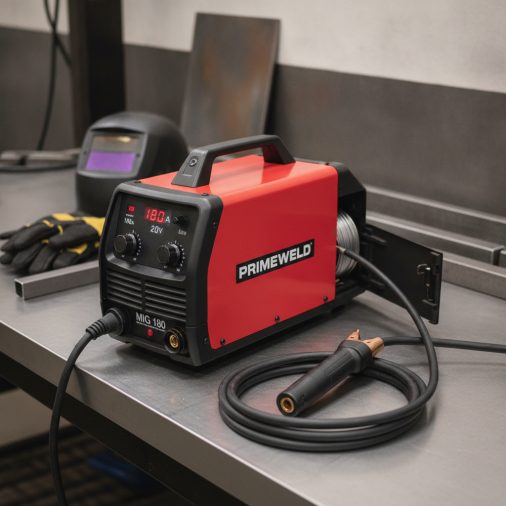
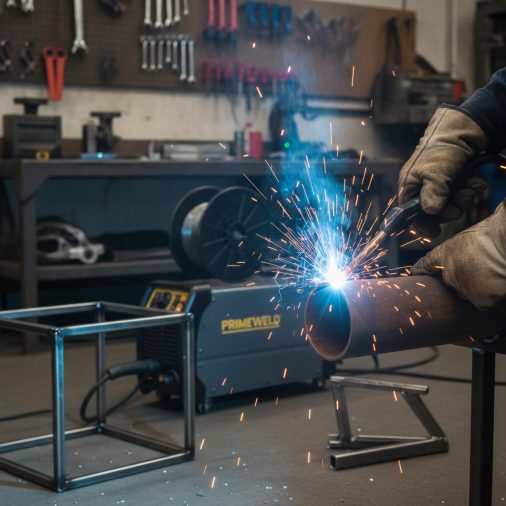
If you’re shopping for a mid-range MIG welder that punches above its price point, the PrimeWeld MIG 180 keeps coming up in conversations. It sits in a sweet spot between entry-level hobby machines and full industrial units — and for many home shop welders and small fabricators, that’s exactly where they need to be.
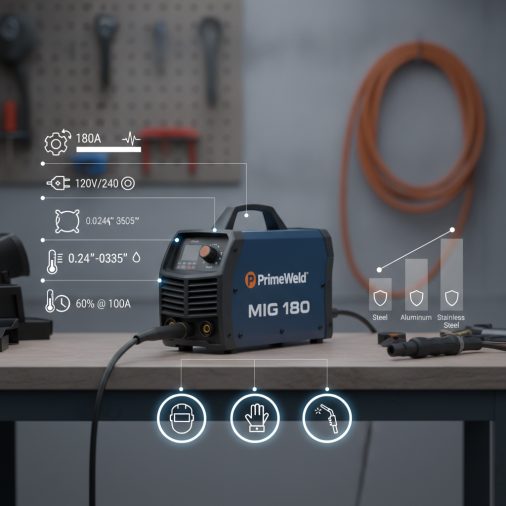
The PrimeWeld MIG 180 is a 180-amp multi-process MIG/Flux-Core/Lift-TIG welder capable of handling mild steel up to around 3/8 inch in a single pass. It runs on 220V power, supports both gas-shielded MIG and gasless flux-core welding, and offers solid duty cycle performance for the price. It’s best suited for intermediate home shop users, farmers, auto body workers, and small fabricators who need reliable output without a professional shop budget.
Key Specifications at a Glance
Before going deeper, here’s a quick reference for the core specs:
Specification
Detail
Amperage Range
30A – 180A
Input Voltage
220V / Single Phase
Welding Processes
MIG, Flux-Core, Lift-TIG
Wire Feed Speed
Adjustable
Duty Cycle
60% at 130A
Wire Diameter (MIG)
0.023" – 0.035"
Wire Diameter (Flux-Core)
0.030" – 0.035"
Max Weld Thickness
~3/8" single pass (mild steel)
Spool Size
4 lb and 8 lb spools
Weight
Approximately 39 lbs
Warranty
3 years
The 3-year warranty is a genuine standout at this price tier. Most comparable machines offer 1 year at best.
What the PrimeWeld MIG 180 Is Actually Good At
This machine is built for versatility in a mid-duty environment. It handles the everyday welding tasks that home shop users and small shops deal with regularly.
Mild steel is where it performs best. The 30–180A range gives you enough control for thin sheet metal and enough output to handle heavier structural work up to 3/8 inch. If you’re welding automotive frames, trailer hitches, farm equipment repairs, or structural brackets, this machine delivers consistent results.
Flux-core welding works well on the MIG 180 when you’re working outdoors or in drafty conditions where shielding gas gets blown away. Gasless flux-core capability is a practical feature for fieldwork and outdoor repairs.
Lift-TIG is included and functional, though it’s more of a bonus feature than a primary strength. If you occasionally need TIG welds and don’t want a dedicated TIG machine, it covers light-duty use. For serious TIG work, you’d want a dedicated unit.
Duty Cycle — What It Means in Practice
The 60% duty cycle at 130A means the machine can weld for 6 minutes out of every 10-minute window before needing a cool-down period.
In a home shop or small fab setting, this is typically a non-issue. Most welders aren’t laying continuous beads at high amperage for long stretches. You weld, reposition, grind, tack — and the machine stays well within safe operating limits.
At the full 180A, the duty cycle drops, so extended heavy welding at max output isn’t the intended use case. For occasional high-amp passes on thicker material, it handles it without trouble.
Wire and Gas Setup
The MIG 180 accepts both 4 lb and 8 lb wire spools, which is more practical than machines limited to smaller spools. You won’t be swapping spools constantly during longer jobs.
For shielding gas, the standard recommendation for mild steel MIG welding is a 75% Argon / 25% CO2 mix (commonly called C25). Pure CO2 is also compatible and produces slightly more spatter but deeper penetration. whether you actually need shielding gas for MIG welding depends on which mode you’re using — gas-shielded MIG requires it, while flux-core mode does not.
The regulator and gas hose are included in the package, which saves an immediate extra purchase.
Controls and Usability
The control panel is straightforward. You have:
– Voltage control — typically 2 coarse steps with fine adjustment
– Wire feed speed — continuously adjustable
– Process selector — switches between MIG, Flux-Core, and Lift-TIG
– Polarity setup — requires manual changeover between DCEP (MIG) and DCEN (Flux-Core)
The polarity change for flux-core requires switching the cables inside the machine. It’s a simple process but worth knowing upfront — you need to swap the torch lead and work clamp connections when changing between modes. First-time users sometimes overlook this and wonder why their flux-core welds look terrible.
The included torch is a standard European-style MIG gun. It’s a comfortable hold and the consumables (tips, nozzles, liners) are widely available and inexpensive.
Welding Stainless and Aluminum — What’s Possible
The PrimeWeld MIG 180 can weld stainless steel with the right wire and gas. You’ll need ER308L stainless wire and a tri-mix shielding gas (typically 90% He / 7.5% Ar / 2.5% CO2) or at minimum a 98% Argon / 2% CO2 mix. welding stainless with a MIG welder is fully achievable on the MIG 180 for light to medium stainless work.
Aluminum MIG welding is technically possible but requires a spool gun, which is not included. Running aluminum wire through the standard push-drive liner causes birdnesting due to the softness of aluminum wire. If aluminum work is a priority, factor in the additional cost of a compatible spool gun.
Common Setup Mistakes to Avoid
A few issues come up repeatedly with new MIG 180 owners:
Wrong polarity for flux-core — as mentioned above, flux-core requires DCEN (electrode negative). Running it on DCEP causes excessive spatter and poor fusion. Always check polarity when switching modes.
Wire speed too high for thin material — starting with wire feed speed too high on sheet metal leads to burn-through and globbing. Start lower and adjust upward until the arc sounds smooth and consistent. Knowing what a good MIG weld looks like helps you dial in settings faster.
Skipping the ground clamp placement — placing the ground clamp far from the weld zone increases resistance and produces an erratic arc. Keep it close to the work area.
Not checking for gas leaks — after connecting the regulator, always check fittings for leaks before striking an arc. A slow leak wastes gas and affects weld quality without being immediately obvious.
How It Compares to Similar Machines
Machine
Amperage
Input Voltage
Duty Cycle
Warranty
Flux-Core
PrimeWeld MIG 180
30–180A
220V
60% @ 130A
3 Years
Yes
Hobart Handler 190
25–190A
230V
30% @ 90A
5 Years
Yes
Lincoln Electric MIG-Pak 180
30–180A
230V
30% @ 130A
3 Years
Yes
YESWELDER MIG-205DS
30–205A
110V/220V
60% @ 160A
1 Year
Yes
The PrimeWeld MIG 180 holds its own on duty cycle compared to the Hobart Handler 190 and Lincoln Electric MIG-Pak 180, both of which are frequently mentioned alternatives. The 3-year warranty also matches the Lincoln and beats most others in this class.
The Hobart brand carries stronger dealer network support in North America, which matters if you prefer in-person service. PrimeWeld handles support directly and generally has a solid reputation for customer service response.
Practical Welding Tips for This Machine
A few observations that make the MIG 180 perform better day-to-day:
– Tip size matters — Use the correct contact tip diameter for your wire. Oversized tips cause wire wander and an inconsistent arc.
– Clean your base metal — Rust, mill scale, paint, and galvanizing all degrade weld quality. A quick pass with a flap disc before welding pays off in bead appearance and strength.
– Nozzle dip — Anti-spatter nozzle dip or spray reduces spatter buildup inside the nozzle and extends its life.
– Short circuit transfer — At lower amperages, this machine operates in short circuit transfer mode, which is ideal for thin material and out-of-position welding. If you’re welding vertically or overhead, understanding how to weld vertical MIG will save you a lot of frustration with puddle control.
– Tack before running full beads — On longer joints, tacking at intervals prevents warping from heat buildup, especially on thinner stock.
FAQ
Is the PrimeWeld MIG 180 good for beginners?
It can work for a motivated beginner, but it’s genuinely better suited to intermediate users. The 220V requirement means you need a dedicated circuit, and the polarity changeover between modes requires some basic understanding of the machine. A beginner willing to learn setup and settings will get a lot of value from it, but it’s not a plug-and-play starter unit.
What thickness of metal can the PrimeWeld MIG 180 weld?
On mild steel, it handles material from thin sheet metal (around 24 gauge with care) up to approximately 3/8 inch in a single pass. For material thicker than 3/8 inch, multiple passes are possible but the machine is operating near its limits at that point. Pre-heating heavier stock helps fusion on those edge cases.
Does the PrimeWeld MIG 180 come with everything needed to start welding?
It includes the MIG gun, ground clamp, gas regulator, gas hose, and a contact tip. You’ll need to supply your own shielding gas cylinder and welding wire. A welding helmet, gloves, and other PPE are also on you. It’s reasonably complete out of the box for gas MIG welding.
Can the PrimeWeld MIG 180 weld aluminum?
Not out of the box. Aluminum MIG welding requires a spool gun to prevent wire feeding problems, and the standard torch setup isn’t suitable for aluminum wire. If a compatible spool gun is available for this model, that option opens up aluminum capability, but it’s an additional purchase and setup.
What shielding gas should I use with the PrimeWeld MIG 180?
For mild steel MIG welding, C25 (75% Argon / 25% CO2) is the standard recommendation and produces clean, low-spatter welds. Pure CO2 is a cheaper alternative with more penetration and spatter. For stainless steel, a tri-mix or high-argon blend is needed. using 100% argon for MIG welding on mild steel is generally not recommended as it produces an unstable arc.
How does the Lift-TIG feature work on the MIG 180?
Lift-TIG uses a touch-start method — you briefly touch the tungsten electrode to the base metal and lift it to strike the arc, avoiding high-frequency start. It produces a usable TIG arc for light fusion work. You’ll need a TIG torch and argon shielding gas, neither of which are typically included. It’s a functional feature for occasional TIG work, not a replacement for a dedicated TIG machine.
Is the PrimeWeld MIG 180 suitable for auto body work?
Yes, with appropriate settings. Auto body panels are typically 18–22 gauge, which is in the lower end of the MIG 180’s range. Running lower voltage and wire feed speed with short stitch welds prevents burn-through. MIG welding thin sheet metal successfully on this machine is very much doable once you dial in the settings.
Final Thoughts
The PrimeWeld MIG 180 delivers genuine capability at a price point that’s hard to argue with. The 3-year warranty, solid duty cycle, and multi-process flexibility make it a strong choice for home shop welders, hobby fabricators, and anyone doing regular maintenance welding on farm equipment or automotive projects.
It’s not a professional production machine, and it doesn’t pretend to be. But for the work most people in this segment actually do — structural repairs, brackets, trailers, automotive work, and occasional stainless — it covers the ground reliably. Setup takes some attention to detail, especially around polarity and gas connections, but once it’s dialed in, it’s a consistent performer.