

The rod kept sticking, the arc felt weak, and the bead just piled up instead of biting into the metal. I turned the amperage up, then down, trying to find that sweet spot while burning through electrodes and patience. That’s when it finally hit me — with stick welding, amperage has to match metal thickness, or nothing works the way it should.
In real stick welding, wrong amps mean real problems. Too low and you get poor penetration and stuck rods; too high and you blow through thin metal, create undercut, and waste electrodes fast.
I learned through hands-on trial and error that dialing in the right amperage isn’t just about nice-looking welds — it’s about strength, safety, and not redoing the same joint twice.
If you’re tired of guessing your settings and want consistent, solid welds on any thickness, keep going. I’ll walk you through how to match stick welding amperage to metal thickness the practical way, step by step, like it’s done in real shops.
Getting the Basics Right in Stick Welding
Stick welding starts with understanding your setup. You’re using a constant current power source, either DC or AC, to strike an arc between the electrode and the base metal. The electrode melts, adding filler while the flux coating creates slag to protect the weld from contamination.
It’s rugged, portable, and great for outdoor work or dirty materials, which is why it’s a go-to for construction and repairs.
How it works is straightforward: electricity flows through the rod, heating it to create the arc. The key is balancing that heat so it penetrates without overwhelming the metal.
When to use it? Anytime you’re dealing with carbon steel, stainless, or cast iron in a shop or field setting. Why? It’s forgiving on rusty or painted surfaces compared to MIG or TIG.
In the shop, I always start by cleaning the metal—wire brush or grinder—to remove scale. A clean joint means better arc stability.
Practical tip: If you’re new, practice on scrap. Strike the arc like scratching a match, then hold a short arc length, about the rod’s diameter, and move steadily. I’ve seen guys rush this and end up with porosity from trapped slag.
How Amperage Influences Your Weld Quality
Amperage is the amount of electrical current flowing through the circuit, and in stick welding, it’s what drives the heat. Higher amps mean more heat, faster rod melt-off, and deeper penetration—perfect for thicker metals. Lower amps keep things cooler, ideal for thin stock to avoid burn-through.
It works by controlling the arc’s intensity. At the right setting, the weld pool forms evenly, and the bead lays flat with good tie-in to the edges. Too high, and the arc becomes violent, spattering everywhere and undercutting the metal. Too low, and the rod sticks, the puddle stays thin, and you get poor fusion.
Use higher amps when you’re on thick plates or need deep root passes in multi-layer welds. Lower them for sheet metal or overhead positions where gravity pulls the puddle down. Why bother dialing it in? Because mismatched amperage leads to defects like cracks from rapid cooling or weak joints that fail under load.
From my experience, on a 1/8-inch rod, starting around 100 amps for flat welding gives a good baseline. But adjust based on how the rod runs—if it’s popping and hissing too much, back it off.
One time, I was welding a bracket on a truck frame, cranked too high, and warped the whole thing. Lesson learned: always test on similar scrap first.
Matching Amperage to Metal Thickness
This is the heart of it—pairing your amps to the metal’s gauge. Thinner metal needs less heat to prevent warping or holes, while thicker stuff requires more to ensure penetration without cold laps.
How does it work? Heat input scales with thickness. For every 1/16-inch increase in metal, you might bump amps by 20-30, but it varies by rod type. Start low and creep up as you watch the puddle.
When to adjust? Always for the thinnest part in a joint. Why? To avoid damaging the weaker section. For example, welding 1/8-inch to 1/4-inch, set for the 1/8-inch side.
Shop tip: Measure thickness with calipers, not guesses. I’ve botched jobs assuming stock was uniform. Prep the joint—bevel edges on anything over 1/4-inch for better fusion. Use a stringer bead for thin stuff, weaves for thicker to fill gaps.
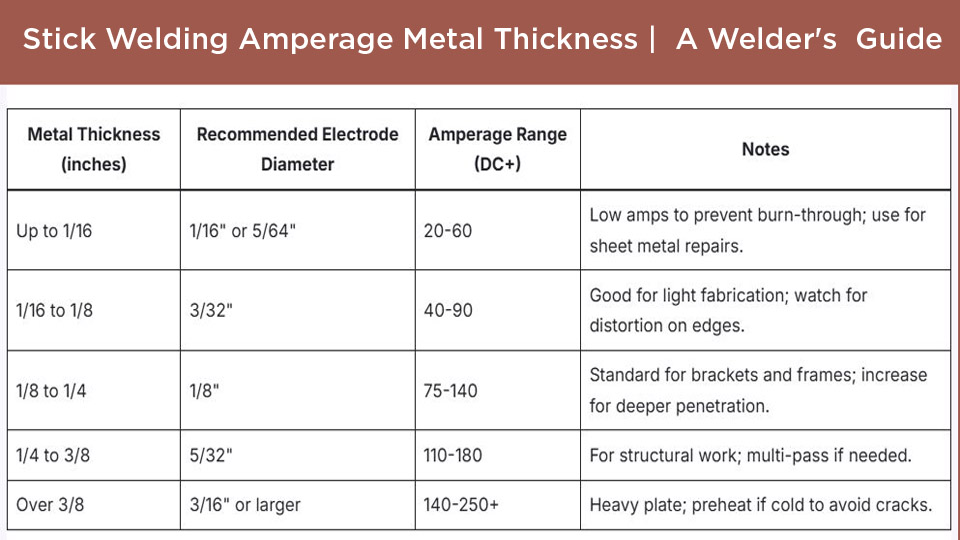
Here’s a practical comparison table for mild steel, based on common setups:
| Metal Thickness (inches) | Recommended Electrode Diameter | Amperage Range (DC+) | Notes |
|---|---|---|---|
| Up to 1/16 | 1/16″ or 5/64″ | 20-60 | Low amps to prevent burn-through; use for sheet metal repairs. |
| 1/16 to 1/8 | 3/32″ | 40-90 | Good for light fabrication; watch for distortion on edges. |
| 1/8 to 1/4 | 1/8″ | 75-140 | Standard for brackets and frames; increase for deeper penetration. |
| 1/4 to 3/8 | 5/32″ | 110-180 | For structural work; multi-pass if needed. |
| Over 3/8 | 3/16″ or larger | 140-250+ | Heavy plate; preheat if cold to avoid cracks. |
This isn’t set in stone—rod type like 6013 runs cooler than 6010. Test and tweak.
Choosing the Right Electrode Diameter
Electrode diameter ties directly to amperage and thickness. Smaller diameters run at lower amps, suiting thin metal; larger ones handle higher amps for thick stock.
It works because thicker rods carry more current without overheating, depositing more filler faster. Measure by the core wire, not the flux—common sizes are 3/32″, 1/8″, 5/32″.
When to pick small? For precision on thin gauge or out-of-position welds. Larger for flat, heavy-duty jobs. Why? Small rods give better control but burn quicker; large ones boost productivity but need beefy machines.
Tip: Rule of thumb—rod diameter should be about the metal’s thickness or slightly less. For 1/4-inch plate, 1/8-inch rod at 120 amps works well. I once used a 5/32″ on thin tube and blew holes—switched to 3/32″ and it was smooth.
Pros of smaller diameters: Easier starts, less heat input. Cons: Slower deposition, more rods used. Larger: Faster welds, but harder to maneuver vertically.
Amperage Settings for Common Rod Types
Different rods have unique flux coatings, affecting how they run at certain amps. Let’s break down popular ones for mild steel.
6010/6011: Deep penetrating, great for dirty metal. Amps: 3/32″ 40-85, 1/8″ 75-125, 5/32″ 110-165. Use on pipes or roots; runs hot, so lower for thin.
6013: Mild penetration, easy to use. Amps: Similar to above but 10-20 lower; good for beginners on clean stock.
7018: Low hydrogen for strong welds. Amps: 3/32″ 70-110, 1/8″ 90-165, 5/32″ 130-220. Keep dry to avoid cracks; ideal for structural.
How to choose? Match to job—6010 for penetration, 7018 for quality. When? 6013 for hobby, 7018 for pros.
Tip: For stainless like 308L, amps are similar but use DC+ for best results. On cast iron, Ni-CL rods at lower amps to minimize stress.
In my shop, 7018 is my daily driver for fab work—runs smooth at 120 on 1/8″ rod for 1/4″ plate.
Handling Different Welding Positions
Position changes everything—flat is forgiving, overhead tricky.
In flat/horizontal, use higher amps for speed. Vertical-up: Lower 10-15% to fight gravity; smaller rod helps.
Overhead: Even lower, short arc to prevent drips.
Why? Puddle control—high amps make it sag.
Tip: Practice vertical weaves—start low, like 90 amps on 1/8″ rod for 3/16″ metal. I learned this welding tank stands; too high and it ran everywhere.
Preparing Joints for Better Results
Joint prep is key before amps. Clean, bevel, gap properly.
For butt joints on thick metal, bevel 30-45 degrees, land 1/16″. Amps higher for root, lower for fills.
T-joints: Fillet welds, 10% more amps than butts.
Why prep? Ensures fusion without excess heat.
Tip: Use backing strips on thin metal to contain the puddle. Once, skipping bevel on 3/8″ led to weak welds—re-did the whole thing.
Common Mistakes and How to Fix Them
Beginners crank amps too high on thin metal, causing burn-through. Fix: Drop 20 amps, use smaller rod.
Pros sometimes go too low on thick, getting cold laps. Fix: Increase, ensure full penetration.
Rod sticking? Amps too low—bump up, strike better.
Spatter? Too high or wrong polarity—switch to DC+.
Anecdote: On a gate repair, low amps gave porous welds. Scraped it out, upped to 110, perfect.
Step-by-Step Guide to Setting Up Your Stick Welder
- Assess metal: Measure thickness, note type.
- Pick rod: Diameter slightly less than thickness, type for job.
- Set polarity: DC+ for most penetration.
- Dial amps: Start mid-range from chart.
- Prep joint: Clean, bevel if needed.
- Test weld: On scrap, adjust by bead appearance.
- Weld: Steady motion, watch puddle.
- Inspect: Check for cracks, clean slag.
This process saved me hours on jobs.
Safety Considerations with Amperage and Thickness
High amps mean more heat, UV, fumes—always helmet, gloves, respirator.
Thin metal heats fast, risk of burns. Thick takes longer, but slag pops hot.
Why care? Wrong settings amplify hazards like arc flash.
Tip: Ventilate, especially indoors. I use a fan pulling fumes away. Ground properly to avoid shocks.
Advanced Tips for Experienced Welders
For multi-pass on thick stock, lower amps on cap passes to avoid undercut.
Preheat cold thick metal to 200°F for better flow.
On alloys, match filler—e.g., 309 for stainless to carbon.
Pros/cons of AC: Cheaper machines, but more spatter vs DC’s stability.
In the field, portable inverters shine—light but powerful up to 200 amps.
One pro tip: Listen to the arc—a steady bacon sizzle means good settings.
Wrapping Up
Nailing stick welding amperage for metal thickness turns frustrating guesswork into confident craftsmanship. You’ve got the charts, tips, and fixes now to tackle any job, from hobby fixes to pro builds. It equips you to spot issues early, save materials, and produce welds that hold up.
Remember, the best welders experiment but start smart. Always keep a log of your successful settings for different metals and rods—it’ll become your shop bible over time.
What Amperage Should I Use for 1/8-Inch 7018 Rod on 1/4-Inch Steel?
Aim for 100-130 amps on DC+. Start at 110, test on scrap—if the bead is too high, bump up; if flat or spattering, drop down. Good for structural fillets.
How Do I Avoid Burn-Through on Thin Sheet Metal with Stick Welding?
Use 3/32″ 6013 at 50-70 amps, short arc, fast travel. Tack first, weld in short bursts to let cool. If holes appear, lower amps or switch to TIG if possible.
What’s the Best Rod for Welding Rusty Metal?
Go with 6010 or 6011—they cut through contaminants. Amps: 75-125 for 1/8″ on 3/16″ thickness. Clean what you can, but these forgive more.
Why Is My Weld Bead Undercut and How to Fix It?
Often from too-high amps or fast travel. Reduce by 10-20 amps, angle electrode properly at 15-20 degrees. Weave slightly to fill edges.
Can I Use the Same Amperage Settings for AC and DC Machines?
Not exactly—AC needs 10-20% higher amps for similar penetration due to less stability. Test accordingly, and prefer DC+ for critical work.


