

The rod started sticking, the arc went wild, and the bead piled up like it didn’t know where to go. I hadn’t changed the joint or the electrode — just guessed at the amperage and hoped for the best. That’s the fastest way to ruin a weld with a stick machine.
With stick welding, your settings control everything: penetration, arc stability, slag release, and even how many rods you burn through in a day.
I learned through real shop jobs that having a reliable stick welder settings chart saves time, prevents rework, and keeps your welds strong and safe. When the numbers are right, the machine finally works with you instead of against you.
If you want cleaner beads and fewer stuck rods, keep reading. I’ll show you how to use a stick welder settings chart the practical way, so you can dial in fast and weld with confidence.
What Do the Numbers on a Welding Rod Actually Mean?
Every stick electrode carries an AWS classification like E6010 or E7018. The “E” stands for electrode. The first two or three digits show minimum tensile strength in thousands of psi—60 for 60,000 psi, 70 for 70,000 psi. That tells you the weld’s strength once cooled.
The next digit indicates positions the rod can run in:
- 1 = all positions (flat, horizontal, vertical, overhead)
- 2 = flat and horizontal only
- 4 = flat only (rare for most work)
The last digit describes flux type and operating characteristics:
- 0 = cellulose, deep penetration, fast freeze, usually DC+
- 1 = similar to 0 but works AC or DC
- 3 = rutile, easy arc, moderate penetration, AC/DC
- 8 = low-hydrogen, smooth arc, high ductility, usually DC+
Understanding this code helps you pick the right rod before you even look at the amperage chart.
Most Common Stick Welding Rods and When to Use Them
Here’s what I reach for in a typical shop:
E6010: Deep penetration, fast-freeze slag, great for root passes on pipe or dirty steel. Runs best on DC+. I use it for open-root joints where I need the arc to dig in. Downside: more spatter and rougher bead appearance.
E6011: Almost identical to 6010 but runs AC or DC. Perfect for home shops with basic machines or when welding outdoors on rusty material. It handles poor fit-up better than most.
E6013: Beginner-friendly, smooth arc, shallow penetration. Ideal for sheet metal, light fabrication, or repairs where appearance matters more than deep fusion. Runs AC or DC and leaves a nice-looking bead with easy slag removal.
E7018: Low-hydrogen rod for structural work, heavy equipment, or anything that sees stress or code inspection. Smooth arc, low spatter, excellent ductility. Must stay dry—moisture causes cracking.
E7024: High-deposition, iron-powder rod for flat/horizontal fillets on thick plate. Fast travel speed, but limited to flat positions.
Pick the rod based on the job: deep penetration for roots (6010/6011), strength for structural (7018), ease for light work (6013).
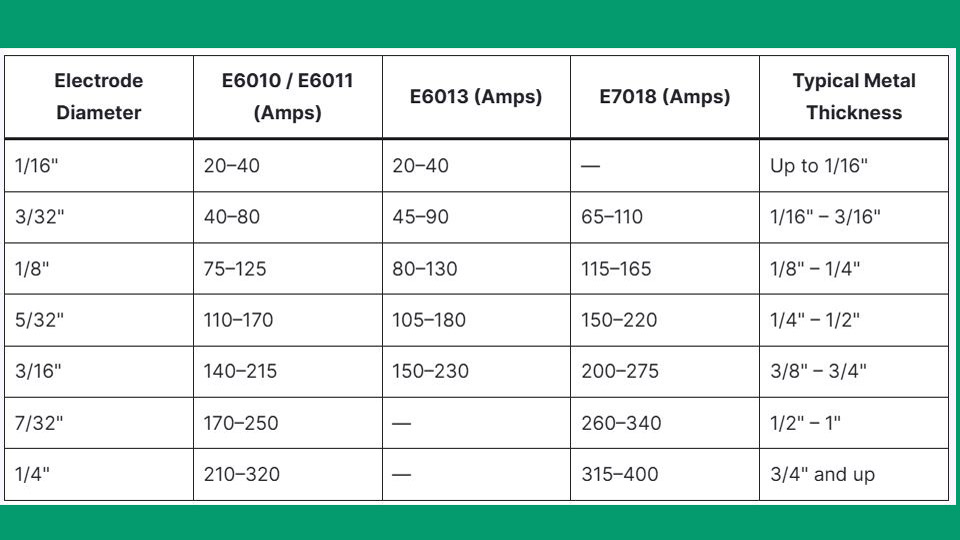
Stick Welder Settings Chart: Amperage Ranges by Rod Diameter
This is the core reference most welders want. These ranges come from manufacturer data and years of shop use on mild steel. Start in the middle of the range, then adjust based on metal thickness, position, and how the puddle behaves.
| Electrode Diameter | E6010 / E6011 (Amps) | E6013 (Amps) | E7018 (Amps) | Typical Metal Thickness |
|---|---|---|---|---|
| 1/16″ | 20–40 | 20–40 | — | Up to 1/16″ |
| 3/32″ | 40–80 | 45–90 | 65–110 | 1/16″ – 3/16″ |
| 1/8″ | 75–125 | 80–130 | 115–165 | 1/8″ – 1/4″ |
| 5/32″ | 110–170 | 105–180 | 150–220 | 1/4″ – 1/2″ |
| 3/16″ | 140–215 | 150–230 | 200–275 | 3/8″ – 3/4″ |
| 7/32″ | 170–250 | — | 260–340 | 1/2″ – 1″ |
| 1/4″ | 210–320 | — | 315–400 | 3/4″ and up |
Notes:
- E6010 and E6011: Use DC+ for max penetration (DCEP). E6011 can run AC.
- E6013 and E7024: AC or DC, AC often preferred for smoother arc.
- E7018: DC+ preferred, AC acceptable but increase amps 10–15%.
- These are starting points for flat/horizontal. Reduce 10–15% for vertical up or overhead.
I keep a laminated copy of this chart taped to my welder cart. It saves guessing every time.
How to Dial In Amperage: Listen to the Arc and Watch the Puddle
Amperage controls heat input. Too low: the arc stutters, rod sticks, puddle stays small, slag won’t release. Too high: arc blows violently, spatter flies, metal warps or burns through.
Start at the middle of the range. Strike the arc and watch:
- Good arc: steady crackle, cone-shaped, puddle flows evenly.
- Low amps: harsh, erratic arc; rod sticks; narrow bead.
- High amps: explosive arc; wide bead; excessive spatter; rod turns red fast.
Fine-tune in 5–10 amp increments. On a 1/8″ 7018, I usually settle around 130–140 amps for flat fillets on 1/4″ plate—enough penetration without undercut.
For material thickness:
- Thin metal (<1/8″): lower amps, faster travel, smaller rod.
- Thick metal (>3/8″): higher amps, slower travel, larger rod for deposition.
Polarity Matters: Why Most Pros Stick with DC+
Polarity affects penetration and arc stability:
- DC+ (DCEP): Electrode positive. Deep penetration, used for 6010, 7018. About 70% of shop work.
- DC- (DCEN): Electrode negative. Shallow penetration, more heat in rod—rare for stick.
- AC: Medium penetration, good for 6011 and 6013 on machines without DC.
If your machine has DC, use it for better control. AC is forgiving on dirty or rusty steel.
Adjusting Settings for Position: Vertical and Overhead Are Different
Flat is easiest—use full range. Vertical up and overhead require lower amps and better control:
- Vertical up: Drop 10–15% amps, smaller rod, whip or weave technique.
- Overhead: Drop 15–20% amps, fast-freeze rods like 6010, short arc, circular motion to control puddle.
I once welded vertical 7018 on 1/2″ plate at full amps—puddle sagged and slag trapped. Dropped to 135 amps on 1/8″ rod, used a triangular weave, and the bead stacked clean.
Material Thickness, Joint Prep, and Rod Selection
Match rod to thickness:
- Sheet metal (16–12 ga): 3/32″ 6013, 60–90 amps.
- 1/4″ plate: 1/8″ 7018 or 6011, 110–150 amps.
- 1/2″+: 5/32″ or larger 7018, 160–220 amps.
Prep is half the battle:
- Clean to bright metal—wire brush, grinder, or solvent.
- Bevel thick plate for full penetration.
- Tack weld securely to control distortion.
- Preheat high-carbon or thick material to avoid cracking (especially with 7018).
Common Mistakes I See (and How to Fix Them)
- Rod too big for thickness: causes burn-through. Switch to smaller diameter.
- Amps too low on 7018: slag inclusions. Increase 10 amps, shorten arc.
- Long arc: porosity. Keep 1/8″–1/4″ arc length.
- Wet 7018 rods: hydrogen cracking. Store in oven or sealed container.
- Wrong polarity: poor penetration. Double-check leads.
I’ve fixed bad welds by grinding to sound metal, then re-running with correct settings. Prevention is better.
Step-by-Step: Setting Up and Running a Weld
- Select rod based on material and position.
- Check machine polarity (DC+ for most).
- Set amperage to mid-range.
- Clean joint thoroughly.
- Clamp or tack pieces.
- Strike arc (scratch or tap method).
- Establish puddle, maintain short arc.
- Travel at speed that keeps puddle size consistent.
- Chip slag, inspect bead, adjust if needed.
Practice on scrap until the arc sounds right and the bead looks uniform.
Safety: The Stuff That Keeps You Welding Tomorrow
Always wear a helmet (auto-darkening is a game-changer), gloves, jacket, boots. Ground the work close to the weld. Ventilate fumes. Keep a fire extinguisher handy. Check cables for damage.
One spark on dry grass can turn into a disaster. I’ve seen it happen.
Take the time to get your stick welder settings right. The chart above is your starting point, but the real skill comes from adjusting on the fly based on how the arc and puddle behave. Once you dial it in consistently, your welds improve dramatically—stronger, cleaner, faster.
The best pro tip I can give: slow down on the first pass. Rushing leads to defects that take longer to fix than doing it right the first time. Keep practicing, keep that chart handy, and your welds will speak for themselves.
FAQ
What amperage should I use for a 1/8″ 7018 rod?
Start at 130–140 amps on DC+ for flat or horizontal. Drop to 120–130 for vertical up. Watch the puddle—if it’s sluggish, bump up 5–10 amps; if spatter flies, dial back.
Can I run 6010 on AC?
No—6010 needs DC+ for proper performance. Use 6011 instead if you only have AC.
Why do my 7018 rods keep cracking the weld?
Moisture in the flux. Low-hydrogen rods must stay dry. Store them in a rod oven at 250–300°F or sealed container. If they’ve been exposed, re-dry per manufacturer specs or toss them.
What’s the best rod for rusty or painted metal?
E6011 on AC or DC. It burns through contaminants better than most. Clean as much as possible first, but it forgives imperfect prep.
How do I avoid sticking the rod when starting?
Keep a short arc, strike with a scratch motion, and set amps in the middle of the range. If it sticks anyway, twist it off quickly and clean the tip before restarting.


