If you’re working on a plumbing project, pneumatic system, or hydraulic fitting and the spec calls for a “1/8 pipe thread,” you might assume that means a pipe that’s 1/8 inch in diameter. That assumption leads to a lot of confusion at the hardware store.
A pipe with 1/8 pipe thread uses the NPT (National Pipe Taper) standard, where “1/8” refers to the nominal pipe size — not the actual outer diameter. The real OD of a 1/8 NPT pipe is approximately 0.405 inches (about 10.3 mm). The threads taper at 1° 47′ per side, creating a pressure-tight seal as male and female fittings are threaded together.
Why the Size Doesn’t Match the Name
Pipe thread sizing is one of those legacy systems that confuses almost everyone the first time. The nominal size was originally based on the approximate inside diameter of older iron pipe — but wall thickness, material, and manufacturing standards have changed significantly since then.
For 1/8 pipe thread (1/8 NPT), here’s what the actual measurements look like:
Specification
Measurement
Nominal Pipe Size
1/8 inch
Actual Outer Diameter (OD)
0.405 inches (10.3 mm)
Threads per Inch (TPI)
27
Thread Taper
1° 47' (1/16 per foot)
Typical Thread Engagement Length
0.180 inches
This mismatch between the nominal name and the real dimension is consistent across the entire NPT system. Once you know this, reading pipe specs becomes much easier.
NPT vs. NPS: Two Thread Types You’ll Encounter
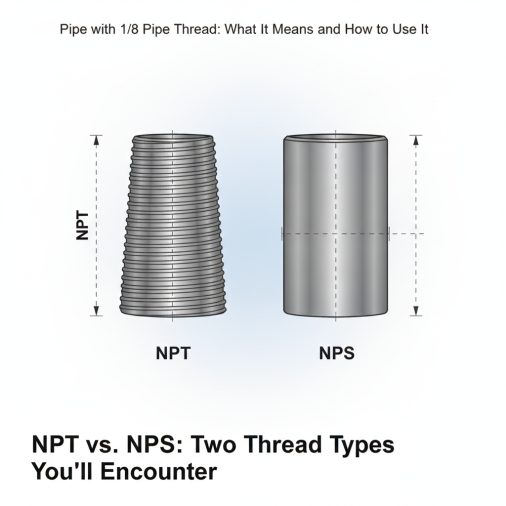
When shopping for 1/8 pipe thread fittings, you may also come across NPS (National Pipe Straight) threads. These use the same thread count and outer diameter as NPT but without the taper.
– NPT (National Pipe Taper): Threads taper slightly toward the end. As you tighten the connection, the threads bind together and create a seal. Requires thread sealant or PTFE tape in most applications.
– NPS (National Pipe Straight): Threads are parallel, not tapered. Relies on a gasket or O-ring to seal rather than thread interference. Common in low-pressure applications.
For most pressurized systems — including air lines, gas, hydraulic fittings, and residential plumbing — 1/8 NPT is the standard. NPS threads at 1/8 size appear more often in instrumentation or specialty fittings.
Where 1/8 Pipe Thread Is Commonly Used
The 1/8 NPT size is one of the most frequently used thread sizes in light-duty and instrumentation applications. You’ll find it across a wide range of industries and systems:
– Air compressors and pneumatic systems — pressure gauge ports, blow-off valves, and quick-connect fittings
– Hydraulic systems — sensor ports and pressure tap points on small equipment
– Gas lines — pilot light connections, small burner assemblies, and propane fittings
– Automotive — oil pressure sensor ports, coolant temperature sender ports
– Plumbing — connections for water supply shutoffs, valve bodies, and inline filters
– Industrial instrumentation — pressure transducer and transmitter ports
In practice, the 1/8 NPT port is often the smallest threaded pipe connection on a given piece of equipment. It’s frequently used for sensor or gauge connections where flow volume is low but pressure integrity still matters.
How to Identify a 1/8 Pipe Thread
If you’re trying to confirm whether a fitting or port uses 1/8 NPT, you have a few reliable methods:
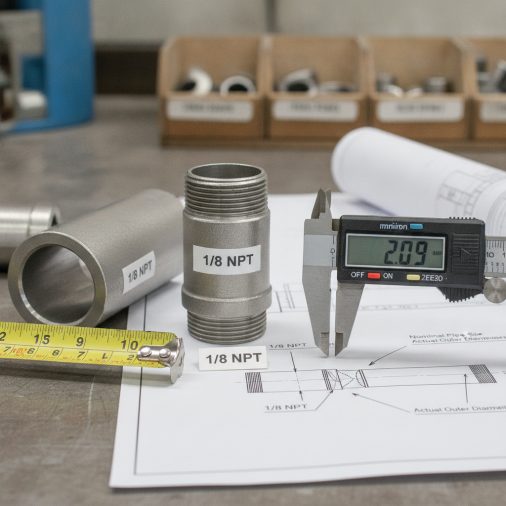
1. Measure the outer diameter. Use calipers on the male thread. An OD around 0.405 inches strongly suggests 1/8 NPT.
2. Count the threads. 1/8 NPT has 27 threads per inch (TPI). A thread pitch gauge makes this quick and accurate.
3. Test with a known fitting. Thread a confirmed 1/8 NPT fitting into the port. If it catches cleanly at the correct engagement depth, you have a match.
4. Check the taper. Run your finger along the male thread — you should feel the diameter increasing slightly toward the base. NPS threads will feel perfectly uniform.
A common field mistake is confusing 1/8 NPT with metric thread sizes like M10 or M12. The thread pitch and taper are different enough that cross-threading is possible if you force the wrong fitting. Always verify before applying torque.
Sealing a 1/8 NPT Connection Properly
Because NPT threads seal through thread interference, the sealing method matters. Two options are used in practice:
PTFE Thread Tape (Teflon Tape)
Wrap 2–3 layers of PTFE tape clockwise around the male thread before assembly. Start at the first full thread and work toward the pipe end. Avoid covering the very first thread — this can cause tape fragments to enter the system.
Pipe Thread Sealant (Pipe Dope)
A liquid or paste compound that fills thread voids and cures in place. Products like Rectorseal No. 5 are commonly used in gas and plumbing applications. Pipe dope generally provides a more reliable seal than tape alone for pressurized gas lines.
Some applications call for both tape and sealant together for critical connections. Gas installations in particular benefit from the added security.
Typical hand-tight plus wrench turns for 1/8 NPT:
– Hand tight first
– 1.5 to 2 additional full turns with a wrench
– Do not overtighten — the taper will lock before the threads strip, but excessive force can crack brittle fittings
Material Options for 1/8 Pipe Thread Fittings
1/8 NPT fittings are available in several materials depending on the application:
Material
Best For
Considerations
Brass
Water, air, low-pressure gas
Easy to machine; corrosion resistant; common choice
Stainless Steel
Harsh chemicals, high pressure
More expensive; excellent corrosion resistance
Carbon Steel
High-pressure hydraulic
Strong; may require coatings to prevent rust
Black Iron
Natural gas, propane
Standard for gas lines; not for water
PVC / Plastic
Low-pressure water, irrigation
Lightweight; not suitable for heat or high pressure
Brass 1/8 NPT fittings are the most widely available and work well for the majority of applications involving water, air, and light gas service. Stainless is the right choice when working near corrosive fluids or in food-grade environments.
Common Mistakes When Working with 1/8 Pipe Thread
A few errors come up repeatedly, even with experienced trades workers:
– Assuming the size is the actual diameter. A 1/8 NPT fitting will not fit a 1/8-inch hole. The actual OD is over 0.4 inches.
– Cross-threading on small fittings. At 27 TPI, the threads are fine. Always start by hand to confirm alignment before applying a wrench.
– Using NPS fittings in NPT ports. They’ll start to thread in, but won’t seal correctly under pressure.
– Over-applying PTFE tape. Thick tape buildup can prevent full thread engagement or cause tape to enter the system.
– Under-tightening. The taper needs adequate engagement to seal. Hand tight alone is never sufficient for pressurized service.
If you’re working on a copper pipe system and need to transition into NPT threaded fittings, understanding how solder joints behave under pressure is also worth knowing — particularly if the system has residual moisture. You can find practical guidance on soldering copper pipe when water is present, which is a common challenge in existing systems.
FAQ
What is the actual outer diameter of a 1/8 NPT pipe thread?
The actual outer diameter of a 1/8 NPT male thread is 0.405 inches, which is approximately 10.3 mm. This is larger than the nominal size suggests. The “1/8” designation reflects historical nominal pipe sizing, not any physical dimension you can directly measure on the thread or pipe body.
How many threads per inch does 1/8 NPT have?
1/8 NPT has 27 threads per inch (TPI). This is a fine thread pitch compared to many larger NPT sizes — for example, 1/4 NPT has 18 TPI. The fine pitch and small diameter make proper hand alignment especially important before applying wrench torque.
Can I use 1/8 NPT fittings for natural gas connections?
Yes, 1/8 NPT fittings in black iron or brass are commonly used in low-volume gas connections such as pilot light assemblies, gas valves, and small burner lines. Always use an approved pipe thread sealant rated for gas service rather than standard PTFE tape alone, and verify compliance with local code requirements.
What’s the difference between 1/8 NPT and 1/8 BSP threads?
1/8 NPT and 1/8 BSP (British Standard Pipe) are not interchangeable. Both have a nominal 1/8 designation and similar OD, but BSP uses a different thread angle (55° vs. 60° for NPT) and a different thread pitch. Forcing a BSP fitting into an NPT port — or vice versa — can result in a connection that appears to seat but will leak under pressure.
How tight should a 1/8 NPT fitting be?
Start finger-tight to ensure the threads are aligned, then apply 1.5 to 2 full turns with a wrench. The taper will create resistance as threads bind. Avoid going beyond 3 wrench turns past hand-tight, especially with brass or plastic fittings, as overtightening can crack the fitting or distort the port.
What tools do I need to install a 1/8 NPT fitting?
For most 1/8 NPT installations you need: an adjustable wrench or appropriate open-end wrench, PTFE tape or pipe thread sealant, and calipers or a thread gauge if you need to verify the thread spec. On small fittings, needle-nose pliers or a 1/4-inch drive socket can sometimes reach ports in tight spaces.
Is 1/8 NPT the same as 1/8 pipe thread on pressure gauges?
Yes. When a pressure gauge spec lists “1/8 pipe thread” or “1/8 PT,” it almost always refers to 1/8 NPT. This is the most common port size on compact pressure gauges used in pneumatic and hydraulic systems. Always confirm with the manufacturer’s datasheet if the application is safety-critical.
Practical Takeaway
A pipe with 1/8 pipe thread uses the NPT tapered thread standard, with an actual OD of 0.405 inches and 27 threads per inch — not a 1/8-inch diameter. Getting the sealing method right, verifying thread type before assembly, and applying correct wrench torque are the three things that determine whether a 1/8 NPT connection holds or leaks. Once you understand that the nominal size is a historical label rather than a measurement, working with pipe thread specs becomes straightforward.