You pull the trigger on your MIG gun and get absolutely nothing — no arc, no wire, no gas, no sound. It’s one of the most frustrating moments in the shop, especially when you were ready to weld.
When a MIG welder does nothing on trigger pull, the most common causes are a tripped thermal overload, a faulty or dirty trigger connection, a blown fuse inside the machine, a bad ground clamp connection, or a failed contactor. In most cases, the fix is straightforward — a quick visual check of the power supply, ground, and internal fuse resolves the issue without needing professional repair.
Why Your MIG Welder Goes Completely Silent
A MIG welder that shows zero response — no wire feed, no gas, no arc — is different from one that partially works. Partial problems (wire feeds but no arc, gas flows but no wire) point to specific subsystems. Total silence usually means the trigger signal never reached the machine, or the machine isn’t powered correctly.
The trigger on a MIG gun is essentially a simple switch. When you squeeze it, it completes a low-voltage control circuit that tells the machine to activate the contactor, start the wire feed motor, and open the gas solenoid valve. If anything interrupts that signal — or if the machine itself can’t respond — nothing happens.
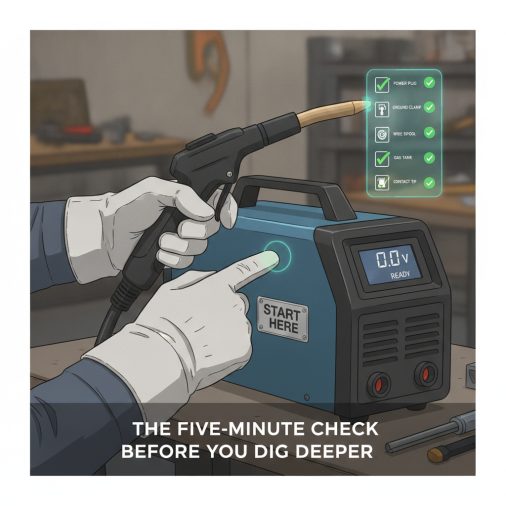
Start Here: The Five-Minute Check Before You Dig Deeper
Before opening panels or testing components, work through these basics. Most “dead trigger” problems get solved here.
1. Check the power supply first
– Is the machine plugged in firmly?
– Is the outlet breaker tripped? Reset it and try again.
– If using an extension cord, is it rated for the welder’s amperage? Undersized cords cause voltage drop that prevents the machine from operating. Learn more about using an extension cord with a MIG welder before assuming the cord is fine.
2. Check the power switch and indicator lights
– Is the machine actually on? Some units have a main power switch separate from the front panel.
– Are there any error codes or fault lights on the display?
3. Inspect the ground clamp
– Clip it directly to bare metal on the workpiece — not paint, rust, or a table edge.
– A bad ground connection can prevent the machine from completing its ready circuit on some models.
4. Check the duty cycle — thermal overload
– If you were welding heavily before the trigger stopped responding, the machine may have tripped its thermal protection.
– Most MIG welders have a thermal overload indicator light (often orange or red).
– Solution: turn the machine off, let it cool for 15–20 minutes, then try again.
5. Wiggle the gun cable and trigger
– While squeezing the trigger, gently flex the gun cable near the connection point at the machine.
– If the machine briefly responds when you move the cable, you have a broken wire inside the cable or a loose gun connection.
Checking the Internal Fuse
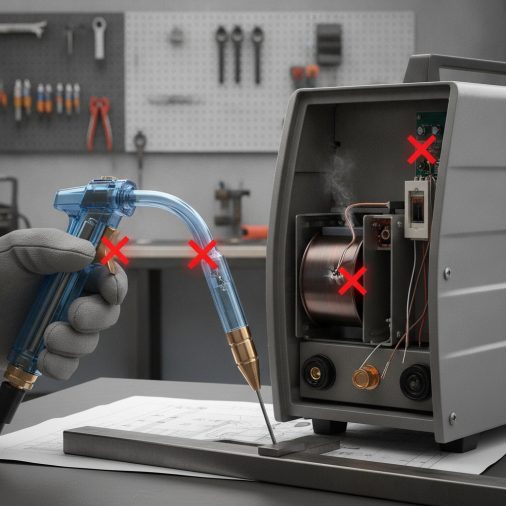
This is one of the most overlooked fixes. Nearly every MIG welder has one or more internal fuses — typically a small glass or blade-type fuse on the control board or near the power input.
A blown fuse causes complete silence on trigger pull because the control circuit has no power.
To check:
1. Unplug the machine completely.
2. Remove the side panel (usually 4–6 screws).
3. Locate the fuse — check near the wire feed motor, the control board, or the power input terminals.
4. Remove the fuse and inspect it visually, or test continuity with a multimeter.
5. Replace with an identical-rated fuse only.
Never replace a fuse with a higher-rated one. If the new fuse blows again immediately, there’s an underlying electrical fault that needs proper diagnosis.
Testing the Trigger and Gun Connection
The MIG gun trigger is a simple two-wire switch. When it fails — which happens from wear, corrosion, or physical damage — the machine receives no activation signal.
Quick trigger test:
1. Unplug the gun from the machine.
2. Locate the trigger pins on the gun’s Euro connector or machine-side socket.
3. Using a multimeter set to continuity mode, probe the two trigger pins on the gun connector while squeezing the trigger.
4. You should hear a beep (or see near-zero resistance) with the trigger pressed, and open circuit when released.
5. No continuity when squeezed = faulty trigger switch or broken wire in the gun cable.
Replacement trigger switches are inexpensive and available for most gun models. If the gun cable itself has an internal break, replacing the whole gun is often more practical than attempting a cable repair. If your wire feed motor isn’t working after the trigger circuit checks out fine, the problem has moved downstream to the drive system.
The Contactor: When the Machine Powers On But Nothing Fires
If the machine powers on (fans run, lights work) but pulling the trigger still produces nothing, the contactor is a strong suspect.
The contactor is an electromagnetic relay inside the machine. When the trigger signal arrives, the contactor closes to connect the welding output and enable wire feed. A stuck, burned, or failed contactor stops everything dead.
Signs the contactor may be the issue:
– Machine powers on normally
– Display shows no fault codes
– Trigger test shows the trigger is working
– You can hear a faint click (or no click at all) from inside the machine when the trigger is pulled
Contactors can sometimes be freed if stuck, but a failed contactor should be replaced. This is a repair most intermediate welders can handle with the correct replacement part and basic electrical knowledge.
Wire Feed Motor and Control Board
If trigger, fuse, and contactor checks are all clear, the wire feed motor or control board becomes the next point of investigation.
A seized wire feed motor or failed motor controller will prevent any response when the trigger is pulled on some machines where motor startup is part of the trigger activation sequence. You can often check the motor independently by applying direct low-voltage power to its terminals — if it spins freely, the motor is fine and the fault is upstream in the control board.
Control board failures are less common but do happen, particularly after a power surge or if the machine has been run on an undersized circuit for extended periods. For Hobart Handler series owners, troubleshooting Hobart wire feed problems covers the motor and drive system in more detail.
Common Causes at a Glance
Cause
Symptoms
Fix
Tripped thermal overload
No response after heavy use
Cool machine 15–20 min, restart
Blown internal fuse
Complete silence, no lights change
Replace fuse with correct rating
Faulty trigger / broken gun cable
No response, flexing cable causes intermittent response
Test trigger continuity, replace switch or gun
Bad ground clamp connection
Intermittent or no arc
Clamp directly to bare metal
Failed contactor
Machine powers on, no weld output
Inspect or replace contactor
Power supply issue
Machine won't power on at all
Check breaker, outlet, cord rating
Failed control board
All other checks pass
Professional inspection or board replacement
When to Call a Professional
Most trigger-dead situations resolve with fuse replacement, trigger inspection, or simply letting the machine cool down. However, some situations call for professional service:
– Visible burn marks or scorching inside the machine
– A replaced fuse blows immediately again
– The contactor appears stuck or shorted
– Diagnosis points to the control board
Attempting high-voltage internal repairs without proper training creates serious safety risks. Budget welders with failed boards often cost more to repair than replace — worth considering before investing in a diagnosis.
FAQ
Why does my MIG welder click but not weld when I pull the trigger?
A single click with no arc usually means the contactor is engaging but the welding circuit isn’t completing. Check the ground clamp connection first — a poor ground prevents arc initiation even when everything else is working. If the ground is solid, inspect the contact tip for blockage and verify the wire is feeding. A worn or clogged contact tip can stop the arc from forming even with the contactor functioning correctly.
Can a bad ground cause a MIG welder to not respond at all?
On most machines, a bad ground alone won’t prevent the trigger from activating the wire feed and gas. However, some machines with integrated feedback circuits may detect an open circuit and suppress output as a protection measure. In practice, a dead trigger is rarely caused by the ground alone — but it’s worth eliminating early because it’s a 10-second check.
Why did my MIG welder suddenly stop working mid-weld?
Stopping mid-weld almost always points to thermal overload tripping from exceeded duty cycle, or a power supply interruption such as a breaker trip. Less commonly, a wire jam at the drive rolls or a kinked gun liner causes the wire feed motor to stall, which can trigger a fault on machines with motor protection circuitry. Let the machine cool, inspect the wire path, and reset the breaker before attempting another weld.
How do I know if the trigger switch itself is broken?
Test it with a multimeter on continuity mode. Disconnect the gun from the welder, probe the two trigger terminals on the connector, and squeeze the trigger. A working trigger shows continuity when pressed and open circuit when released. No continuity when pressed means the switch is faulty. This is a $5–$15 repair on most guns and takes about 20 minutes if you’re comfortable with basic wiring.
My MIG welder powers on and the fan runs, but pulling the trigger does nothing. What’s wrong?
This symptom typically points to the trigger circuit, contactor, or an internal fuse on the control side. If the fan and power indicator work, the main power supply is fine. Work through trigger continuity testing first, then check for any internal control fuses separate from the main power fuse. If both check out, the contactor or control board is the likely culprit.
Could a bad wire spool or tangled wire cause no trigger response?
A tangled wire or bird’s nest at the drive rolls can stall the wire feed motor, but it doesn’t typically cause the trigger to produce zero response — you’d usually still hear the motor struggling or hear the contactor click. If the trigger is completely dead with no sounds at all, the problem is in the trigger circuit or power supply, not the wire path. A bird’s nest causes a different set of MIG wire feeding problems with their own diagnostic steps.
Is it safe to open my MIG welder to check the fuse?
Yes, as long as the machine is completely unplugged and you wait a few minutes for any capacitors to discharge before touching internal components. Never open the machine while plugged in. Stick to visual inspection of the fuse and obvious wiring — don’t probe live internal circuits without proper electrical training and appropriate test equipment.
A Practical Takeaway
A completely dead trigger is almost always caused by something simple: thermal overload, a blown fuse, a bad trigger switch, or a power supply problem. Work through the quick check sequence before assuming the machine is seriously damaged. In the majority of real-world cases, the fix takes less than 30 minutes and costs under $20. Save the board-level diagnosis for after you’ve ruled out every accessible component first.