

Gas bottles empty faster than most beginners expect. One minute the arc is running smooth, and the next the weld starts popping, the puddle gets dirty, and you realize the shielding gas is gone right in the middle of a job.
Situations like that are exactly why understanding How to Calculate Argon Gas Consumption for Welding becomes a practical skill in the shop, not just a bit of math.
Argon flow might seem simple — set the regulator, pull the trigger, and weld. But the reality is different. Gas flow rate, cylinder size, welding time, and even small leaks can change how long a bottle actually lasts. If you don’t calculate it properly, you’ll either run out mid-project or overspend constantly refilling cylinders.
I learned pretty quickly that knowing your gas consumption helps with planning jobs, estimating costs, and avoiding those frustrating moments when the arc suddenly turns unstable. It also helps prevent wasted gas, which adds up faster than most welders expect.
In this guide, I’ll walk through the simple way to estimate argon usage, explain the numbers on your regulator, and show a practical formula you can use in the shop. Once you know it, you’ll always have a good idea of how long your gas will really last.
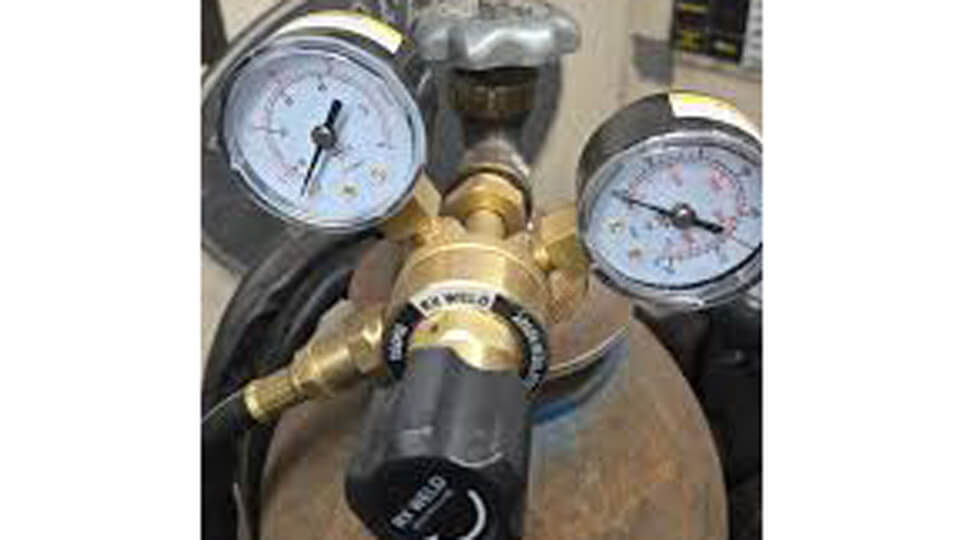
Image PRIMEWELD EQUIPMENT USERS
Why Precise Calculation Prevents Costly Rework
Argon constitutes the dominant shielding expense in non-ferrous and stainless fabrication. A typical 125 cu ft cylinder at 20 CFH delivers only 6 hours of continuous flow before residual pressure limits further use.
Without quantified consumption tracking, shops overestimate remaining gas or under-shield critical passes, leading to defects that require grinding and re-welding. The core equation eliminates guesswork:
Total argon volume (cubic feet) = Flow rate (CFH) × Total gas-on time (hours)
Gas-on time includes arc time plus pre-flow and post-flow intervals. All subsequent sections build directly on this foundation using verified flow rates and cylinder derating factors.
Standard Argon Flow Rates by Process and Torch Configuration
Flow rate selection balances laminar coverage against atmospheric ingress. Pure argon density requires lower velocities than helium blends.
TIG (GTAW) flow rates
- #5 cup (0.625 in ID): 10–15 CFH
- #6–#8 cup (standard): 15–20 CFH
- #10–#12 cup or Furick Fupa: 20–35 CFH (maximum before turbulence)
- Rule of thumb: cup size × 2 = baseline CFH for still air.
MIG (GMAW) flow rates with argon-rich mixes
- 0.035 in wire, indoor: 15–25 CFH
- Aluminum spray transfer: 20–30 CFH
- Drafty conditions or large nozzles: add 5–10 CFH.
MillerWelds confirms TIG ranges of 10–35 CFH; exceeding 35 CFH creates venturi effect and draws air into the shield. Always verify with a flowmeter at the torch, not regulator gauge alone.
Core Calculation: Arc Time Plus Pre/Post-Flow
Arc time equals actual weld deposition duration. Pre-flow (0.5–1.0 s) purges air from the torch; post-flow (5–15 s) protects the tungsten and puddle during cooling. The 1-second-per-10-amp rule provides a conservative post-flow baseline: 100 A = 10 s post-flow.
Adjusted total gas-on time (hours) = Arc time + [(Pre-flow + Post-flow seconds per start/stop) × Number of starts/stops] / 3600
Example 1 – Single-pass 1/8 in aluminum TIG, 12 in/min travel speed, 18 in weld length
Arc time = 18 / 12 / 60 = 0.025 h
15 CFH flow, one start/stop, 1 s pre + 10 s post = 11 s extra
Total gas-on time = 0.025 + 11/3600 ≈ 0.028 h
Argon consumed = 15 × 0.028 = 0.42 cu ft per weld.
Example 2 – Production MIG mild steel, 300 ipm wire speed
Arc time per hour of operation = 0.75 h (75 % duty cycle)
25 CFH flow
Hourly consumption = 25 × 0.75 = 18.75 cu ft.
Cylinder Usable Volume and Duration Calculation
High-pressure cylinders (2200–2400 psi full) retain gas until regulator cutoff at 100–500 psi. Usable fraction formula:
Usable volume (cu ft) = Rated capacity × (Full pressure – Residual pressure) / Full pressure
80 cu ft cylinder at 2200 psi full, 500 psi residual:
Usable = 80 × (2200 – 500) / 2200 = 62 cu ft.
Cylinder duration (hours) = Usable volume / Flow rate (CFH)
At 15 CFH the above 80 cu ft cylinder delivers 4.13 hours of continuous gas flow. Subtract 10–15 % for multiple starts/stops in real shop conditions.
Per-Meter or Per-Foot Consumption for Production Estimating
For repetitive joints, convert to linear consumption:
Gas consumption (L/m) = [Flow rate (L/min) ÷ Travel speed (cm/min)] × 100
Convert CFH to L/min first: 1 CFH = 0.472 L/min.
15 CFH = 7.08 L/min. At 30 cm/min travel: 7.08 / 30 × 100 = 23.6 L per meter.
This metric enables quoting gas cost per linear foot on large pipe or structural jobs without timing every arc second.
Unit Conversions for Mixed Shop Environments
U.S. regulators read CFH; metric torches use L/min.
1 CFH = 0.472 L/min
1 cu ft = 28.3168 L
To convert cylinder pressure-based volume: multiply psi-derived cu ft by 28.3168 for liters.
Factors Altering Actual Consumption
- Draft or wind: Increase flow 5–10 CFH or install screens.
- Gas lens/diffuser: Allows 20–30 % lower flow while maintaining coverage.
- Torch angle >15°: Turbulence requires +5 CFH.
- Pulsed TIG: Reduces average flow 15–25 % versus continuous.
- Leaks at hose fittings: Common 10–20 % loss; pressure-test weekly.
- Nozzle size: Larger cups demand proportionally higher flow for laminar fill.
Track these variables in a shop log; a 20 % efficiency gain compounds to hundreds of dollars monthly on high-volume work.
Cost Estimation from Calculated Consumption
U.S. argon refill pricing averages $0.40–$0.80 per cubic foot delivered (125 cu ft cylinder refill typically $50–$100).
18.75 cu ft hourly consumption at $0.60 per cu ft = $11.25 gas cost per arc-hour.
Annual 5000 arc-hours = $56,250 gas expense before optimization.
Cylinder rental fees and delivery charges add fixed overhead; calculate total landed cost per cu ft from your supplier invoice.
Optimization Techniques for Reduced Consumption
Install gas-saver solenoids that shut off post-flow precisely.
Use argon-helium blends only where penetration justifies higher cost.
Calibrate flowmeter monthly against a certified bubble tester.
For aluminum, #8 cup with gas lens at 18 CFH outperforms #10 cup at 28 CFH in still air.
Pulsed spray MIG cuts average flow 10–15 % versus constant voltage.
Performance Summary
Every weld station now operates with quantified argon usage: flow rate × adjusted gas-on time yields exact volume consumed. Cylinder duration calculations eliminate mid-job change-outs. Linear per-meter formulas support accurate job costing.
Shops applying these equations routinely achieve 15–25 % reduction in shielding gas expense while maintaining full penetration and zero porosity.
Advanced insight: In automated or high-deposition cells, benchmark gas-to-wire ratio (CFH per lb deposited) against industry 4:1 target; deviations signal nozzle wear or shielding inefficiency long before visual defects appear.


