

Undercut in welding creates a groove melted into the base metal at the weld toe that filler metal never fills. It reduces the effective cross-section, acts as a sharp stress riser, and slashes fatigue life in loaded fabrications.
For DIY welders, students, hobbyists, or shop technicians chasing How to Prevent Undercut in Welding, the payoff is immediate: fewer rejects, stronger joints, and code-compliant welds on the first pass.
This defect shows up across MIG, TIG, stick, and flux-cored processes when heat input, travel speed, angle, or technique fall out of balance. Correct the root causes with precise parameter control and you eliminate undercut before it starts.
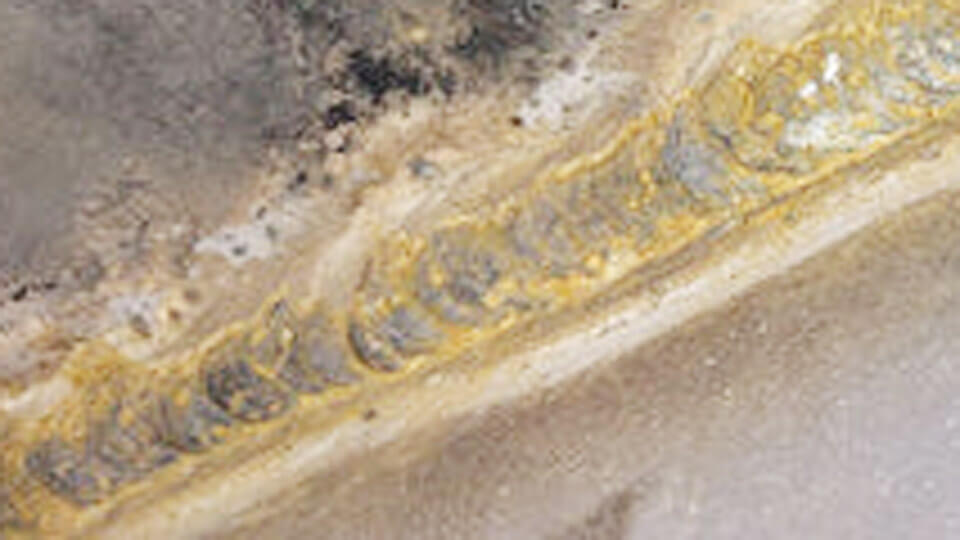
Image by primeweld
Root Causes of Undercut in Welding
Undercut forms when the arc melts base metal faster than filler can replace it at the toes. Three primary drivers dominate in shop practice.
Excessive Heat Input from Amperage and Voltage
High current or voltage drives excessive arc force into the base metal edges, melting a trench the puddle cannot backfill. On ¼-inch mild steel, running 10–15% above optimal amperage widens the pool and pulls molten metal away from the toes before solidification.
High voltage lengthens the arc, spreads heat, and creates the same unfilled groove. In MIG, excessive wire-feed speed compounds this by adding more heat without proportional filler placement.
Travel Speed Too Fast or Inconsistent
When the electrode or gun moves faster than the deposition rate allows, the puddle freezes at the toes before filler reaches them. A 1–2 ipm increase in travel speed on vertical fillets routinely leaves measurable undercut because the molten metal lacks time to wet the edges.
Weave patterns without deliberate hesitation at the toes produce the identical result—localized “fast travel” zones at each reversal.
Incorrect Electrode or Torch Angle and Arc Length
A travel angle steeper than 15° or a work angle that biases heat to one plate directs arc force unevenly. The hotter toe melts while the cooler toe starves for filler. An arc longer than the electrode diameter (example: >⅛ inch for 3/32-inch rod) diffuses energy, increases spatter, and prevents tight wetting.
In fillet welds, failing to direct the arc slightly toward the vertical member lets gravity pull the puddle downward, undercutting the top toe.
Process-Specific Prevention Strategies
Each welding process demands tailored adjustments. Match parameters to material thickness, position, and joint type.
SMAW (Stick) Welding Prevention
Set polarity DCEP for E7018 and most low-hydrogen rods. For ⅛-inch electrodes on mild steel, run 110–160 A flat, dropping 10–20 A vertical or overhead to control fluidity. Maintain arc length no longer than the electrode diameter.
Use a 10–15° drag angle and, if undercut appears on one side, point the rod directly at that toe to force filler metal into the groove. In vertical-up fillets with 7018, pause ½–1 second at each toe during weave passes; the extra dwell time allows the puddle to wash in and tie the toes without sagging.
GMAW (MIG) Prevention
Balance voltage and wire-feed speed so the arc remains short and stable. On 0.035-inch wire and ¼-inch steel, target 22–26 V and 180–250 ipm wire speed in short-circuit or globular transfer; spray transfer needs 28–32 V with 75Ar/25CO₂ and higher WFS.
Push at 10–15° travel angle for gas-shielded mixes; pull for self-shielded. If undercut forms, drop voltage 1–2 V first, then slow travel speed until the toes fill. Pulse or synergic machines simplify this—select the material thickness chart and fine-tune trim for toe tie-in. Keep shielding flow at 25–35 cfh and clean mill scale; contaminants amplify the defect.
GTAW (TIG) Prevention
Lower amperage 15–25% below standard charts on thin material (under ⅛ inch) to limit heat. Use 1.6–2.4 mm tungsten with a 2% thoriated or lanthanated tip sharpened to 30°. Add filler rod at the leading edge of the puddle and maintain a 10–15° torch angle. On aluminum, AC balance set to 65–75% EN prevents excessive cleaning action that erodes edges.
Travel speed must allow the puddle to wet both toes fully; pause slightly on each side during weave if needed. Filler diameter should match or slightly exceed base thickness for adequate deposition without overheating.
FCAW Prevention
Run DCEN for gas-shielded and self-shielded wires. Use 0.045-inch wire at 180–280 A and 22–28 V depending on gas mix. The slag system demands a deliberate pause at the toes of weave beads—½ second per side prevents undercut while the slag blankets the bead.
Vertical-up stringers often outperform wide weaves; if weaving, keep the gun at 45° to the joint and direct slightly upward to counteract gravity.
Joint Preparation and Welding Position Optimization
Clean base metal to bright steel within ½ inch of the joint line. Mill scale, rust, oil, or paint blocks fusion and forces the puddle to undercut rather than wet. Bevel angles of 30–35° per side with 1/16–3/32-inch root face provide enough volume for filler without excess gap.
In T-joints, a 45° work angle biased 5–10° toward the vertical member keeps the puddle centered and prevents top-toe undercut.
Position dictates parameter windows. Flat allows higher amperage and faster travel. Vertical-up requires 10–15% lower heat input and slower travel with stringer or controlled weave. Overhead demands the tightest control—drop amperage another 10 A and shorten arc length to fight gravity-induced sagging.
On-the-Fly Diagnostic Adjustments and Repair
Spot undercut forming? Stop and correct in sequence:
- Reduce amperage/voltage 10% — lowers heat input immediately.
- Slow travel speed until toes fill.
- Re-angle the gun/rod toward the defective toe.
- Shorten arc length.
If the joint already contains undercut, grind to sound metal (remove at least 1/16 inch beyond the groove), preheat if required, then deposit a stringer bead with 10% lower settings. For critical applications, blend toes with a 1/8-inch radius grinder after filling to restore full fatigue strength.
Conclusion
Mastering how to prevent undercut in welding comes down to matching heat input, travel speed, angle, and deposition rate to the exact joint in front of you. Run the numbers—voltage, amperage, and travel speed—before striking an arc, then watch the toes as you weld.
One advanced insight separates consistent pros from the rest: calculate heat input in real time (HI in kJ/in = (voltage × amperage × 60) / travel speed in ipm) and keep carbon-steel welds between 25–35 kJ/in.
That single metric predicts and prevents undercut before it appears, delivering X-ray-quality joints every time.
FAQs
What is the acceptable undercut depth per AWS D1.1?
AWS D1.1 rejects undercut deeper than 1/16 inch (1.6 mm). Depths under 1/32 inch (0.8 mm) are generally acceptable if limited in length; anything a fingernail catches requires repair.
How do I stop undercut on vertical fillet welds?
Drop amperage 10–15%, slow travel speed, pause at each toe during weave, and bias the gun 5–10° toward the vertical plate. Use stringer beads when possible for better control.
Can you weld directly over undercut without grinding?
No. The groove traps slag and creates a stress riser. Grind to sound metal, then refill with lower-heat stringer passes.
Does shielding gas choice affect undercut in MIG?
Yes. Inadequate flow or wrong mixture (too much CO₂) destabilizes the arc and reduces wetting. Use 75Ar/25CO₂ at 25–35 cfh for carbon steel to maintain stable short-arc or spray transfer.
What travel speed range prevents undercut on ¼-inch mild steel?
Target 8–12 ipm for MIG short-circuit and 10–14 ipm for stick in flat position. Adjust slower in vertical or when using weave technique.


