

The wire kept bird-nesting, the arc felt jumpy, and the bead looked like it was sitting on top instead of flowing in. Aluminum will expose every weakness in your setup, especially when your wire speed and voltage aren’t working together. After fighting feed issues and ugly welds, I learned that guessing just doesn’t work with aluminum.
With MIG aluminum, the balance between wire speed and voltage controls arc stability, penetration, and how smooth the bead lays. Too hot and the puddle collapses; too cold and the weld has no fusion.
I learned this through trial, error, and a lot of wasted wire — once I started using a proper aluminum MIG welding wire speed and voltage chart, everything changed.
If you want cleaner arcs, stronger welds, and less frustration when welding aluminum, keep reading. I’ll walk you through how to use the chart the right way, so you can dial in fast and weld with confidence.
Basics of Aluminum MIG Welding
Aluminum MIG welding, or Metal Inert Gas welding with aluminum filler wire, uses a continuous wire electrode fed through a gun, shielded by argon or an argon-helium mix to keep that pesky oxide layer at bay. Unlike steel, aluminum demands pure inert gas—no CO2 blends, or you’ll get porosity like Swiss cheese.
How does it work? Your MIG welder pushes the wire at a set speed while voltage controls the arc length and heat input. Wire speed dictates how much filler metal you’re depositing per minute, and voltage fine-tunes the arc’s stability. Too high voltage, and you get a wide, flat bead with excessive spatter; too low, and it’s erratic with poor wetting.
When should you use it? For anything from automotive frames to aerospace repairs where speed and efficiency trump the precision of TIG.
It’s my go-to for production runs on aluminum extrusions or fixing ATV parts in the garage. Why? It’s faster than stick or TIG, with less cleanup if you dial it in right.
Always clean your aluminum with a stainless steel brush dedicated to aluminum—never use one that’s touched steel, or you’ll contaminate it with iron particles that cause cracking. I learned that the hard way on a custom trailer job; had to grind out the whole seam and start over.
Why Wire Speed and Voltage Settings Are Critical for Aluminum
Ever wonder why aluminum behaves differently? It’s got high thermal conductivity, so heat dissipates quick, requiring higher amps to maintain the puddle. But crank it too high, and you warp thin gauges like 1/8-inch sheet.
Wire speed, measured in inches per minute (IPM), directly ties to amperage—faster speed means more amps. Voltage, usually 18-28 volts for aluminum, affects droplet transfer: Spray transfer is ideal for clean, deep penetration without the globbing you see in short-circuit mode.
Use these settings when you’re aiming for quality on varying thicknesses. For example, on 1/4-inch plate, you’ll want higher speed to fill the joint without overheating.
I once had a trainee set wire speed too slow on a 6061 alloy repair, leading to cold laps. We fixed it by bumping speed 20% and practicing on scrap. Common mistake: Ignoring machine calibration. Test your welder’s output with a meter; cheap units can be off by 10-15%, throwing your chart out the window.
Choosing the Right Aluminum Wire Diameter
Wire diameter isn’t just a detail—it’s foundational. Common sizes for aluminum MIG are 0.030″, 0.035″, and 0.047″. Thinner wire like 0.030″ suits lighter gauges under 1/8-inch, offering better control at lower amps.
How it works: Smaller diameter melts easier, needing less heat, while thicker wire handles higher amps for beefier joints.
When to use each? Go 0.030″ for auto body work or thin tubing; 0.035″ is versatile for most fab jobs like ladders or frames; 0.047″ for heavy plate over 1/4-inch where you need serious deposition.
Why bother? Mismatched diameter leads to feeding issues—thin wire burns back at high volts, thick one starves the puddle.
Tip I’ve shared with countless apprentices: Match wire to your gun’s liner. Aluminum wire’s soft, so use a Teflon liner to prevent kinking. And store it sealed; humidity turns it brittle overnight. I keep mine in a dry box after a batch went bad during a humid summer in Florida.
Decoding the Aluminum MIG Welding Wire Speed and Voltage Chart
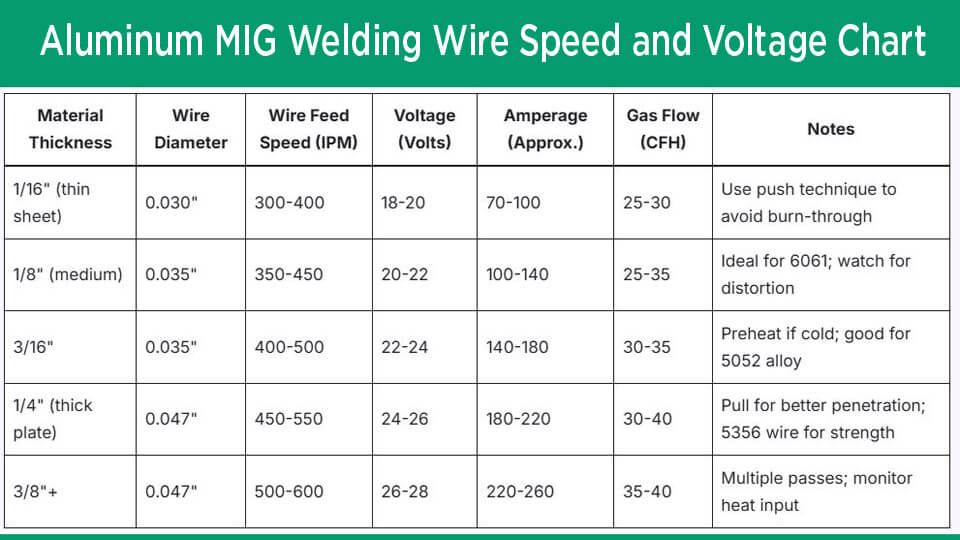
The chart itself. I’ve compiled this from years of testing on machines like Lincoln Power MIGs and Miller Millermatics, common in US shops. These are starting points—tweak based on your setup, gas flow (25-35 CFH argon), and material alloy (like 4043 vs. 5356 filler).
Here’s a comparison table for quick reference:
| Material Thickness | Wire Diameter | Wire Feed Speed (IPM) | Voltage (Volts) | Amperage (Approx.) | Gas Flow (CFH) | Notes |
|---|---|---|---|---|---|---|
| 1/16″ (thin sheet) | 0.030″ | 300-400 | 18-20 | 70-100 | 25-30 | Use push technique to avoid burn-through |
| 1/8″ (medium) | 0.035″ | 350-450 | 20-22 | 100-140 | 25-35 | Ideal for 6061; watch for distortion |
| 3/16″ | 0.035″ | 400-500 | 22-24 | 140-180 | 30-35 | Preheat if cold; good for 5052 alloy |
| 1/4″ (thick plate) | 0.047″ | 450-550 | 24-26 | 180-220 | 30-40 | Pull for better penetration; 5356 wire for strength |
| 3/8″+ | 0.047″ | 500-600 | 26-28 | 220-260 | 35-40 | Multiple passes; monitor heat input |
Consistent results, less trial and error, safer operation. Cons: It’s not one-size-fits-all—factors like joint type (butt vs. fillet) or position (flat vs. vertical) require adjustments. For vertical up, drop voltage 1-2V to control the puddle.
In practice, start at the low end and creep up. I remember a job welding aluminum ramps where we started too hot, causing warp. Dropped voltage to 21V, and it laid flat as a board.
Step-by-Step Guide to Setting Up Your MIG Welder for Aluminum
Setting up isn’t rocket science, but skip a step, and you’re fighting the machine all day.
- Prep your material: Degrease with acetone, brush off oxide. Joint prep—bevel edges for thicker stuff to ensure fusion.
- Select wire: 4043 for general use (flows well), 5356 for higher strength but trickier feed.
- Install spool: Tension just enough to prevent overrun—too tight, and it birds-nests.
- Set gas: Pure argon at 25-35 CFH. Test flow at the nozzle.
- Dial in settings: Use the chart above. For a 1/8″ fillet, try 400 IPM wire speed at 21V.
- Test weld: On scrap matching your project. Adjust if bead’s too crowned (drop speed) or flat (up voltage).
- Weld: Maintain 1/2-3/4″ stickout, 10-15° push angle. Travel speed around 10-15 IPM.
Common fix: If wire stubs, clean contact tip or increase voltage. I’ve trained guys who forgot to switch to drive rolls for aluminum—use U-groove ones, not V for steel.
Common Mistakes in Aluminum MIG Settings and How to Avoid Them
Even seasoned welders slip up. Top one: Running steel settings on aluminum. Steel likes lower volts; aluminum needs more to break through oxide.
Another: Ignoring preheat. Cold aluminum sucks heat, leading to lack of fusion. Warm to 200°F for thick sections.
Pros make this: Overlooking wire quality. Cheap wire has inconsistencies causing erratic feed. Stick to ER4043 from reputable brands like Hobart.
Beginners often set wire speed too high, burning tips. Solution: Monitor amp draw—if it’s spiking, back off.
On a brewery tank repair, I set voltage too low, got porosity. Traced it to low gas flow blocked by spatter. Now, I check post-weld every time.
Joint Preparation Tips for Optimal Aluminum MIG Welds
Joint prep is half the battle. For butt joints, chamfer edges 30° on material over 1/8″ to allow filler penetration.
How it works: Clean prep exposes fresh metal, reducing oxide interference.
When to focus on it? Always, but especially for load-bearing like structural beams.
Why? Poor prep leads to inclusions or weak bonds.
Use a plasma cutter for clean edges, then file burrs. For lap joints, overlap 1-1.5 times thickness. I once skipped deburring on a gate fab, and the weld cracked under weight—lesson learned, always smooth it out.
Filler Metal Compatibility: Matching Wire to Base Aluminum
Not all aluminum plays nice. 6061-T6 base? Use 4043 wire—it won’t crack like 5356 might post-weld.
How compatibility works: Alloys have different chemistries; mismatch causes corrosion or brittleness.
When to check: Every job. Look up alloy specs if unsure.
Practical advice: For marine apps, 5356 resists saltwater better. Store wire properly to avoid contamination.
Mistake I see: Using whatever’s on hand. Led to a failed bike frame weld once—now I triple-check.
Safety Considerations When Adjusting Wire Speed and Voltage
Safety first, always. High voltage means hotter arcs—wear FR clothing, gloves, and a helmet with proper shade (10-13).
Voltage spikes can cause electrical hazards; ground your workpiece securely.
Wire speed too fast? Flying spatter risks burns.
Tip: Ventilate—aluminum fumes aren’t as bad as some, but ozone from the arc irritates lungs. Use exhaust in confined spaces.
I’ve seen guys skip eye protection during setup; one flash burn, and you’re out for days. Don’t be that guy.
Advanced Techniques: Pulsed MIG for Better Aluminum Control
Once basics are down, try pulsed MIG if your machine supports it (like newer Millers). It alternates high/low current for less heat input, reducing distortion.
How it works: Pulses detach droplets cleanly, improving bead appearance.
When to use: Thin materials or cosmetic welds, like furniture.
Why? Better than standard spray for heat-sensitive alloys.
On a custom exhaust, pulsing at 22V base with peaks to 28V gave mirror-like beads. But practice—it’s finicky at first.
Cons: Not all machines have it; settings vary by brand.
Troubleshooting Bad Welds from Wrong Settings
Bead looks porous? Low voltage or dirty material. Fix: Up volts, reclean.
Cracking? Wrong wire or too much heat. Cool slower or switch filler.
Undercut? High travel speed—slow down, adjust angle.
Anecdote: Fixed a pro’s wavy bead by dropping wire speed 50 IPM. Turned out his chart was for steel.
Always inspect post-weld: Tap test for soundness, or dye pen for cracks.
Material Handling Notes for Aluminum MIG Success
Handle aluminum gently—it’s soft, scratches easy, holding contaminants.
Store flat to prevent warping. Cut with carbide tools, not abrasive—grit embeds.
In the shop, segregate from steel to avoid galvanic corrosion.
Tip: For outdoor jobs, cover from rain; moisture causes hydrogen porosity.
I’ve ruined sheets by stacking wet—now everything’s racked dry.
Comparing Aluminum MIG to Other Processes
MIG vs. TIG: MIG’s faster for long seams, TIG better for precision.
Vs. Stick (SMAW): Stick’s portable but messier with flux; rare for aluminum anyway.
Pros of MIG: Efficiency, less skill for basics.
Cons: Gas dependency, wire feeding issues.
For US shops, MIG’s king for volume work like trailers.
Real Fabrication Jobs: Applying the Chart in Action
Take a boat transom repair: 3/16″ 5086 alloy. Set 0.035″ wire at 450 IPM, 23V. Multi-pass fillet, no warp.
Or auto radiator: Thin 0.050″, so 0.030″ at 350 IPM, 19V. Push-pull gun helps feed.
Welded a food truck frame—started with chart, adjusted for vertical sections. Saved hours vs. guessing.
Final Thoughts
Getting your aluminum MIG settings right isn’t about memorizing numbers; it’s about understanding how they interact in the heat of the moment.
You’ve got the chart, the steps, and the fixes now, so next time you’re staring down a tricky aluminum job, you’ll approach it with confidence, wasting less time on do-overs and producing welds that last. Remember, the best welders experiment on scrap first—it’s cheap insurance against costly mistakes.
FAQs
What voltage should I use for 1/8-inch aluminum MIG welding?
For 1/8-inch, aim for 20-22 volts with 0.035″ wire at 350-450 IPM. This gives good penetration without burn-through. Test on scrap, and if it’s spattering, bump gas to 30 CFH.
How do I prevent wire feeding problems in aluminum MIG?
Use a spool gun or push-pull system for soft aluminum wire. Keep tension light, clean the liner monthly, and ensure drive rolls are U-grooved. If it birds-nests, check for kinks in the cable.
What’s the best filler wire for welding 6061 aluminum?
ER4043 is forgiving and flows well for most 6061 jobs. If you need more strength, like in structural work, go ER5356 but preheat to avoid cracking. Match to your base for compatibility.
Why is my aluminum MIG weld porous?
Usually dirty material or insufficient gas shielding. Clean thoroughly, ensure 25-35 CFH flow, and check for drafts. Low voltage can also cause it—up it slightly for better arc coverage.
How does wire speed affect amperage in aluminum MIG?
Wire speed directly ramps amps—faster feed means higher current for more deposition. For balance, pair high speed with moderate voltage to avoid excessive heat. Always monitor your machine’s display for real-time adjustments.


