Rust holes have a way of revealing themselves at the worst time — you start grinding what looks like a small rusty spot, and suddenly the metal opens up like paper. I’ve been there plenty of times, chasing rust that kept spreading until there was more air than steel.
Repairing rusted metal with holes isn’t about slapping a weld over it; it’s about stopping the damage and rebuilding the strength properly.
In real-world welding, rust is your enemy because it weakens the metal and contaminates the weld. If you don’t handle it the right way, you’ll get porous welds, cracking, or patches that fail months later.
I learned through trial, error, and a few redo jobs that proper prep and technique make the difference between a temporary fix and a long-lasting repair.
If you’re dealing with rust holes and want a solid, clean repair that actually holds up, you’re in the right place. I’ll walk you through the practical steps that work in the shop and the garage, so you can fix it once and fix it right.
Photo by goldeagle
Understanding Rust Damage and Holes in Metal
Rust damage starts small but escalates quickly, especially in humid environments or on untreated steel. It’s essentially iron oxide forming when metal reacts with oxygen and moisture, weakening the structure layer by layer.
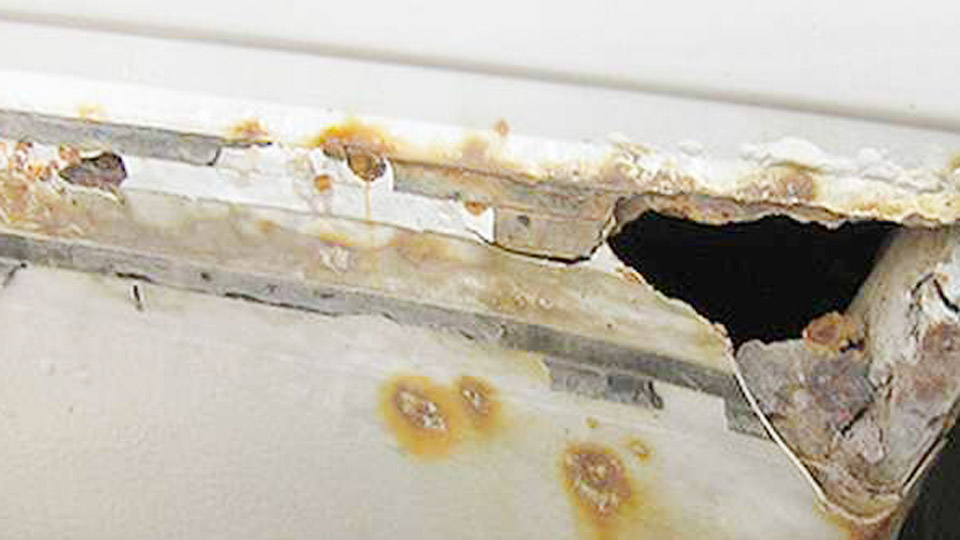
Holes appear when the rust penetrates fully, often in spots like seams, welds, or low points where water pools. I’ve seen this on everything from old gates to industrial machinery—neglect one season, and suddenly you’ve got Swiss cheese metal.
This matters because holes don’t just look bad; they invite more corrosion and reduce load capacity. For instance, in a trailer frame, a small hole can lead to cracking under weight, turning a simple fix into a full replacement. Assessing early saves time and materials.
What Causes Rust and Holes?
Moisture is the big culprit, but salt, chemicals, and poor coatings accelerate it. In coastal areas or winter-road states, road salt eats through undercarriages fast.
Galvanic corrosion happens when dissimilar metals touch, like aluminum on steel, speeding up the process. Holes form in thin-gauge metal first, but even thick plates can develop them if rust pits deeply.
In my shop, I’ve noticed that neglected welds—those with slag inclusions or poor fusion—are prime spots for rust to start. Why use this knowledge? Because preventing holes beats repairing them.
But when they show up, understanding the cause helps choose the right fix, like using stainless patches on high-corrosion areas.
Assessing the Damage Before Repair
Before firing up your welder, get up close. Use a wire brush or grinder to scrape off loose rust and measure hole sizes with calipers. Probe the edges; if metal crumbles, the damage is deeper than it looks. For larger pieces, tap with a hammer—solid metal rings, rusted stuff thuds.
This step is crucial for safety and efficiency. I’ve had jobs where what looked like a pinhole turned out to be widespread thinning, forcing me to cut out bigger sections.
Check thickness with a micrometer; if it’s below 50% original, consider reinforcing or replacing. Poor assessment leads to welds that pop under stress, wasting filler and time.
Shop tip: Light it up with a flashlight from behind the hole to spot hidden thinning. And always wear gloves—rust edges are sharp and tetanus isn’t fun.
Preparing the Metal for Repair
Prep work is where most repairs succeed or fail. Rushing this means contaminants burn into your weld, causing porosity or weak bonds. For rusted metal with holes, it’s about creating clean, stable surfaces for strong fusion.
I’ve botched a few early in my career by skimping here, ending up with bubbly welds that needed grinding out. Now, I treat prep like the foundation of a house—solid or the whole thing crumbles.
Cleaning and Removing Rust
Start by knocking off loose scale with a hammer or chisel, then hit it with a wire wheel on an angle grinder. For stubborn rust, use a chemical remover like naval jelly, but rinse thoroughly to avoid residue. Sandblasting is gold for big jobs, blasting away rust without warping thin metal.
How it works: These methods expose bare metal, essential for weld adhesion. When to use: Always, but especially on painted or coated surfaces. Why? Rust under your weld expands with heat, creating cracks.
Practical tip: Work in sections to avoid re-rusting from humidity. In my humid shop, I wipe with acetone right before welding. Common mistake: Using a dirty wire brush, which just spreads grime—keep yours clean.
Cutting Out Severely Damaged Areas
If rust has thinned metal beyond repair—say, less than 1/8 inch thick—cut it out. Use a plasma cutter for clean edges or a cutoff wheel for precision. Square off holes for easier patching; round ones are trickier to fit.
This technique removes weak material, preventing future failures. Use it when probing shows extensive damage. Why? Patching over thin rust leads to burn-through during welding.
Once fixed a rusted mower deck by cutting a 6-inch hole instead of patching pinholes—saved hours of rework.
Tip: Bevel edges at 45 degrees for better penetration, and clamp a backer plate if metal’s thin to prevent warping.
Choosing the Right Welding Process
Not every process suits rust repairs. Factors like material thickness, location, and your setup dictate the choice. I’ve used all three main ones—MIG, stick (SMAW), and TIG—on rust jobs, each with strengths.
For DIYers, MIG is forgiving; pros might lean on stick for outdoor work. Understanding when to pick what avoids frustration and bad welds.
MIG vs. Stick vs. TIG for Rust Repairs
MIG (Metal Inert Gas) uses wire fed through a gun with shielding gas, great for quick, clean welds on thin to medium steel. It penetrates well on rusted edges but watch for spatter.
Stick welding (SMAW) employs coated rods that create their own shield, ideal for dirty, outdoor repairs since it handles contaminants better. TIG (Tungsten Inert Gas) offers precision with a non-consumable electrode, perfect for thin metal or alloys, but it’s slower.
When to use MIG: Indoor shop fixes on auto bodies. Stick: Field repairs on farm gear. TIG: Critical, aesthetic jobs like stainless exhausts.
Why compare? Wrong choice leads to distortion or poor fusion. I’ve switched mid-job from MIG to stick when gas ran out—stick saved the day on windy sites.
Pros and cons table:
| Process | Pros | Cons |
|---|---|---|
| MIG | Fast, low distortion, easy for beginners | Needs clean surfaces, gas setup required |
| Stick (SMAW) | Portable, tolerates rust/dirt, no gas needed | More slag cleanup, higher heat input |
| TIG | Precise control, clean welds, good for thin metal | Slow, requires skill, expensive setup |
Tip: For holes, MIG with short-circuit transfer minimizes burn-through on thin sheets.
Selecting Materials and Equipment
Materials make or break the repair. Match patch metal to the base—mild steel on mild steel—for compatibility. Electrode choice ties into process and thickness.
I’ve learned the hard way: Using mismatched filler once caused galvanic corrosion on a boat repair, rusting faster than before.
Patch Materials and Compatibility
Use clean, rust-free sheet metal cut to size, overlapping holes by at least 1 inch. For carbon steel, 1018 or A36 works; stainless for corrosive environments.
How it works: Patch bridges the hole, welded around edges for seal. When: For holes up to 12 inches; larger might need frames.
Why: Compatibility prevents cracking from different expansion rates. Tip: Pre-heat thick patches to avoid cold cracks.
Welding Rods and Wire Recommendations
For stick, E6010 or E7018 rods—E6010 digs into rust, E7018 for strong, low-hydrogen welds. MIG wire: ER70S-6 for general steel, 0.030-inch diameter common.
Electrode diameters: 1/8-inch for most repairs, 3/32 for thin metal to reduce heat.
Why these? They match tensile strength and resist corrosion. Mistake: Using too thick a rod burns through—start small.
Anecdote: On a rusted silo, E6010 cleaned the crud, letting me weld without full grinding.
Amperage Settings and Electrode Sizes
Amperage depends on rod size and metal thickness. For 1/8-inch E7018, 90-140 amps; thinner metal, drop to 70-100.
How: Higher amps for penetration, lower to avoid burn-through. Test on scrap.
When: Adjust based on position—overhead needs less to prevent drips.
Tip: Use a chart from your machine manual, but fine-tune by bead appearance—smooth, no undercut.
Common fix: If rod sticks, bump amps; if it burns off, dial down.
Step-by-Step Guide to Patching Holes
Let’s walk through a typical repair, say on a rusted fender. This assumes MIG, but adapt for others.
First, safety gear: helmet, gloves, respirator for fumes.
Preparing the Patch
Measure hole, cut patch 2 inches larger all around. Bevel edges on both for V-groove.
Clean patch with grinder, clamp in place flush or slightly recessed.
Why: Ensures full fusion without gaps.
Tip: Use magnets for holding on curved surfaces.
Tacking and Welding the Patch
Tack at corners with short bursts—10 amps higher than run setting.
Weld perimeter in sections, alternating sides to minimize distortion. Use weave for wider gaps.
How: Maintain 1/8-inch arc, travel speed steady.
When: After tacks hold, check alignment.
Mistake: Continuous welding warps—cool between passes.
Finishing and Grinding
Grind welds flush with flap disc, avoiding thinning base metal.
Apply rust inhibitor or paint immediately.
Why: Protects from re-rusting.
Tip: Stress-relieve with peening if distortion occurs.
This process has saved countless parts in my shop—patience pays off.
Common Mistakes and How to Avoid Them
Beginners often overheat, causing warping—cool with wet rags between passes.
Pros skip prep, leading to porous welds—always clean thoroughly.
Wrong amperage: Too high burns holes; test settings.
Filler mismatch: Causes cracks—match alloys.
Anecdote: Welded a patch with wrong wire once; it cracked in a week. Lesson: Double-check labels.
Avoid by planning: Sketch repair, gather materials first.
Safety Tips for Rust Repair Welding
Welding rusty metal kicks up fumes—use ventilation or respirator.
Eye protection: Auto-darkening helmet essential.
Fire watch: Rust dust is flammable; keep extinguisher handy.
Electrical: Ground properly to avoid shocks.
Why: I’ve seen sparks ignite oily rags—clean workspace.
Tip: Wear leather for sparks; cotton burns.
Advanced Techniques for Larger Holes
For big holes, like in tanks, use backing bars inside for support.
Multi-pass welding: Build up layers for strength.
Butt welds with inserts for seamless fixes.
When: Structural repairs.
Why: Adds integrity.
Tip: Pre-heat to 200°F for thick steel to prevent cracks.
In one job, backed a 2-foot hole in a beam—held up a barn roof fine.
Wrapping Up
I’ve walked you through the gritty details of tackling rusted metal with holes, from spotting the damage to nailing that final grind. Drawing from those long shop nights where a solid patch turned a junker into a keeper, you now have the tools to assess, prep, and weld with confidence.
You’ll sidestep the pitfalls that waste time and materials, like mismatched fillers or rushed preps, and end up with repairs that hold strong under real-world abuse. Whether you’re fixing your own rig or training the next guy, this knowledge means safer, more efficient work—less rework, more satisfaction.
Always run a test bead on scrap from the same material before the real deal; it fine-tunes your settings and saves headaches down the line.
FAQs
Can I weld directly over rust without cleaning?
No, that’s a recipe for weak, porous welds. Rust contaminants cause inclusions that crack under stress. Always grind or blast to bare metal—I’ve tried shortcuts, and they always backfire, leading to do-overs.
What’s the best filler metal for repairing rusted mild steel?
ER70S-6 wire for MIG or E7018 rods for stick. They match strength and resist corrosion. For holes, use low-hydrogen types to avoid hydrogen cracking. Test compatibility on scrap to ensure good fusion.
How do I prevent warping when patching large holes?
Alternate welding sides, use clamps or jigs to hold shape, and cool between passes with compressed air or damp cloths. Start with lower amps and build up. On a big frame repair, this kept everything straight—no distortion issues.
Is TIG welding suitable for rusty metal repairs?
Yes, for precise work on thin or alloyed metals, but it requires thorough cleaning since it doesn’t tolerate contaminants well. Use it indoors with good ventilation. I’ve used TIG on exhaust patches—clean results, but slower than MIG.
What amperage should I use for 1/8-inch holes in 16-gauge steel?
Aim for 80-100 amps on MIG with 0.023 wire, short-circuit mode to avoid burn-through. Adjust based on bead: If it puddles, drop amps. Practice on similar gauge scrap first for the sweet spot.