

Hot metal popping, filler rod sticking when it shouldn’t, and a weld bead that just didn’t look right — that’s the kind of situation that taught me how critical filler choice really is. I’ve stood at the bench wondering why a clean joint suddenly turned brittle or cracked after cooling, only to realize the rod was the wrong match.
That’s why a TIG Welding Filler Rod Selection Chart isn’t just a reference sheet; it’s a shortcut past expensive mistakes I learned the hard way, especially when combined with proper machine setup using Lincoln welder settings chart.
After years of TIG welding stainless, mild steel, and aluminum on real job sites, I’ve seen how the right filler improves arc control, strength, and even saves gas and time. The wrong one? It can ruin a perfect prep job and compromise safety without warning.
If you want cleaner beads, stronger joints, and fewer do-overs, let me walk you through the approach that actually works — step by step, from the shop floor.
Why Filler Rod Choice Can Make or Break Your TIG Weld
Filler rods in TIG welding aren’t just add-ons—they’re the backbone of your weld pool. They add material to fill gaps, strengthen joints, and match the base metal’s properties to prevent issues like corrosion or cracking. Think of them as the glue that holds everything together, but with heat and precision involved.
How does it work?
In TIG (or GTAW, if we’re being technical), you feed the rod manually into the arc created by your tungsten electrode. The rod melts into the pool, blending with the base metal.
Choose a rod that’s too thick, and you’ll struggle with control; too thin, and it’ll burn off too fast. The key is balancing rod diameter with your amperage and the metal’s thickness.
Use it when you’re after high-quality, precise welds on thin materials or where appearance matters, like aerospace parts or custom exhausts. Wrong selection leads to common weld defects like porosity or weak bonds. In my experience, using the wrong rod can even cause rod contamination that ruins your tungsten electrode mid-weld.
In real situations, like welding stainless steel pipes, a mismatched rod can cause intergranular corrosion, turning a simple job into a nightmare recall.
From my shop experience, I once grabbed an ER70S-2 rod for mild steel without checking the base—turned out it had some alloying that didn’t play nice, and the weld cracked under load. Lesson learned: Always match compositions first.
Practical tip: Store rods in sealed tubes to avoid moisture pickup, which causes hydrogen cracking. And always clean them with a dedicated stainless brush before use—no sharing with your base metal tools.
Decoding TIG Filler Rod Classifications and Types
Filler rods come with AWS (American Welding Society) codes that tell you their composition and best uses. For example, ER stands for “electrode or rod,” followed by numbers indicating tensile strength and chemistry.
It works by standardizing rods so you know an ER308L is low-carbon stainless for 304 series metals. These codes guide compatibility—mismatch them, and you’re inviting weld failures.
When to use specific types? For general mild steel, go with ER70S series; aluminum calls for 4xxx or 5xxx. Why? They match expansion rates and strength, reducing distortion.
Shop tip: If you’re new, start with a multipack of common rods to experiment on scrap. I keep a labeled rack in my shop—ER70S-6 for dirty steel, ER4043 for aluminum casting repairs.
Common mistake: Using the same rod for everything. Pros do it sometimes in a pinch, but it bites back on critical jobs. Fix bad welds from wrong types by grinding out and restarting with the right match—better than patching.
Matching Filler Rods to Base Metals: The Core of Selection
The heart of TIG welding is pairing your rod to the base metal. This ensures mechanical properties align, like hardness and ductility.
How? Check the base’s alloy—mild steel to mild steel rod, and so on. Joint type matters too; fillets need more filler than butts.
Use this approach for any project, from auto frames to food-grade tanks. Why? Mismatches cause brittleness or softness where you need toughness.
Anecdote: On a brewery tank repair, I used ER316L on 304 stainless—close, but the molybdenum in 316L prevented pitting in acidic environments. Saved the client from leaks down the line.
Tip: For dissimilar metals, pick a rod that overmatches the weaker one. Clean joints thoroughly; I use acetone wipes before tacking.
Filler Rods for Mild and Carbon Steels
Mild steel is forgiving, but rod choice affects strength. ER70S-2, -3, or -6 are staples—S-6 handles rust better due to deoxidizers.
It melts smoothly into the pool, providing good wetting for clean beads.
When? For structural work like frames or brackets up to 1/2 inch thick. Why? High tensile strength (70,000 psi) matches common steels.
Tip: On thin sheet, dip-feed slowly to avoid burn-through.
Mistake: High amperage melts rods too fast—dial it back to 80-120 amps for 1/16″ rod. Fix distortions by peening the weld while hot.
Filler Rods for Stainless Steels
Stainless demands low-carbon rods like ER308L or ER316L to fight carbide precipitation.
The low carbon (L) keeps welds ductile, resisting cracks.
Use on food processing or exhausts where corrosion resistance is key. Why? Matches austenitic structures for longevity.
Shop story: Welded a marine railing with ER309L for dissimilar joins—held up against salt spray for years.
Common error: Skipping preheat on thicker sections leads to cracks—warm to 200°F.
Tip: When working on critical joints like exhaust pipes, always back-purge with pure argon to prevent ‘sugaring’ or oxidation on the back side of the weld. I’ve also seen how proper parameter setup using a welder settings chart improves consistency on stainless work.
Filler Rods for Aluminum Alloys
Aluminum is notoriously tricky because of its heavy oxide layer. To get the best results with your filler metal, ensure you are properly
balling your tungsten electrode to handle the AC cleaning action required for a clean puddle.
For aluminum, use ER4043 for silicon alloys or ER5356 for magnesium ones.
It flows well, cracking less on heat-treatable alloys.
When welding bike frames or boat hulls. Why? Good fluidity reduces hot cracking.
Tip: Scrub with a stainless brush right before welding; oxide reforms fast.
Anecdote: Fixed a cracked engine block with ER4043—matched the cast aluminum perfectly, no leaks.
Mistake: Dirty rods cause black soot—clean them!
Filler Rods for Exotic Metals Like Titanium or Nickel
For titanium, ER Ti-2 or -5; nickel uses ERNi-1.
They maintain corrosion resistance in harsh environments.
Use in aerospace or chemical plants. Why? High purity prevents embrittlement.
Tip: Glove box welding for titanium to avoid contamination. I’ve seen pros skip it and regret the blue-tinted welds signaling weakness.
TIG Filler Rod Size and Diameter: Getting It Right Every Time
Rod diameter ties directly to material thickness and amperage.
How? Thicker rods carry more current without burning; thinner for precision.
Use 1/16″ for most jobs—versatile from 1/8″ plate down.
Why? Balances feed rate and pool control.
Chart time—here’s a quick reference:
| Base Metal Thickness | Recommended Rod Diameter | Typical Amperage Range (DC) |
|---|---|---|
| Up to 1/16″ | 1/16″ | 50-100 A |
| 1/16″ to 1/8″ | 3/32″ | 80-150 A |
| 1/8″ to 1/4″ | 1/8″ | 120-200 A |
| Over 1/4″ | 5/32″ or larger | 180+ A |
Tip: Cut rods to 18″ for better handling. Mistake: Oversized rod on thin metal causes cold laps—switch down.
Amperage Settings and Their Impact on Filler Rod Performance
Amperage controls melt rate—too low, rod sticks; too high, it vaporizes. Proper setup is easier when referenced with Lincoln welder settings chart.
How? Start at 1 amp per 0.001″ thickness, adjust based on rod size.
Use DCEN for steels, AC for aluminum to clean oxides.
Why? Proper heat ensures fusion without defects.
Tip: Pulse settings help on thin stuff—I’ve used 50% background on aluminum to cut distortion.
Anecdote: Over-amped a stainless job once, burned the rod—dropped 20 amps, perfect beads.
Common fix: If rod balls up, increase travel speed.
Joint Preparation: Setting Up for Success with Your Filler Rod
Prep is half the battle—bevel edges for penetration.
How? Grind a 30-45° bevel on thicker joints.
When? Always, but critical for butts over 1/8″.
Why? Allows filler to fill properly, reducing inclusions.
Tip: Use a dedicated grinder wheel for each metal type.
Mistake: Poor prep leads to lack of fusion—grind deeper.
Safety First: Handling Filler Rods and TIG Welding Hazards
Rods can contaminate if mishandled—wear gloves.
How? Avoid touching the end you’ll feed.
Why? Oils cause porosity.
Tip: UV from the arc is brutal—use #10-12 lens. I’ve skipped ventilation once, got metal fume fever—not fun.
Step-by-Step Guide to Selecting and Using TIG Filler Rods
- Identify base metal and thickness—test with a magnet or spark.
- Match rod type via AWS chart.
- Choose diameter based on thickness.
- Set amperage: 90-130A for 1/16″ mild steel.
- Prep joint: Clean, bevel if needed.
- Tack up, then weld, feeding rod at 15-20° angle.
- Post-weld: Check for cracks, clean slag if any.
Pros of right selection: Strong, aesthetic welds. Cons: Time to learn curves.
Common Mistakes in Filler Rod Selection and How to Avoid Them
Beginners often grab any rod—leads to weak welds. This is where understanding proper material pairing from MIG welding stainless steel settings helps avoid repeat failures.
How to fix: Reference charts always.
Pros might overlook rod condition—bent ones feed poorly.
Tip: Straighten or toss them.
Anecdote: Rushed a job with wrong aluminum rod—cracked on cooling. Slow down, double-check.
Advanced Tips for Pro-Level TIG Filler Rod Mastery
Mix rods for custom alloys? Rare, but possible on repairs.
Use filler for buildup on worn parts.
Why? Restores without full replacement.
Tip: Layer thin, peen between for stress relief.
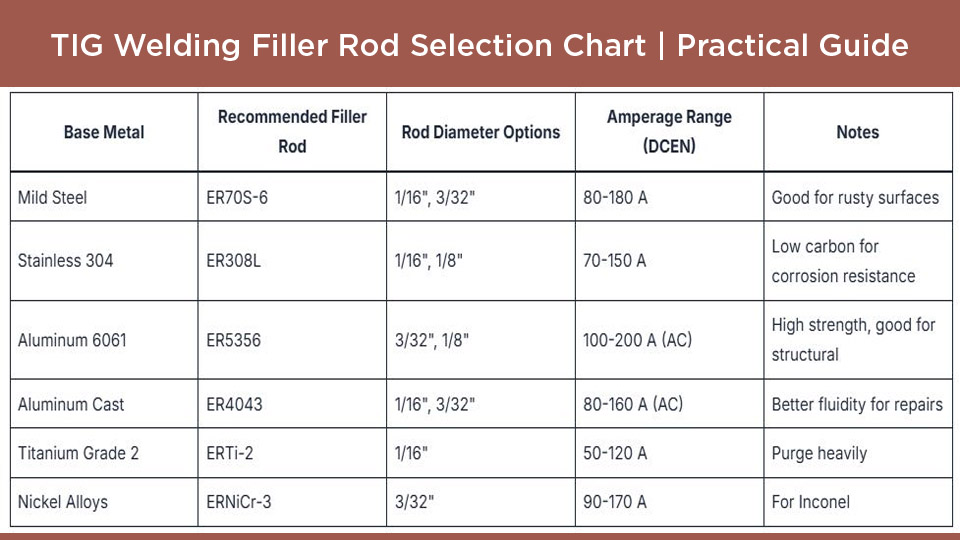
TIG Welding Filler Rod Selection Chart: Your Go-To Reference
Here’s a comprehensive chart compiling common matches. Use it as a starting point—always verify with material specs.
| Base Metal | Recommended Filler Rod | Rod Diameter Options | Amperage Range (DCEN) | Notes |
|---|---|---|---|---|
| Mild Steel | ER70S-6 | 1/16″, 3/32″ | 80-180 A | Good for rusty surfaces |
| Stainless 304 | ER308L | 1/16″, 1/8″ | 70-150 A | Low carbon for corrosion resistance |
| Aluminum 6061 | ER5356 | 3/32″, 1/8″ | 100-200 A (AC) | High strength, good for structural |
| Aluminum Cast | ER4043 | 1/16″, 3/32″ | 80-160 A (AC) | Better fluidity for repairs |
| Titanium Grade 2 | ERTi-2 | 1/16″ | 50-120 A | Purge heavily |
| Nickel Alloys | ERNiCr-3 | 3/32″ | 90-170 A | For Inconel |
Pros: Quick reference.
Cons: Doesn't cover all alloys—consult manufacturer for specifics.
Material Compatibility: Ensuring Your Rod and Base Play Nice
Compatibility prevents galvanic corrosion.
How? Check alloy charts—silicon in ER4043 aids aluminum flow.
When joining dissimilar? Use overmatching rod like ER309 for carbon to stainless.
Why? Bridges properties.
Tip: Test on scrap first. I’ve welded copper to steel with silicon bronze—worked for non-structural.
Cost Considerations in Filler Rod Choices
Cheaper rods might have impurities—stick to reputable brands.
How? Buy in bulk for commons.
Why? Saves rework costs.
Tip: Recycle scraps for practice.
Shop-Tested Advice for Better Welds
In my years, I’ve found preheating aluminum to 200°F cuts cracking. For stainless, walk the cup for steady beads.
Mistake: Fast travel—slow down for full fusion.
Fix: If porosity hits, check gas flow—15-20 CFH usually.
Wrapping Up
It’s clear that proper filler selection and machine setup go hand in hand, especially when using tools like the Lincoln welder settings chart for consistency across different metals and applications.
No more guessing games or wasted material—you’re equipped to tackle jobs with confidence, whether it’s a quick fix or a full fab. Remember, the best welds come from practice, so grab some scrap and experiment.
One pro tip to leave you with: Always dip the rod end in the pool before pulling back—it ensures contamination-free starts every time.
FAQ
What size TIG filler rod should I use for thin sheet metal?
For sheets under 1/16″, stick with 1/16″ diameter rods. They melt controllably at lower amps (50-100A), preventing burn-through. Feed slowly, and use pulse if your machine has it.
How do I know if my filler rod is contaminated?
Look for black specks or erratic melting. Clean with emery cloth, and store in dry tubes. If it’s bad, it’ll cause porosity—toss it and start fresh.
Can I use the same filler rod for aluminum and steel?
No, that’ll cause brittle welds. Aluminum needs 4xxx/5xxx series; steel ER70S. Mismatch leads to cracks—always match base metal.
What’s the best amperage for 1/8″ stainless with 3/32″ rod?
Aim for 100-160A DCEN. Start low, ramp up for penetration. Too high burns the rod; too low, no fusion. Test on scrap.
Why does my TIG weld crack with the wrong filler rod?
Mismatched thermal expansion or chemistry causes stress. Fix by grinding out, reheating, and rewelding with the correct rod like ER5356 for 6061 aluminum.
Read More TIG Welding Related Posts:
- How to Ball Tungsten for Aluminum TIG Welding?
- How to TIG Weld Different Thickness Metals: Pro Guide
- TIG Welding Without Foot Pedal | Practical Guide
- Pulsed TIG for Aluminum | Practical Welding Guide
- What Is the Best Gas for TIG Welding? Practical Guide
- TIG Welding Amps to Metal Thickness Chart | Guide


