
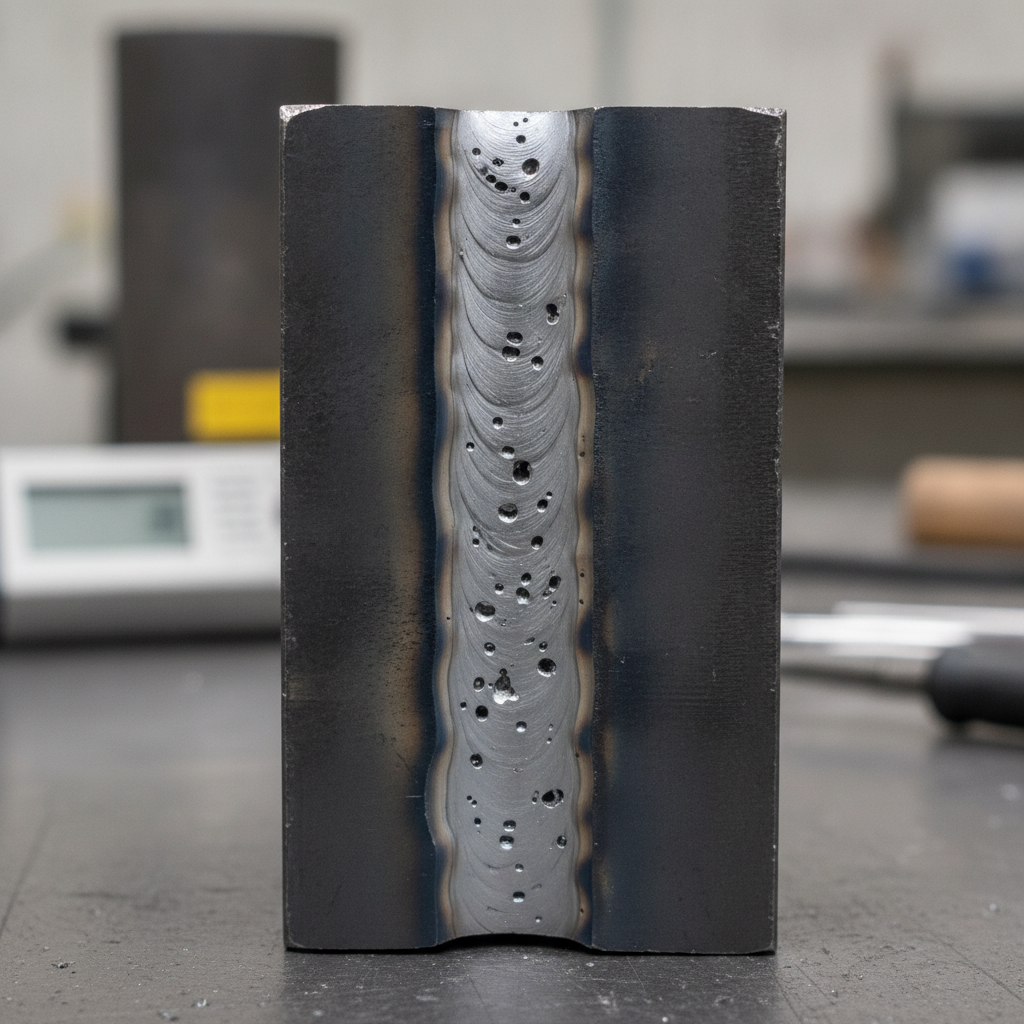
Porosity is one of the most frustrating problems in MIG welding. You lay down what looks like a decent bead, then grind it back or cut a cross-section and find it riddled with holes. Those voids weaken the weld, cause it to fail inspection, and often mean grinding everything out and starting over. This article explains exactly why MIG welds go porous, what’s actually happening inside the weld pool, and the practical steps you can take to eliminate the problem for good.
MIG welds become porous when gas gets trapped inside the solidifying weld pool. The most common causes are inadequate shielding gas coverage, contaminated base metal or wire, moisture, and incorrect welding parameters. Fixing porosity means identifying which of these factors is present and correcting it before welding.
What Porosity Actually Is (And Why It Matters)
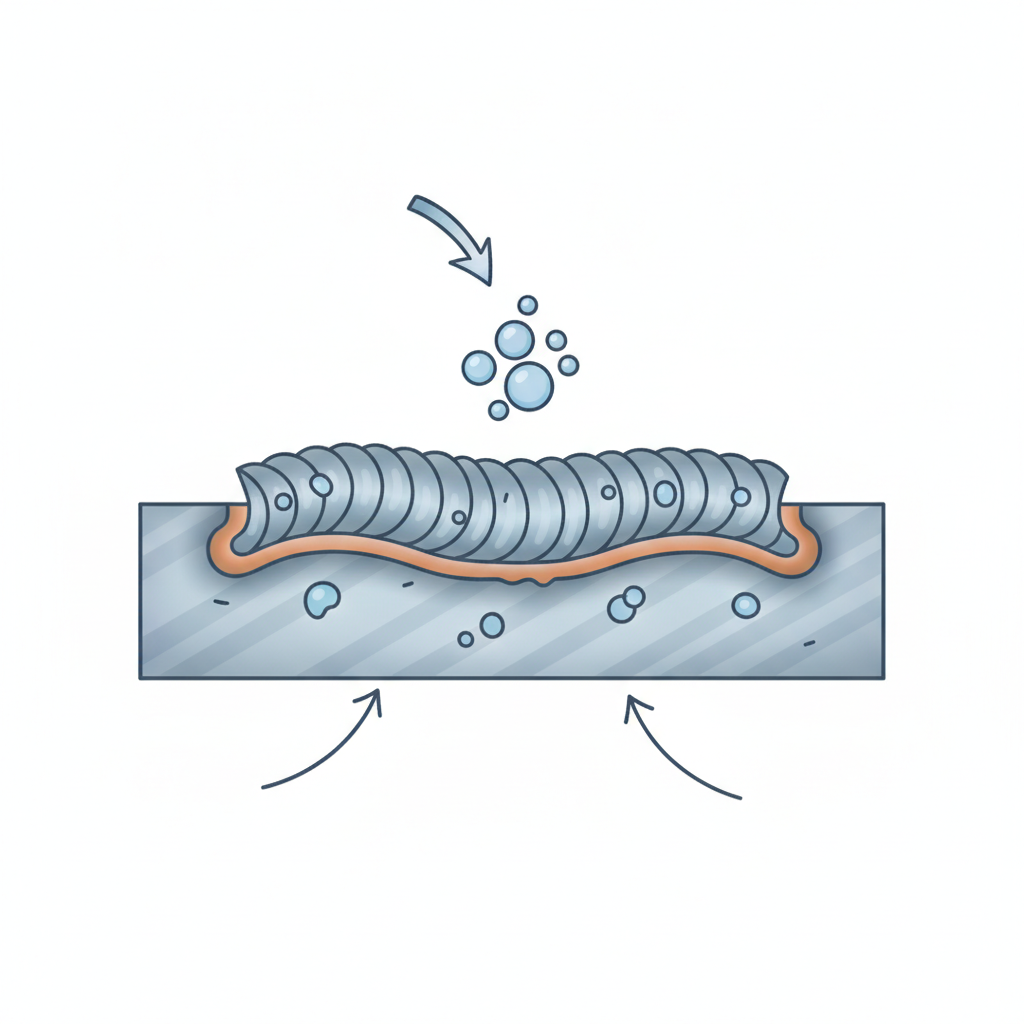
Porosity refers to gas pockets or voids that form inside a weld as it solidifies. During the welding process, the weld pool is molten for a brief window. If gas is present in that pool and can’t escape before the metal freezes, it gets locked in as a bubble.
These voids range from tiny pinhole clusters just below the surface to large internal cavities that compromise structural integrity. In critical applications — pressure vessels, structural steel, automotive chassis — porosity is a weld defect that fails inspection under AWS D1.1, ISO 5817, and similar standards.
Even in non-critical work, a porous weld is a weak weld. The cross-sectional area carrying load is reduced, and the voids act as stress concentration points where cracks initiate.
The Main Causes of Porosity in MIG Welding
Understanding the root cause is the fastest path to a fix. Most porosity problems fall into one of these categories.
1. Shielding Gas Problems
This is the single most common cause of MIG weld porosity. The shielding gas — typically 75% argon / 25% CO₂ (C25) for mild steel, or pure argon for aluminum — creates a protective envelope around the arc and weld pool. If that envelope breaks down, atmospheric nitrogen and oxygen contaminate the pool and produce gas pockets.
Common shielding gas failures include:
– Insufficient flow rate — Too little gas and the arc pulls in ambient air. For most MIG applications, 15–25 CFH (cubic feet per hour) is the standard starting range. Thin material and short-circuit transfer often sit at the lower end; spray transfer and thicker material need more.
– Excessive flow rate — Counterintuitively, too much gas creates turbulence that actually draws air into the shielding envelope. Cranking the regulator past 35–40 CFH often makes porosity worse, not better.
– Drafts and wind — Outdoor welding or shop fans blowing across the weld area disperse the shielding gas before it can protect the pool. Even a light breeze of 4–5 mph can strip coverage entirely.
– Damaged or kinked hose — A cracked MIG gun hose or loose fitting introduces air into the gas line. The weld looks like a shielding gas failure even though the regulator reads correctly.
– Empty or low cylinder — As a cylinder empties, pressure drops and flow becomes inconsistent. Always check cylinder pressure before starting a job.
– Contaminated gas — Moisture inside a regulator, a cylinder that’s been stored improperly, or a mixed-up gas supply can introduce water vapor or wrong gas mixtures.
2. Surface Contamination on the Base Metal
The weld pool is extremely reactive at welding temperatures. Any organic or inorganic contamination on the base metal surface can volatilize and generate gas inside the pool.
Contaminants that cause porosity include:
– Mill scale — The dark oxide layer on hot-rolled steel traps gases and resists fusion. It should be ground or wire-brushed off in the weld zone.
– Rust — Corroded steel releases hydrogen and other gases as it melts into the pool.
– Oil, grease, and cutting fluid — These are particularly problematic because they decompose into carbon monoxide and hydrogen at welding temperatures.
– Paint and coatings — Zinc-rich primers, galvanized coatings, and epoxy paints all generate significant gas when burned. Galvanized steel is especially notorious for producing worm-track porosity.
– Moisture — Water on the base metal surface or in a joint gap introduces hydrogen into the pool. Hydrogen porosity is particularly damaging because hydrogen atoms are small enough to diffuse into the metal and cause delayed cracking.
In practice, the fix is straightforward: clean the metal. Use an angle grinder, flap disc, or wire brush to remove contamination at least 1–2 inches on either side of the weld joint. Wipe down with acetone for oil and grease. Don’t skip this step on used steel, structural sections, or anything that’s been sitting in a shop or yard.
3. Wire Quality and Condition
The filler wire itself can be a source of contamination. MIG wire is drawn through lubricants during manufacturing, and while most of this is removed before packaging, wire that’s been stored poorly can accumulate:
– Surface rust — Even light surface oxidation on the wire introduces iron oxide into the pool.
– Drawing lubricant residue — Excessive lubricant on the wire surface burns off and generates gas.
– Moisture absorption — Flux-cored wire (FCAW) is especially sensitive to moisture. Even solid MIG wire stored in humid conditions can pick up enough surface moisture to cause pinhole porosity.
Store wire in sealed containers or bags when not in use. If wire has been sitting on a machine for weeks in a humid shop, it’s worth replacing the spool. Rusty wire should never be used — the cost of a new spool is far less than the cost of grinding out a porous weld.
4. Incorrect Welding Parameters
Even with clean metal and good shielding gas, wrong settings can create porosity.
– Travel speed too fast — Moving the gun too quickly doesn’t allow the pool time to degas. Gas bubbles that would normally float out get frozen in place.
– Voltage too low — A cold, narrow arc produces a stiff, fast-freezing pool. Gas has less time to escape.
– Wire feed speed mismatched to voltage — If the wire feed speed is too high relative to voltage, the arc becomes erratic and shielding coverage becomes inconsistent.
– Stick-out too long — Excessive contact tip to work distance (CTWD) reduces arc stability and can pull shielding gas away from the pool. Most solid wire MIG applications call for ¾” to 1″ stick-out.
– Wrong polarity — MIG welding solid wire requires DCEP (electrode positive). Running DCEN or AC produces an unstable arc and poor shielding effectiveness.
5. Gun Angle and Technique
The angle at which you hold the MIG gun affects how well the shielding gas covers the pool.
A drag angle (also called a push angle depending on convention) of 5–15 degrees from vertical is standard for most MIG work. Excessive gun angle — leaning the gun back more than 20–25 degrees — can push shielding gas away from the leading edge of the pool, leaving it exposed.
Maintaining a consistent travel speed also matters. Stopping and starting, hesitating mid-bead, or weaving too aggressively all create inconsistencies in shielding coverage and pool behavior.
Porosity Troubleshooting at a Glance
| Symptom | Most Likely Cause | First Fix |
|---|---|---|
| Scattered pinholes across the bead | Shielding gas loss or contamination | Check flow rate, hose, fittings |
| Worm-track porosity | Galvanized or coated metal | Grind coating off weld zone |
| Porosity at weld start only | Cold base metal or moisture | Preheat, clean surface |
| Porosity at weld end only | Gas post-flow too short | Increase post-flow time |
| Random large voids | Drafts disrupting shielding | Block wind, increase flow rate |
| Consistent subsurface porosity | Contaminated wire or base metal | Replace wire, clean metal |
How to Prevent Porosity Before You Strike an Arc
Prevention is faster than repair. Run through this checklist before welding:
1. Inspect the gas system — Check hose condition, all fittings, and regulator. Set flow rate to 15–25 CFH and verify it at the gun.
2. Clean the base metal — Grind or brush the weld zone. Wipe with acetone if oil or cutting fluid is present.
3. Check the wire — Look for rust or excessive residue. Confirm the wire matches the base metal and gas combination.
4. Verify settings — Match voltage, wire feed speed, and stick-out to the material thickness and transfer mode.
5. Control the environment — Block drafts. If welding outdoors, use a welding screen or windbreak.
6. Preheat if needed — On cold or thick material, a preheat of 150–250°F drives off surface moisture and slows cooling, giving gas more time to escape.
FAQ
Can porosity be repaired, or does the weld need to be completely removed?
Minor surface porosity can sometimes be repaired by grinding out the affected area to sound metal and re-welding. Subsurface or widespread porosity typically requires full removal of the weld bead. For structural or code work, the repair procedure must meet the same standard as the original weld, and the repaired area should be re-inspected.
Does porosity always show on the surface, or can it be hidden inside the weld?
Porosity can be entirely subsurface and invisible to the naked eye. Surface-breaking pinholes are a visible warning sign, but internal porosity requires non-destructive testing methods like radiographic testing (X-ray), ultrasonic testing (UT), or cross-sectional destructive testing to detect. This is why visual inspection alone isn’t sufficient for critical welds.
Why does my MIG weld only go porous on galvanized or painted steel?
Zinc from galvanized coatings and compounds in paint vaporize at welding temperatures and inject gas directly into the weld pool. This produces a characteristic worm-track or elongated porosity pattern. The fix is to grind the coating off the weld zone completely before welding. If the coating must remain for corrosion protection, use a lower heat input and slower travel speed to allow more time for outgassing.
What’s the difference between porosity and a lack of fusion defect?
Porosity is a gas void inside the weld metal. Lack of fusion is where the weld metal hasn’t properly bonded to the base metal or a previous weld pass — it’s a physical gap rather than a gas pocket. Both are weld defects, but they have different causes. Lack of fusion is typically caused by insufficient heat, wrong gun angle, or contamination preventing bonding. They can sometimes appear similar on the surface but are distinct under cross-section or X-ray.
How does flux-cored wire compare to solid wire for porosity resistance?
Flux-cored wire (FCAW) is generally more tolerant of surface contamination and mild drafts because the flux itself acts as a deoxidizer and provides additional shielding. In outdoor or field welding conditions, FCAW often produces cleaner welds than solid wire MIG. However, flux-cored wire is more sensitive to moisture absorption in the flux, and improperly stored wire can actually produce more porosity than solid wire in controlled conditions.
Is a small amount of porosity acceptable, or is any porosity a problem?
Acceptance criteria depend on the application and governing standard. AWS D1.1 for structural steel, for example, specifies maximum allowable porosity sizes and frequencies for different weld categories. In non-structural or cosmetic work, minor scattered pinholes may be acceptable. In pressure vessel, aerospace, or safety-critical applications, zero porosity is the standard. When in doubt, consult the applicable welding code for the project.
Can wrong shielding gas cause porosity even if the flow rate is correct?
Yes. Using the wrong gas mixture — for example, pure CO₂ on aluminum, or argon/CO₂ on stainless without the correct tri-mix — can produce porosity regardless of flow rate. Each base metal has a recommended gas or gas mixture. Pure argon is standard for aluminum and most stainless applications. C25 (75/25 Ar/CO₂) is the most common choice for mild steel. Always match the gas to the material and process.
Final Thoughts
Most MIG porosity problems trace back to one of three things: shielding gas failure, surface contamination, or wrong parameters. Solving it is a process of elimination — check the gas system first, then the metal prep, then the settings. A systematic approach almost always finds the cause faster than random adjustments. Clean metal, solid gas coverage, and matched parameters are the foundation of a sound, porosity-free weld every time.


