
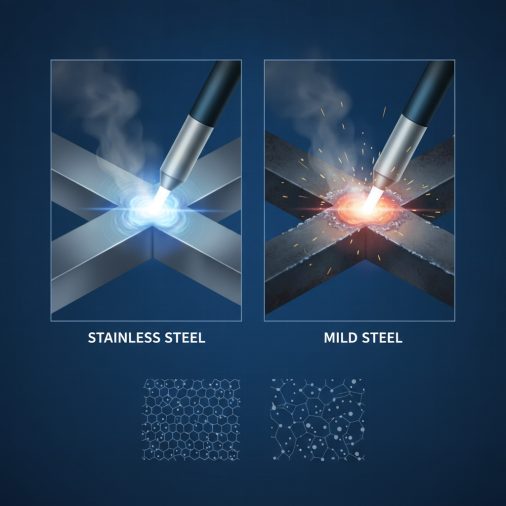
Why Stainless Steel Behaves Differently Than Mild Steel
The Right Wire for MIG Welding Stainless Steel
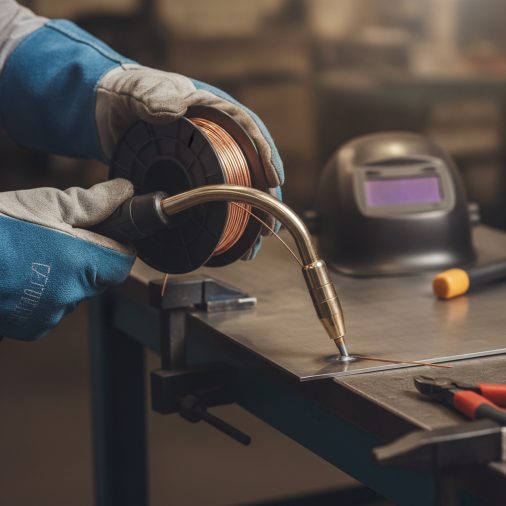
| Wire | Best For | Notes |
|---|---|---|
| ER308L | 304 stainless steel | Most common general-purpose choice |
| ER316L | 316 stainless (marine/chemical environments) | Higher molybdenum for better corrosion resistance |
| ER309L | Welding stainless to mild steel (dissimilar metals) | Handles the metallurgical mismatch between materials |
Shielding Gas: What You Actually Need
This is where most beginners make an expensive mistake. The standard C25 mix (75% argon / 25% CO₂) used for mild steel will contaminate a stainless weld. The CO₂ percentage is too high and causes excessive oxidation, destroying the corrosion-resistant properties of the weld metal. For stainless MIG welding, there are two practical options: Tri-Mix Gas (most recommended) – 90% Helium / 7.5% Argon / 2.5% CO₂ – Produces the best arc stability, bead appearance, and mechanical properties – This is the industry standard for shielding gas when MIG welding stainless steel 98% Argon / 2% CO₂ – More widely available and less expensive than tri-mix – Acceptable results for general fabrication – Slightly less arc stability than tri-mix Pure argon (100%) is typically better suited for TIG welding stainless. Using it for MIG creates a very unstable arc. For a deeper look at how pure argon performs in MIG applications generally, the topic of MIG welding with 100% argon is worth reviewing before making a gas purchase.MIG Welder Settings for Stainless Steel
Stainless steel is punishing when settings are off. Too much heat causes warping and sensitization. Too little leaves cold, porous welds. General starting settings for 0.030″ ER308L wire on 1/8″ (3mm) stainless: – Voltage: 17–19V – Wire feed speed: 250–300 IPM – Gas flow rate: 25–35 CFH – Travel speed: Slightly faster than mild steel to limit heat input – Transfer mode: Short-circuit (for thin material) or spray transfer (thicker stock, needs higher voltage and argon-rich gas) Always run test beads on scrap before welding your actual workpiece. For a full breakdown of machine parameters, MIG welding stainless steel settings covers voltage, wire speed, and gas flow in practical detail. The key principle: keep heat input low and travel speed consistent. Stacking heat into stainless is one of the fastest ways to ruin a weld.Preparing Stainless Steel Before Welding
Contamination is a silent killer with stainless. Even fingerprints or traces of carbon steel can cause rust spots and weld defects. Follow these steps before striking an arc: 1. Clean with acetone or dedicated stainless cleaner — removes oils, grease, and cutting fluids 2. Use stainless-specific brushes — carbon steel wire brushes contaminate the surface; keep dedicated stainless brushes in your shop 3. Avoid using the same grinder discs — grinding wheels used on mild steel can embed iron particles into stainless 4. Clamp carefully — use clean aluminum or copper backing bars rather than carbon steel clamps directly on the weld zone In practice, experienced fabricators keep an entirely separate set of prep tools for stainless work. Cross-contamination from mild steel tools is a more common problem than most beginners expect.Common Problems When MIG Welding Stainless Steel
Warping and distortion Stainless has a high thermal expansion coefficient. Thin sections (under 3mm) warp easily. Use tack welds every few inches, weld in short passes, and allow cooling time between runs. Sugaring on the back side This is the crusty, dark oxidation that forms on the underside of a stainless weld when it’s exposed to oxygen while hot. On pipe or critical applications, purging with argon gas on the back side prevents this. For non-critical fabrication, it’s mostly cosmetic but can cause stress concentration. Discoloration and heat tint Some discoloration is unavoidable, but dark blue or black tinting means too much heat. Light gold is generally acceptable. Pickling paste or electropolishing can restore the surface after welding. Porosity Usually caused by contamination, insufficient gas coverage, or drafty conditions blowing away shielding gas. Check your gas flow rate, inspect for leaks in your hose, and shield your work area from wind. If your welds are consistently coming out rough or porous, reviewing the most common MIG welding mistakes is a useful diagnostic starting point.When MIG Is — and Isn’t — the Right Process for Stainless
MIG welding is practical and efficient for stainless steel fabrication, but it’s not always the best tool for every job. MIG works well for: – Sheet metal and structural stainless fabrication – Production work where speed matters – Thicker sections (3mm and above) – DIY projects and general repair work Consider TIG instead when: – Welding thin material (under 1.5mm) – Cosmetic quality is critical — TIG produces cleaner, more controllable welds – Welding tube and pipe with tight dimensional tolerances – Food-grade or pharmaceutical applications where surface finish must meet regulatory standards If you’re working at home and want to understand the full scope of what’s involved, the guide on welding stainless steel at home safely covers ventilation, safety, and practical setup considerations. For those who prefer stick welding as an alternative, stainless can also be welded with the right electrodes, though it requires more post-weld cleanup. The process for welding stainless steel with an arc welder follows different rules than MIG.Equipment That Handles the Job
Most mid-range multi-process MIG welders handle stainless reasonably well, provided they support the voltage range and wire feed consistency needed for stainless wire. The Lincoln Electric Power MIG 210 MP is a commonly cited example in fabrication shops — it handles both short-circuit and spray transfer modes and pairs well with tri-mix gas for stainless work. A spool gun is generally not required for stainless (unlike aluminum), since stainless wire feeds more predictably through a standard torch liner.FAQ
What wire do I use to MIG weld stainless steel? ER308L is the standard choice for most stainless steel projects, particularly 304-grade material. ER316L is used when higher corrosion resistance is needed — marine environments, chemical processing equipment, or applications involving chlorides. ER309L is the right pick when you’re welding stainless to mild steel. Always choose the “L” (low carbon) variant to minimize the risk of sensitization. Can I use my regular C25 gas mix on stainless steel? No. The 25% CO₂ in C25 is too high for stainless and will cause excessive oxidation, weld porosity, and a loss of corrosion resistance in the weld zone. Stainless requires tri-mix (90/7.5/2.5 helium/argon/CO₂) or at minimum a 98% argon / 2% CO₂ blend. Using the wrong gas is one of the most common — and costly — mistakes when starting with stainless. Why does my stainless steel weld turn black? Black or dark blue discoloration is a sign of overheating and heavy oxidation. It means the heat input was too high, the travel speed too slow, or the shielding gas coverage was inadequate. Light gold or straw color is normal and acceptable. Black indicates the chromium oxide layer has been significantly compromised in that area, which can reduce corrosion resistance. Do I need a special MIG welder for stainless steel? Not necessarily. Most mid-range MIG welders with adjustable voltage and wire feed can weld stainless. The key requirements are compatibility with stainless filler wire and the ability to run with the appropriate shielding gas. A machine that supports spray transfer mode gives you more flexibility on thicker material, but short-circuit transfer is sufficient for most general stainless work. Can I MIG weld stainless steel without shielding gas? No. Flux-core wire designed for stainless exists, but standard gasless flux-core wire is not suitable for stainless. The weld quality, corrosion resistance, and mechanical properties all depend on proper gas shielding. Running stainless wire without gas will result in a heavily oxidized, porous weld with no corrosion resistance. How do I prevent stainless steel from warping when MIG welding? Use tack welds spaced closely together before running full beads. Weld in short, intermittent passes rather than one continuous run. Allow the workpiece to cool between passes — you should be able to touch the metal (carefully) without it being dangerously hot. Clamping or fixturing the workpiece before welding also helps control distortion significantly. What’s the difference between MIG welding 304 and 316 stainless steel? The main difference is in the filler wire, not the process. For 304 stainless, use ER308L wire. For 316 stainless, use ER316L wire, which contains molybdenum to match 316’s enhanced corrosion resistance. The machine settings and gas requirements are essentially the same. Mismatching wire to base metal grade won’t necessarily cause an immediate failure, but it can compromise long-term corrosion performance.MIG welding stainless steel is well within reach for anyone with a capable machine and the right consumables. The process demands more attention to gas selection, wire matching, and heat control than mild steel, but the fundamentals are the same. Get the tri-mix gas, use ER308L or ER316L wire, keep your travel speed up, and keep your prep tools dedicated to stainless. Those four habits will produce clean, corrosion-resistant welds consistently.


