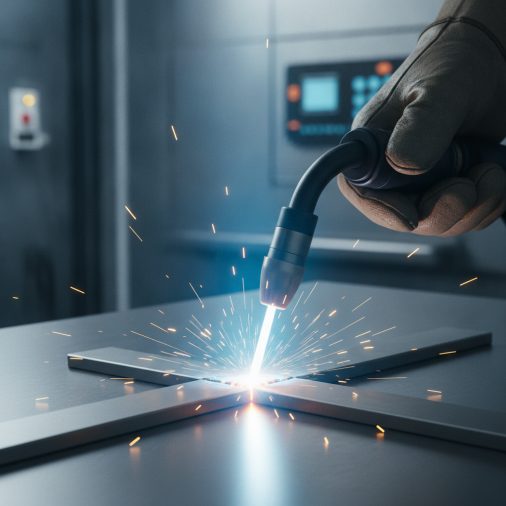
Precision welding on aerospace components, medical devices, or thin exotic metals demands more than a standard TIG setup can reliably deliver. Plasma arc welding fills that gap — offering tighter arc control, deeper penetration, and greater consistency on demanding materials.
Plasma arc welding (PAW) is a high-precision fusion welding process that uses a constricted plasma arc to generate extreme heat — typically between 20,000°F and 30,000°F — in a focused column. Unlike TIG welding, the arc passes through a small copper nozzle orifice that compresses and superheats ionized gas, producing a stiffer, more controllable arc with superior energy density. PAW is used across aerospace, electronics, and precision fabrication for its accuracy and weld quality.
How the Plasma Arc Is Generated
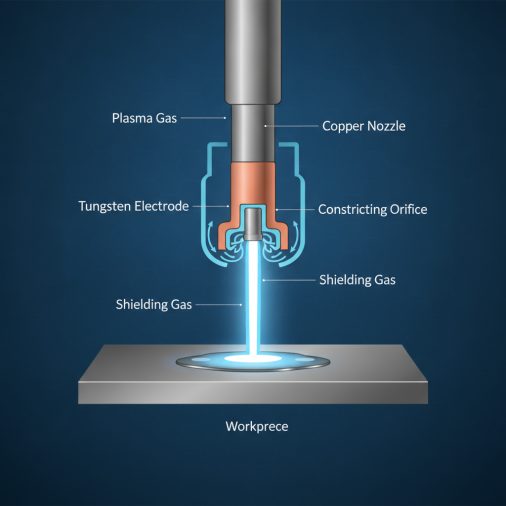
A plasma arc forms when a gas — usually argon or an argon-hydrogen blend — is forced through a small orifice in a water-cooled copper nozzle surrounding the tungsten electrode. An electrical arc ionizes that gas, converting it into plasma: a superheated state of matter with dramatically higher energy density than a standard TIG arc.
Two gas flows are involved:
– Plasma gas — the gas channeled through the nozzle orifice that forms the arc column
– Shielding gas — a separate outer flow (usually argon or argon/hydrogen) that protects the weld pool from atmospheric contamination
This dual-gas configuration is one of the key differences that separates PAW from GTAW. The plasma gas constricts the arc mechanically and thermally, while the shielding gas handles atmospheric exclusion independently.
Transferred vs. Non-Transferred Arc Modes
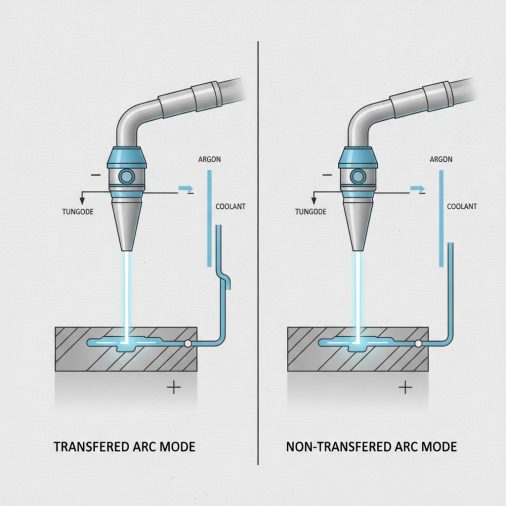
Plasma welding operates in two distinct arc configurations. Understanding the difference matters because they serve completely different purposes.
Transferred arc: The arc forms between the tungsten electrode and the workpiece. This is the standard mode for welding — it delivers maximum heat directly into the base material. Most structural and precision welding applications use this configuration.
Non-transferred arc: The arc forms between the electrode and the copper nozzle, not the workpiece. The plasma jet still exits the torch and produces heat, but the workpiece is not part of the electrical circuit. This mode is typically used for plasma spraying, powder surfacing, and certain thermal applications rather than fusion welding.
For a deeper look at the surfacing side of plasma technology, the plasma transferred arc welding process is particularly relevant in high-wear component repair and hardfacing applications.
Three Operating Modes: Microplasma, Medium Current, and Keyhole
PAW covers an unusually wide current range — from less than 1 ampere up to several hundred amps — which is why it spans from delicate foil welding to full-penetration structural joints.
Microplasma (0.1A – 15A)
Used for extremely thin materials, including foils, fine wire, and medical-grade components. At these current levels, the arc remains stable where TIG would struggle to maintain a consistent arc without burning through. Electronics housings and instrument components often fall into this range.
Medium Current (15A – 100A)
Covers general-purpose precision welding on thin to moderate material thicknesses. This range handles most stainless steel tubing, titanium sheet, and similar applications. Arc behavior at medium current closely resembles TIG but with better directional stability and less sensitivity to standoff variation.
Keyhole Mode (100A+)
At higher currents, the plasma arc’s energy density becomes intense enough to pierce completely through the base material, forming a keyhole — a small hole at the leading edge of the weld pool. As the torch advances, the molten metal flows around the keyhole and fuses behind it, producing full-penetration welds in a single pass on material that would typically require multiple TIG passes.
Keyhole welding dramatically improves productivity on thicker sections and is one of the primary reasons manufacturers choose PAW over TIG for certain production applications.
How PAW Compares to TIG Welding
TIG (GTAW) is the most common reference point for plasma arc welding, since both processes use a non-consumable tungsten electrode and produce high-quality welds on similar materials. The differences, however, are significant in practice.
Feature
Plasma Arc Welding
TIG Welding
Arc constriction
Mechanically constricted via nozzle
Open, unconstricted arc
Arc temperature
~20,000–30,000°F
~10,000–15,000°F
Arc stiffness
High — less arc wander
Moderate — more sensitive to tip distance
Penetration depth
Deeper per pass (keyhole capable)
Shallower; multi-pass on thick material
Minimum current
Down to ~0.1A (microplasma)
Typically 5A+ for stable arc
Equipment cost
Higher
Lower
Setup complexity
More complex (two gas flows, nozzle)
Simpler
Operator learning curve
Steeper
More accessible
Weld quality
Excellent
Excellent
Ideal use case
Precision, production, exotic metals
General fabrication, repairs
In practice, experienced welders often describe the PAW arc as feeling more confident — it doesn’t wander or respond to minor standoff changes the way TIG does. The mechanics behind plasma welding explain why the constricted arc column behaves so differently from a standard GTAW arc.
Materials Commonly Welded with PAW
Plasma arc welding works on most metals that TIG handles, but it particularly excels on materials where arc stability and heat control are critical:
– Stainless steel — tubing, thin-wall vessels, food-grade fabrication
– Titanium — aerospace structures, medical implants, performance components
– Nickel alloys — heat exchangers, turbine components
– Copper and copper alloys — electrical components, heat sinks
– Refractory metals — molybdenum, tantalum, tungsten (with appropriate parameters)
– Carbon steel — particularly in keyhole mode for full-penetration single-pass joints
– Exotic alloys — Hastelloy, Inconel, and similar high-temperature materials
Aluminum can be welded with PAW, but it is less common. TIG typically handles aluminum with AC current more efficiently, while plasma equipment is generally optimized for DC applications.
Shielding and Plasma Gas Selection
Gas selection affects arc behavior, penetration, heat input, and weld appearance.
Argon is the baseline plasma gas for most applications. It produces a stable arc, good penetration, and works across a wide range of materials. Pure argon shielding is standard for titanium, stainless steel, and nickel alloys.
Argon-hydrogen blends (typically 2–5% hydrogen) increase arc energy and improve fluidity of the weld pool. This is especially useful for austenitic stainless steels and nickel alloys where increased heat input improves penetration and surface appearance. Hydrogen must be avoided on carbon steel and ferritic stainless steel due to hydrogen embrittlement risk.
Helium additions increase heat input and arc voltage, useful for improving penetration on thick sections or thermally conductive materials like copper. Helium-argon blends are more expensive but effective for specific applications.
Common Setup Mistakes and Process Challenges
PAW equipment introduces variables that aren’t present in TIG setups. A few recurring issues stand out among welders transitioning from GTAW.
Incorrect plasma gas flow rate. Too little plasma gas produces an unstable, wandering arc that behaves like poor TIG. Too much gas causes arc constriction to become excessive, reducing arc stability and potentially damaging the nozzle. Flow rates for plasma gas are typically much lower than shielding gas — often 0.5 to 3 SCFH depending on mode.
Nozzle wear and contamination. The copper nozzle orifice is precision-machined and sensitive to spatter, contamination, and mechanical damage. A worn or damaged nozzle distorts the arc column and produces inconsistent welds. Regular inspection and replacement is necessary in production environments.
Tungsten setback distance. The distance between the tungsten tip and the nozzle orifice face affects arc characteristics significantly. Manufacturer specifications for tungsten setback should be followed precisely — deviating even 1–2mm changes the arc behavior noticeably.
Incorrect pilot arc settings. PAW requires a pilot arc (a low-current arc maintained between the tungsten and nozzle) to initiate the main transferred arc. If the pilot arc is too weak, the transferred arc fails to establish. If too strong, nozzle erosion increases.
Understanding the full range of plasma welding advantages and disadvantages helps welders make informed decisions before committing to the process.
Typical Applications by Industry
Plasma arc welding is not a generalist process — it earns its place in specific production contexts where its strengths matter most.
Aerospace: Titanium fuselage panels, engine components, sensor housings, and hydraulic tubing routinely specify PAW for its dimensional consistency and low distortion.
Medical devices: Implant-grade titanium and stainless components demand precise, contaminant-free welds. Microplasma welding handles thin-wall tubing and small housings at sub-amp current levels.
Automotive and motorsport: Exhaust manifolds, fuel system components, and suspension parts in exotic alloys benefit from PAW’s single-pass keyhole capability.
Electronics: Hermetic seals on sensors, relay housings, and precision enclosures are often plasma-welded due to the process’s stability at very low currents.
Oil and gas: Tube-to-tubesheet joints in heat exchangers and orbital pipeline welding applications use PAW for consistency in automated setups.
Equipment Overview
A plasma arc welding system is more complex than a standard TIG setup. It typically includes:
– Plasma torch with integrated nozzle and electrode holder
– Power source capable of pilot arc output and precise amperage control
– Two-gas supply system — separate regulators and flowmeters for plasma gas and shielding gas
– Water cooling unit — most production PAW torches are water-cooled
– Control console — manages pilot arc, gas flows, and weld sequence timing
Automated PAW setups are common in production environments and often integrated with orbital welding heads for pipe and tube applications. Manual PAW is used in tool rooms, prototype shops, and repair contexts.
For those working in precision repair applications, the Lincoln Electric Precision TIG 225 is occasionally used as a TIG baseline before stepping up to a dedicated PAW system — though plasma-specific power sources from manufacturers like Thermal Dynamics or Fronius are purpose-built for the process.
FAQ
What is plasma arc welding used for?
Plasma arc welding is primarily used in precision and production applications where TIG welding’s arc stability or penetration capability falls short. Common uses include aerospace titanium structures, medical implants, stainless steel tubing, electronics hermetic seals, and heat exchanger fabrication. The keyhole mode makes it particularly effective for full-penetration single-pass welds on medium-thickness materials.
How is plasma arc welding different from TIG welding?
The core difference is arc constriction. In TIG, the arc spreads freely from the tungsten to the workpiece. In PAW, the arc is forced through a precision nozzle orifice, compressing it into a stiffer, hotter column. This produces better arc directionality, deeper penetration, and stability at much lower currents. PAW equipment is more complex and expensive but outperforms TIG in precision and penetration on demanding applications.
Can beginners learn plasma arc welding?
PAW has a steeper learning curve than TIG or MIG welding due to its additional variables — plasma gas flow, nozzle condition, tungsten setback, and pilot arc management. Most welders benefit from solid TIG experience before transitioning to plasma. The process is learnable, but it typically requires dedicated training and patience with setup before producing consistent results.
What gases are used in plasma arc welding?
Argon is the most common plasma gas, used either pure or blended with 2–5% hydrogen for stainless and nickel alloys. Shielding gas is typically pure argon, or argon-helium blends for higher heat input applications. Hydrogen-containing mixtures must never be used on carbon steel, low-alloy steel, or ferritic stainless steel due to hydrogen cracking risk.
Is plasma arc welding the same as plasma cutting?
No. Both processes use a plasma arc, but plasma cutting uses a much higher-velocity plasma gas jet and typically air or oxygen to melt and blow away material. Plasma arc welding controls heat input precisely to fuse metal without removing it. The equipment, parameters, and torch designs are fundamentally different between the two processes.
What thickness of material can plasma arc welding handle?
In microplasma mode, PAW handles material as thin as 0.1mm. In keyhole mode, it can produce full-penetration welds on carbon steel up to approximately 8–10mm in a single pass without edge preparation. Thicker sections are possible with multi-pass techniques or joint preparation. The wide operating range is one of PAW’s significant practical advantages over other fusion processes.
How does plasma welding compare to laser welding?
Both processes offer high energy density and precision. Laser welding generally achieves even narrower heat-affected zones and faster travel speeds, but requires significantly higher capital investment. Plasma arc welding offers better adaptability to joint fit-up variation, is easier to implement in small shops, and handles a wider material thickness range without as tight a fit-up requirement. Laser welding dominates in high-volume automated production; PAW is more versatile across production volumes.
What PAW Actually Delivers in Practice
Plasma arc welding earns its place when precision, penetration depth, or stability at low currents genuinely matter. It is not a replacement for TIG in general fabrication, nor is it a beginner process. But in the right context — thin titanium, full-penetration tube joints, or production environments where arc consistency translates directly to yield — PAW delivers results that other arc processes simply can’t match at the same consistency level.
The higher equipment cost and setup complexity are real considerations. So is the learning investment. But for shops and industries where weld quality directly affects structural integrity or product performance, those trade-offs are justified.