
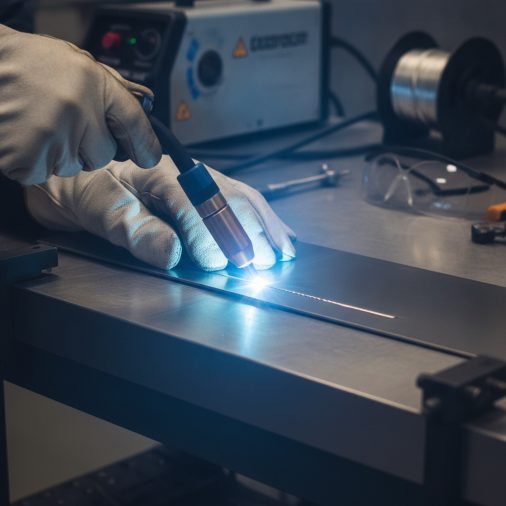
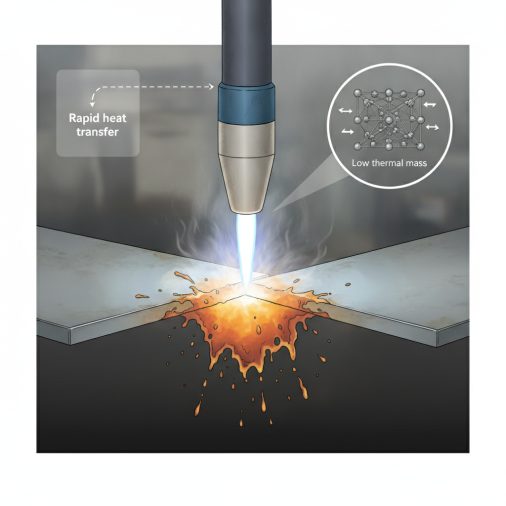
Why Thin Plate Burns Through So Easily
Process Selection: Which Method Works Best on Thin Plate
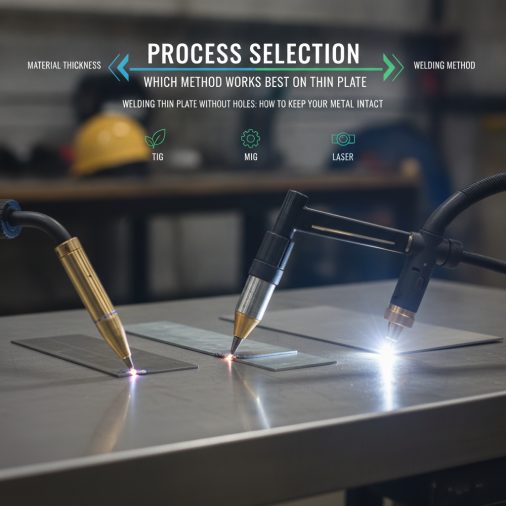
| Process | Minimum Practical Thickness | Heat Control | Skill Required |
|---|---|---|---|
| TIG | 0.5mm (24 gauge) | Excellent | High |
| Short-circuit MIG | 0.8mm (22 gauge) | Good | Moderate |
| Flux-core (FCAW) | 18–16 gauge | Fair | Moderate |
| Stick (SMAW) | 3mm (1/8 inch) | Limited | High |
Amperage and Heat Settings for Thin Plate
Running too much amperage is the single most common cause of holes in thin plate. The goal is the minimum heat needed to achieve proper fusion — not the heat that feels comfortable or produces a fast bead. General amperage starting points for thin steel: – 22 gauge (0.8mm): 20–35A (TIG), 30–50A (MIG short-circuit) – 18 gauge (1.2mm): 30–50A (TIG), 50–80A (MIG short-circuit) – 16 gauge (1.6mm): 40–70A (TIG), 70–100A (MIG short-circuit) – 14 gauge (2.0mm): 60–90A (TIG), 90–120A (MIG short-circuit) – 1/8 inch (3.2mm): 80–120A (TIG), 100–140A (MIG short-circuit) These are starting ranges, not universal constants. Joint configuration, fit-up quality, shielding gas mix, and whether you’re using a backing bar all affect where you land. Always run a test bead on scrap before committing to the actual joint. For MIG work on thin plate, many welders find the Lincoln Electric Weld-Pak 140 responsive enough for light gauge work when dialed in at its lower voltage and wire speed settings.Stitch Welding: The Most Reliable Technique for Avoiding Holes
Stitch welding — welding in short, spaced bursts rather than one continuous bead — is the most practical technique for preventing burn-through on thin plate. Each stitch deposits a small weld, then you move ahead and allow that area to cool slightly before returning for the next. A basic stitch sequence for thin plate: 1. Tack weld the joint at regular intervals first to maintain fit-up and minimize distortion. 2. Set your amperage at the low end of the appropriate range. 3. Run a short weld bead — typically 10–25mm depending on thickness. 4. Move forward past the weld, or skip to a different section of the joint. 5. Allow brief cooling (even 5–10 seconds makes a difference on very thin material). 6. Overlap the next stitch slightly with the trailing edge of the previous one. 7. Continue in a back-step or skip pattern until the joint is complete. Stitch welding manages heat accumulation across the joint. A continuous bead forces heat to build progressively, and by the time you’re halfway down a seam, the metal is already pre-heated to near melting point.Backing Bars and Chill Blocks
A backing bar is a piece of copper, aluminum, or steel placed directly behind the weld joint. It acts as a heat sink, pulling thermal energy away from the base metal and dramatically reducing burn-through risk. Copper is the preferred material for backing bars on steel because it conducts heat well and doesn’t fuse to the weld metal. Aluminum works in a similar way. Steel backing bars can fuse to the weld metal, so they require careful fit-up if used. In practice, even a piece of thick copper bar clamped beneath a butt joint can make welding 18-gauge steel feel noticeably more forgiving. The puddle stays fluid and controlled instead of threatening to drop through. Chill clamps serve a similar function at edges and corners — areas where burn-through happens fastest. Clamping a piece of copper near the edge absorbs the localized heat spike before it can collapse the material.Travel Speed and Torch Angle
Slow travel speed is one of the hidden causes of holes in thin plate. The longer the arc dwells in one location, the more heat accumulates. Moving too slowly is just as damaging as running too much amperage. On thin plate, travel speed should feel brisk and deliberate. The puddle should stay small and tight. If you see the puddle growing wider than the expected bead width, increase travel speed immediately. Torch angle matters too. For TIG, keep the electrode nearly vertical — a steep work angle helps direct heat into the joint rather than spreading it across the surrounding base metal. For MIG, a slight drag or push angle of about 5–15 degrees is typical, but avoid extreme angles that concentrate heat at a single point. Controlling travel speed on thin MIG welds is one of those things that feels awkward at first but becomes instinctive once you’ve run a few feet of practice beads on scrap.Fit-Up Quality and Its Impact on Holes
Poor fit-up creates gaps in the joint that have no backing material beneath them. When the arc hits an unsupported gap, there’s nothing to fuse — the puddle simply drops through. Even a 0.5mm gap in thin plate can cause immediate burn-through. Before welding thin plate: – File or grind edges flat and square where possible. – Use clamps or fixtures to maintain tight contact along the joint. – Tack weld frequently to prevent gaps from opening as heat causes expansion. – Check fit-up by holding the joint up to a light source — any visible light through the joint means the gap needs correction. Joint type also influences difficulty. Butt joints on thin plate are the most demanding because both edges are fully exposed. Lap joints and T-joints are more forgiving because one piece of metal acts as partial backing for the other.TIG Welding Thin Plate: Pulse Mode
For TIG welding thin plate specifically, pulse mode is one of the most effective tools available. Pulse alternates between a high peak current and a lower background current at a set frequency. The peak melts the puddle, and the background maintains the arc while allowing heat to drop slightly between pulses. This cycling effect keeps heat input lower overall while still achieving penetration. On material under 1.5mm, pulse TIG often makes the difference between a controlled, tight bead and a fight against constant burn-through. Pulsed TIG technique applies similar principles whether you’re working aluminum or thin steel. A basic starting point for pulse TIG on thin steel: – Peak current: 80–90% of the normal non-pulsed amperage – Background current: 30–40% of peak – Pulse frequency: 1–2 Hz for manual hand weldingCommon Mistakes That Cause Holes
Most burn-through problems share the same root causes. Recognizing them early saves a lot of frustration. – Starting the arc on an edge or corner — Always start on flatter, more supported areas and move toward edges. – Stopping and restarting too slowly — A hesitant restart piles heat onto an already-hot area. – Ignoring joint gaps — Even small gaps in thin plate invite burn-through at the start. – Welding continuously without breaks — Cumulative heat builds up across the joint faster than it dissipates. – Using the wrong filler diameter — Oversized filler for TIG adds bulk but slows travel speed, increasing heat input. Match filler diameter to base metal thickness. – Wrong shielding gas — For MIG on thin steel, a 75% Argon / 25% CO₂ mix (C25) produces a cooler, more controllable short-circuit arc than pure CO₂.FAQ
What is the thinnest metal you can weld without burning through? With TIG and proper technique, welders regularly work on material as thin as 0.5mm (24 gauge). At this thickness, pulse TIG, copper backing bars, and very low amperage (15–25A) are all necessary. For MIG, 0.8mm is a practical lower limit for most welders. Below these thicknesses, soldering, brazing, or adhesive bonding are often more appropriate. Does stitch welding prevent burn-through on thin plate? Yes — stitch welding is one of the most effective techniques for preventing burn-through. By welding in short segments and allowing brief cooling between passes, heat accumulation across the joint stays controlled. Using a back-step pattern, where each stitch starts ahead of the previous one, further distributes heat input and reduces warping. What backing material works best behind thin plate welds? Copper is the best backing material for thin steel welding. It draws heat away efficiently and doesn’t fuse to the steel weld metal. Aluminum works similarly. Some fabricators use fire-resistant ceramic backing tape for butt welds, which supports the root pass without requiring a solid bar clamped in position. Can you weld thin plate with a stick welder without burning holes? It’s difficult but not impossible. Thin-gauge stick electrodes like 3/32-inch E6013 at low amperage (50–65A) give the best chance on 14-gauge or slightly thicker material. Preventing burn-through when stick welding requires fast travel speed, short arc length, and a skip-weld sequence. Below 3mm (1/8 inch), stick welding is generally not the right process for thin plate. Why does my weld start fine but burn through partway down the joint? Heat accumulation is almost always the cause. As you weld further along a joint, the surrounding metal gradually preheats from conducted heat. By the time you’re a few inches in, the base metal is already significantly warmer than when you started. The solution is to weld in shorter segments, increase travel speed as the joint heats up, or use a stitch sequence with cooling pauses. Does shielding gas mix affect burn-through risk on thin plate MIG? Yes, noticeably. Higher CO₂ content produces a hotter, deeper-penetrating arc — useful on thick plate but problematic on thin material. A 75/25 Argon/CO₂ mix produces a softer, more controllable arc better suited to thin gauge steel. Some welders use 90/10 Argon/CO₂ for even lighter material. Pure Argon is not recommended for steel MIG welding. Is TIG or MIG better for welding thin plate without holes? TIG offers the most control for very thin material because you independently manage heat with the torch and filler addition with your hand. However, short-circuit MIG is faster and more practical for production work on gauges above 18 gauge. For the thinnest materials — under 1mm — TIG is almost always the better choice. For 16 gauge and above, either process works well with proper settings. Welding thin metal without burning through is achievable with both, but TIG gives more margin for error on the lightest gauges.Welding thin plate cleanly takes discipline with heat more than anything else. Lower amperage, faster travel, short stitch sequences, and tight fit-up eliminate most burn-through problems before they start. A copper backing bar behind the joint is often the single biggest improvement a welder can make when struggling with holes. Get those fundamentals right, and thin plate becomes far less intimidating.


