
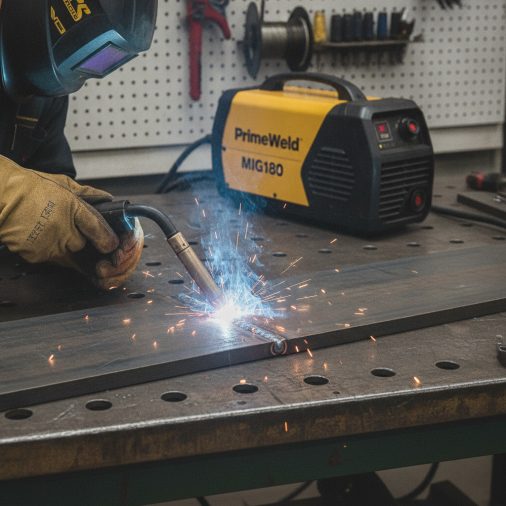
What the PrimeWeld MIG180 Is Actually Rated For
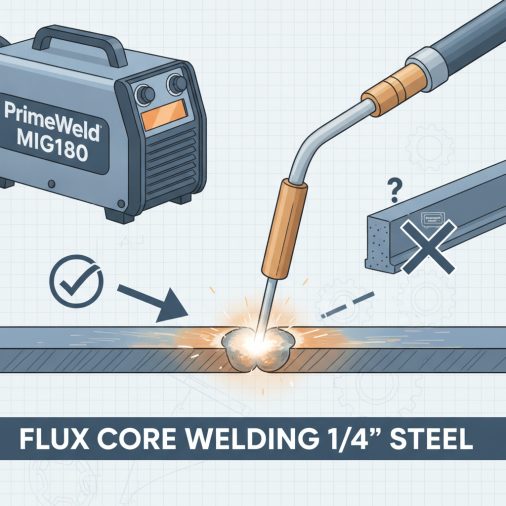
Why Flux Core Works Well for This Thickness
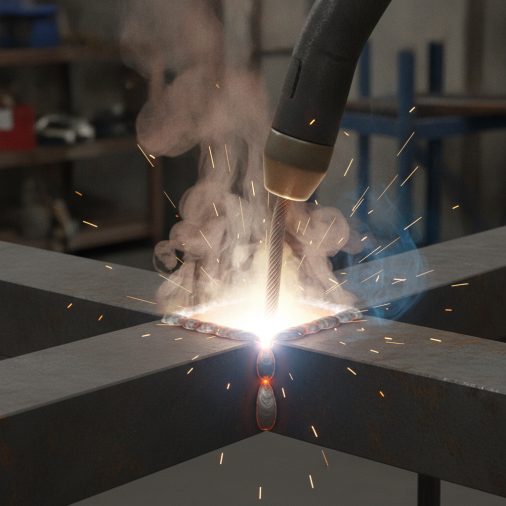
Recommended Settings for Flux Core Welding 1/4″ Steel
Getting the settings right on the MIG180 is more critical at this thickness than it would be on lighter gauge material. A little too cold and you’ll get cold lap — the bead sits on top of the steel without actually fusing into it. Too hot and you can blow through or create undercut. Here’s a practical starting point:| Parameter | Recommended Setting |
|---|---|
| Wire Diameter | .035" self-shielded flux core |
| Voltage | Near maximum (tap 4 on the MIG180) |
| Wire Feed Speed | 280–330 IPM (start at 300, adjust) |
| Polarity | DCEN (electrode negative) |
| Travel Angle | 10–15° drag angle |
| Travel Speed | Slow and steady |
Single Pass vs. Multiple Passes: What Actually Works
At 180 amps with flux core, a single-pass weld on 1/4″ steel is borderline. You may get acceptable fusion on a flat butt joint or fillet weld in the flat position, but you’re riding the edge of the machine’s capability. Multiple passes are the safer and more reliable approach: 1. First pass (root pass): Run at full heat with a tight arc, focusing on fusing both pieces at the root of the joint. Keep travel speed slow enough to fill the joint without rushing. 2. Clean between passes: Use a wire brush and chipping hammer to remove slag. Flux core leaves a slag coating that must be cleaned before the next pass. 3. Second pass (fill/cap pass): Run a slightly wider weave or stringer bead over the root pass to build up full throat dimension. This two-pass approach reliably achieves complete fusion and a weld that actually meets the strength demands of 1/4″ steel joints.Joint Preparation Makes or Breaks the Weld
At this thickness, joint prep isn’t optional. Mill scale, rust, paint, or oil will cause porosity and poor fusion regardless of your settings. – Grind or wire brush the weld zone clean on both pieces – If running a butt joint, bevel the edges at roughly 30–45° to create a V-groove that allows the weld to penetrate fully – Tack weld both ends and the center to control distortion before running the full bead – For T-joints and fillet welds, ensure the joint is tight with minimal gap A clean beveled joint allows even a 180-amp machine to build a structurally sound weld on 1/4″ steel. Without it, you’re relying on surface fusion that may look fine but won’t hold under load.Positions and Their Effect on Results
Welding position significantly affects what the MIG180 can achieve on 1/4″ steel with flux core. Flat position is where the machine performs best. Gravity helps the molten pool fill the joint, and you can run the machine at full output without fighting the puddle. Horizontal and vertical positions are manageable but require faster travel speed or reduced wire feed to keep the pool from sagging. Heat control becomes more important. Overhead welding at this thickness is difficult with any 180-amp machine. If you have overhead joints on 1/4″ steel, consider accessing from a different angle or using a higher-amperage welder.Common Problems and How to Fix Them
Cold lap (bead sitting on top of steel, not fused in): Increase voltage and slow your travel speed. Make sure polarity is set to DCEN. Excessive spatter: Usually caused by voltage being too high relative to wire feed speed. Reduce voltage slightly or increase wire feed speed. Porosity (pinholes in the weld): Check for contamination on the base metal. Also verify the wire isn’t kinked or feeding erratically. With self-shielded flux core, porosity can also indicate wet or damaged wire. Undercut along the toes of the weld: Travel speed is too fast or arc length is too long. Slow down and keep the contact tip closer to the work. These are among the most common MIG and flux core welding mistakes that show up when pushing a welder near its maximum capacity.What to Expect Realistically
The PrimeWeld MIG180 is a capable machine for its class, but it’s honest to acknowledge what it is: a mid-range 180-amp welder suited for fabrication, repairs, and general shop work up to about 3/16″ comfortably. Quarter-inch is doable with proper technique and multiple passes — not a stretch claim, but not effortless either. For occasional 1/4″ welding on non-critical projects like brackets, frames, trailers, or furniture, the MIG180 handles the job well. For high-cycle structural welds where you’re running 1/4″ steel all day, a 200–250 amp machine would be a better fit.FAQ
What flux core wire size should I use with the PrimeWeld MIG180 for 1/4″ steel? Use .035″ self-shielded flux core wire for 1/4″ steel. This diameter provides enough filler metal deposition to fill the joint effectively without exceeding what the machine can drive. Lincoln Electric Innershield NR-211-MP .035″ is a widely used option that works well at the higher amperage range of the MIG180. Does the PrimeWeld MIG180 require gas for flux core welding? No. Self-shielded flux core wire generates its own shielding from the flux inside the wire. The MIG180 can run flux core without a gas cylinder, which makes it convenient for outdoor or field welding. Just confirm the machine is set to DCEN polarity and that you’re using self-shielded wire, not gas-shielded dual-shield wire. Can I weld 1/4″ steel in a single pass with the MIG180? You can attempt a single pass on a flat fillet weld or lap joint in some situations, but fusion reliability is higher with two passes. For anything structurally important, always run a root pass, clean the slag, and follow with a cap pass. Single-pass on 1/4″ at 180 amps is marginal, not ideal. Why are my flux core welds on thick steel looking rough and spattered? Excessive spatter and rough beads on thicker material usually come from polarity being set incorrectly (flux core needs DCEN), voltage and wire feed speed being out of balance, or travel speed being inconsistent. Check polarity first, then fine-tune voltage and wire feed speed together rather than adjusting one at a time. What’s the maximum steel thickness the PrimeWeld MIG180 can realistically weld? PrimeWeld rates the MIG180 for up to 1/4″ with multiple passes in flux core mode. In practice, 3/16″ is the comfortable single-pass maximum. Beyond 1/4″, the machine lacks the sustained output needed for full fusion, and weld quality drops noticeably. For 5/16″ and thicker, a higher-amperage machine is necessary. Is the PrimeWeld MIG180 good for general fabrication work? Yes. For shop fabrication involving mild steel up to 3/16″ regularly and occasional 1/4″ work, the MIG180 is a solid performer. It handles a wide range of welding tasks well within its rated capacity. Understanding what materials and thicknesses a MIG-capable machine can handle helps set realistic expectations before starting a project. Do I need to bevel the edges when flux core welding 1/4″ steel? For butt joints, yes — a 30–45° bevel on each edge creates a V-groove that allows the weld to penetrate to the root rather than just fusing the surface. For T-joints and fillet welds, a bevel isn’t required, but the joint must be tight and clean. Skipping the bevel on butt joints at this thickness is one of the most reliable ways to end up with a weld that looks solid but lacks root fusion.The PrimeWeld MIG180 can weld 1/4″ steel with flux core wire — it’s not marketing fluff, it’s genuinely achievable with the right wire, polarity, settings, and joint prep. Run two passes, clean between them, and the machine delivers solid results. Just don’t treat the 1/4″ rating as a starting point; treat it as the ceiling, and work accordingly.


