

Determining the maximum fillet weld size for plate thickness is critical for structural performance and code compliance. Oversized fillet welds do not automatically increase strength; instead, they can introduce excessive heat input, distortion, residual stress, and unnecessary filler metal cost.
The maximum allowable size depends on plate thickness, joint configuration, and applicable structural codes.
For fillet welds along the edge of a plate, design standards typically limit the maximum leg size to the thickness of the thinner member. When welding to the edge of a plate without beveling, the fillet weld size is generally restricted to avoid overwelding and melting the plate edge.
Structural provisions from organizations such as the American Welding Society—particularly structural welding codes—define these dimensional limits to maintain proper load transfer and effective throat performance.
The following sections explain maximum fillet weld limits by plate thickness, edge conditions, and code considerations, ensuring welds are both structurally sound and fabrication-efficient.
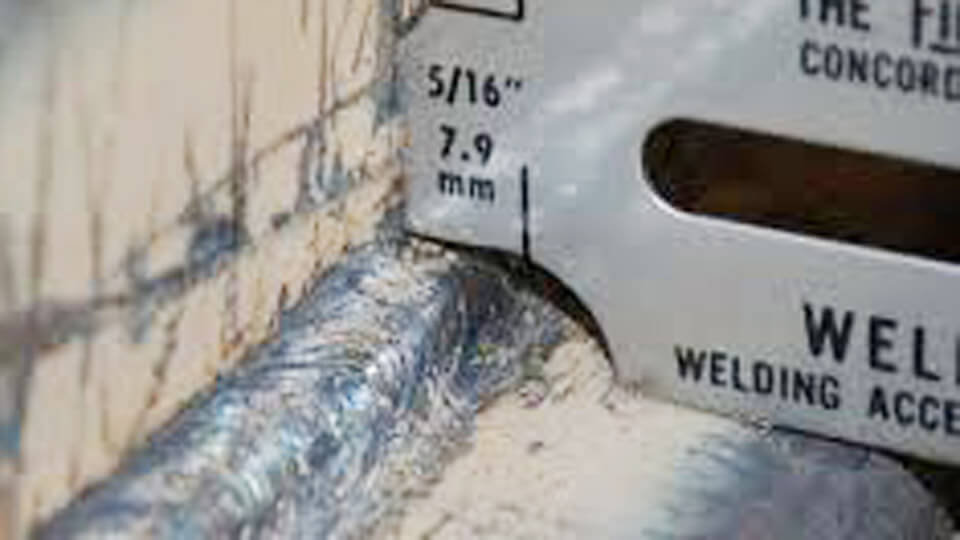
Image ncdot
Fillet Weld Fundamentals and Measurement
Fillet welds are triangular cross-section deposits joining two surfaces at approximately right angles, commonly in tee, lap, or corner joints.
The leg size denotes the distance from the joint root to the weld toe along each base metal surface, while the throat size measures the shortest distance from the root to the weld face.
For equal-leg fillets, the theoretical throat equals leg size multiplied by 0.707 (sine of 45 degrees). Actual throat may vary due to convexity, with maximum convexity limited per AWS D1.1 Table 9.1 to 0.06 inches [1.5 mm] for welds up to 0.31 inches [8 mm] leg size, increasing to 0.19 inches [5 mm] for larger welds.
Joint preparation influences sizing: clean, square edges promote uniform legs, while gaps exceeding 0.06 inches [1.6 mm] require increased leg size by the gap amount to maintain effective throat.
Material compatibility factors in, with Group I and II steels (e.g., ASTM A36, A572 Gr. 50) allowing standard sizing, whereas higher-strength Groups III-V demand qualified WPS for HAZ control.
Quantified data from AWS D1.1 Clause 4.4.2 specifies minimum effective length as four times the leg size, with maximum effective length capped at 100 times leg size for full strength credit in end-loaded connections. For lengths between 100 and 300 times leg size, a reduction factor applies: effective length = actual length × (1.2 – 0.002 × (length / leg size)).
AWS D1.1 Limits on Maximum Fillet Weld Size in Lap Joints
AWS D1.1 Clause 4.4.2.9 establishes the maximum fillet weld size along edges in lap joints to prevent melt-through. For base metal thickness less than 0.25 inches [6 mm], the maximum leg size equals the base metal thickness.
For thicknesses 0.25 inches [6 mm] or greater, the maximum is the base metal thickness minus 0.06 inches [2 mm]. This restriction applies to the detailed weld size on drawings; actual as-welded toe-to-edge distance may be less if the leg size is verifiable.
The rationale involves heat input: larger welds on thin plates increase risk of edge melting, compromising fusion. In prequalified WPS, this limit integrates with Table 5.1 constraints on single-pass sizes. For example, in a lap joint of 0.375-inch [9.5 mm] plates, maximum leg size is 0.375 – 0.06 = 0.315 inches [8 mm – 2 mm = 6 mm].
| Base Metal Thickness (T) | Maximum Fillet Leg Size |
|---|---|
| T < 0.25 in [6 mm] | T |
| T ≥ 0.25 in [6 mm] | T – 0.06 in [2 mm] |
This table derives from AWS D1.1 Figure 5.3 and Clause 4.4.2.9. Exceeding this requires building out the weld face for full throat, but only if specified and qualified.
In tubular lap joints (AWS D1.1 Clause 10), minimum overlap is 1 inch [25 mm], with no upper weld size limit beyond structural design, but the plate thickness rule applies analogously for edge welds.
Minimum Fillet Weld Size Requirements
Complementing maximum limits, AWS D1.1 Table 7.7 defines minimum fillet weld sizes based on the thicker part joined, ensuring adequate heat input for fusion without cracking. For non-low-hydrogen processes without preheat, sizes are:
| Thicker Part Thickness (T) | Minimum Weld Size |
|---|---|
| To 0.25 in [6 mm] incl. | 0.125 in [3 mm] |
| Over 0.25 to 0.50 in [6 to 12 mm] | 0.1875 in [5 mm] |
| Over 0.50 to 0.75 in [12 to 20 mm] | 0.25 in [6 mm] |
| Over 0.75 in [20 mm] | 0.3125 in [8 mm] |
Notes: Weld size need not exceed thinner part thickness. For low-hydrogen processes or with preheat per Clause 5.8, size bases on thinner part, and single-pass not required. Cyclically loaded structures mandate 0.1875 in [5 mm] minimum.
These minima prevent under-welding, which reduces load capacity. For instance, joining 0.50-inch [12 mm] to 0.25-inch [6 mm] plates with low-hydrogen electrodes allows 0.125-inch [3 mm] minimum based on thinner part.
Single-Pass versus Multi-Pass Fillet Weld Constraints
AWS D1.1 Table 5.1 limits maximum single-pass fillet weld sizes in prequalified WPS to control heat input and distortion. Sizes vary by process and position:
| Process | Position | Max Single-Pass Size |
|---|---|---|
| SMAW | Flat | Unlimited |
| Horizontal | 0.50 in [12 mm] | |
| Vertical | 0.375 in [10 mm] | |
| Overhead | 0.3125 in [8 mm] | |
| FCAW/GMAW | Flat | Unlimited |
| Horizontal | 0.50 in [12 mm] | |
| Vertical | 0.625 in [16 mm] | |
| Overhead | 0.3125 in [8 mm] | |
| SAW | Flat | Unlimited |
| Horizontal | 0.625 in [16 mm] |
For multi-pass welds, no code maximum exists beyond design strength and lap joint rules, but practical limits arise from interpass temperature control (minimum 50°F [10°C], maximum per WPS) to avoid HAZ embrittlement.
Deposition rates for multi-pass: FCAW typically 8-12 lb/hr [3.6-5.4 kg/hr] at 250-350 A, depending on diameter (0.045-0.062 in [1.1-1.6 mm]).
Electrode classification impacts: E7018 (low-hydrogen) suits vertical/up positions with slag removal between passes, while E70T-1 (FCAW) offers higher deposition but requires gas shielding for arc stability.
Factors Influencing Maximum Weld Size
Plate thickness directly governs size via heat dissipation: thinner plates (<0.25 in [6 mm]) limit to single-pass to avoid burn-through, with travel speeds 10-15 in/min [250-380 mm/min] at 150-200 A for 0.125-in [3 mm] electrodes.
Material compatibility: Carbon equivalents over 0.45 require preheat (150-300°F [65-150°C]) to extend allowable size without cracking. Polarity: DCEP for deep penetration in GMAW, allowing larger single-pass on thicker plates.
Joint position usability: Overhead limits to 0.3125 in [8 mm] single-pass due to gravity-induced slag entrapment. Arc characteristics: Short-circuit GMAW suits thin plates with lower heat, capping at 0.25 in [6 mm] size, while spray transfer enables 0.50 in [12 mm] on thicker stock.
Common failure causes: Oversized welds induce residual stresses exceeding 50 ksi [345 MPa], leading to distortion up to 0.125 in/ft [10 mm/m]. Quantify via preheat and interpass temps to maintain HAZ hardness below 350 HV.
Practical Applications in Fabrication
In U.S. shop fabrication, apply maximum fillet weld size for plate thickness in stiffener attachments: For 0.50-in [12 mm] plate, max leg 0.44 in [11 mm] in lap configuration, calculated as 0.50 – 0.06 = 0.44 in.
Amperage ranges by rod diameter: 1/8-in [3.2 mm] E7018 at 90-160 A for 0.1875-in [5 mm] leg; 5/32-in [4 mm] at 120-220 A for 0.25-in [6 mm]. Penetration behavior: 20-30% base metal dilution ensures fusion without undercut.
Travel speed influence: 8-12 in/min [200-300 mm/min] for multi-pass maintains bead width 2-3 times electrode diameter, optimizing slag behavior for clean removal.
Case: Welding ASTM A36 plates 0.75 in [19 mm] thick in horizontal lap: Max size 0.69 in [17.5 mm], achieved multi-pass with FCAW at 28 V, 300 A, yielding deposition rate 10 lb/hr [4.5 kg/hr].
This diagram illustrates acceptable fillet weld profiles, with convexity limited per Table 9.1.
Process-Specific Recommendations
Shielded metal arc welding (SMAW): Suits all positions, with E7018 providing low-hydrogen for crack resistance on thicker plates (>0.50 in [12 mm]), allowing multi-pass up to design limits.
Flux-cored arc welding (FCAW): Gas-shielded variants (E70T-1) excel in flat/horizontal for high deposition, but self-shielded (E71T-8) limit to 0.50 in [12 mm] single-pass vertical due to slag volume.
Gas metal arc welding (GMAW): Spray mode at 200-400 A enables larger sizes on thick plates, but requires 90% Ar/10% CO2 for arc stability.
Submerged arc welding (SAW): Automated for flat positions, unlimited size with multi-pass, but joint preparation demands precise fit-up for slag entrapment avoidance.
Electrode classification: Match tensile strength (e.g., E70XX for 70 ksi [485 MPa] yield steels), with polarity DCEP for penetration.
Performance Summary
AWS D1.1 provides precise limits on maximum fillet weld size for plate thickness, emphasizing lap joint restrictions to mitigate melt-through and ensure structural performance. Minimum sizes guarantee fusion, while process-specific single-pass maxima control heat input for HAZ integrity.
Fabrication efficiency improves through quantified parameters like amperage, travel speed, and deposition rates, tailored to material groups and positions. Compliance yields joints with predictable strength, reducing failure risks under static or cyclic loads.
Advanced insight: In high-strength steels (yield >80 ksi [550 MPa]), reduce maximum size by 20% beyond code limits to account for increased HAZ sensitivity, verified through macro-etch testing for fusion depth exceeding 0.125 in [3 mm].
FAQ
What is the maximum fillet weld leg size for a 0.375-inch plate in a lap joint per AWS D1.1?
0.315 inches [8 mm], calculated as plate thickness minus 0.06 inches [2 mm] to prevent edge melt-through.
How does welding position affect single-pass maximum fillet weld size?
Overhead limits to 0.3125 inches [8 mm] for most processes; flat allows unlimited with qualified WPS.
What preheat is required for plates over 0.75 inches when using larger fillet welds?
150-250°F [65-120°C] for carbon equivalents 0.40-0.50, extending allowable multi-pass sizes without cracking.
Can the maximum fillet weld size exceed plate thickness in non-lap joints?
Yes, if structurally required and WPS-qualified, but practical heat input limits apply to avoid distortion.
What electrode diameter supports a 0.50-inch single-pass fillet in horizontal position?
0.062 inches [1.6 mm] for FCAW at 250-350 A, ensuring penetration without excessive spatter.


