
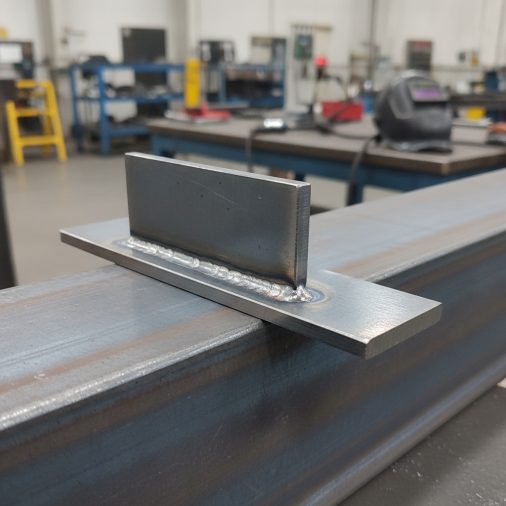
What Is a Sole Plate and Why Does Weld Size Matter?
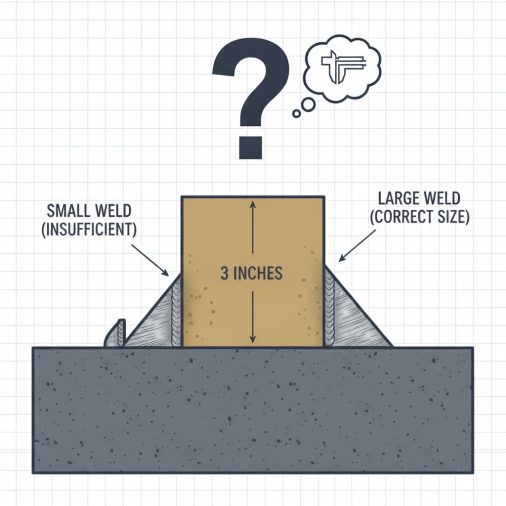
How Plate Thickness Drives Minimum and Maximum Fillet Weld Size
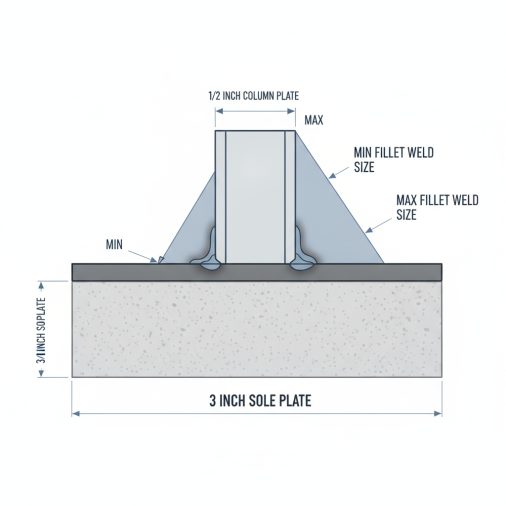
| Plate Thickness (T) | Minimum Fillet Weld Size | Maximum Fillet Weld Size |
|---|---|---|
| T ≤ 1/4" | 1/8" | T (full thickness) |
| 1/4" < T ≤ 1/2" | 3/16" | T − 1/16" |
| 1/2" 3/4" | 5/16" | T − 1/16" |
Typical Weld Details for Sole Plate Connections
In practice, most structural engineers specify sole plate welds in one of two ways: Continuous weld on all edges: – Weld runs fully around the perimeter of the sole plate – Common on heavily loaded bearing plates and column base plates – Provides uniform load distribution and prevents moisture intrusion Intermittent weld: – Weld segments placed at specified intervals – Used when load demands are moderate and distortion is a concern – Less common on sole plates but appears in some light equipment installations For a sole plate under a structural beam, continuous welding on all bearing edges is the standard approach. The typical detail reads something like: “5/16″ fillet weld, all around, continuous.”Factors That Can Require a Larger or Smaller Weld
The 5/16″ default isn’t universal. Several real-world conditions push the required size up or down. Factors that may increase required weld size: – High shear loads transferred through the weld – Eccentric loading on the sole plate – Seismic design requirements – Engineer-specified demand beyond code minimums Factors that may permit a smaller weld: – Thinner sole plate material (per the minimum size table above) – Light equipment mounting with minimal sustained load – Engineer confirmation that minimum code size exceeds calculated demand Always defer to the stamped project drawings. The structural engineer of record calculates the actual demand and specifies accordingly. The code minimums are a floor, not a substitute for engineering judgment.How to Measure and Verify Your Fillet Weld Size
A weld that looks right visually may still be undersized. The leg size of a fillet weld is measured on each leg — from the root to the toe — and must meet the specified dimension. Use a fillet weld gauge to verify the actual deposited weld size. Common gauges like the IWISS 7-Piece Fillet Weld Set allow you to check leg size and throat quickly on flat, horizontal, and overhead welds. If you need a refresher on the measurement process itself, the practical steps for how to measure a fillet weld size correctly are worth reviewing before inspection. The effective throat — 0.707 times the leg size for a standard 45° fillet — is what actually carries the shear stress. On a 5/16″ fillet weld, the effective throat is approximately 0.221″.Common Mistakes When Welding Sole Plates
Field experience surfaces the same errors repeatedly on sole plate welds: Under-welding the corners. Corners are the hardest areas to fill completely. Weld quality degrades there, and inspectors flag them routinely. Take extra time at corners to ensure full fusion. Starting and stopping at the same location repeatedly. Stacking starts and stops creates weak points. Rotate weld passes so starts and stops are staggered around the perimeter. Ignoring preheat requirements. On thicker sole plates (3/4″ and above), especially in colder ambient temperatures, preheat per AWS D1.1 Table 4.2 may be required. Skipping preheat increases the risk of hydrogen-induced cracking. Assuming the plate edge is clean. Mill scale, rust, and paint at the weld joint reduce fusion quality. Grind or wire brush the weld area on both the sole plate and the base metal before welding. Understanding the practical rules of thumb for fillet weld sizing can help you catch errors before they become a failed inspection.Applicable Codes and Standards
Sole plate welds in structural applications fall under these primary governing documents: – AWS D1.1 / D1.1M — Structural Welding Code for Steel. Governs fillet weld minimums, maximums, and quality requirements. – AISC 360 — Specification for Structural Steel Buildings. Addresses design of welded connections. – AISC Design Guide 1 — Column Base Plate Design. Directly relevant when sole plates function as base plates. – IBC / local building codes — May reference AWS D1.1 and AISC as the compliance standard. For industrial equipment installations, additional codes such as ASME or OEM specifications may apply alongside or instead of AWS D1.1.FAQ
What is the standard weld size for a 3/4″ sole plate? For a 3/4″ thick sole plate, AWS D1.1 sets the minimum fillet weld size at 5/16″. Most structural drawings will specify a 5/16″ continuous fillet weld on all edges. The maximum fillet weld permitted on 3/4″ plate is 11/16″ (3/4″ minus 1/16″), though welds that large are rarely needed and would require specific engineering justification. Can you use an intermittent weld on a sole plate? Intermittent welds are permitted by code in some situations but are generally avoided on structural sole plates under beams or columns. Continuous welds distribute the load more uniformly and prevent moisture from entering between the plate and the supporting member. If intermittent welds are shown on the drawing, follow that specification — do not substitute continuous welding without engineering approval. Does weld size change if the sole plate is welded to concrete instead of steel? When a sole plate sits on concrete (not welded to it), the relevant weld is between the sole plate and the steel member above. The welded connection to structural steel follows AWS D1.1. Anchor rods or headed studs handle the connection to concrete — those are governed by ACI 318, not AWS D1.1. The weld size rules discussed in this article apply to the steel-to-steel joint. What happens if the fillet weld is too small on a sole plate? An undersized fillet weld reduces the effective throat, directly reducing the shear capacity of the connection. Under sustained load or dynamic loading, an undersized weld may crack at the root, particularly at corners where stress concentration is highest. This can lead to bearing failure, column settlement, or complete connection failure in severe cases. Is a 1/4″ fillet weld strong enough for a sole plate under a light steel beam? It depends on the plate thickness and the applied load. On plate thicker than 1/2″ and up to 3/4″, the AWS D1.1 minimum is 1/4″ — so that’s the floor, not a guaranteed adequate size. For light loading on thinner plate, 1/4″ may be sufficient. Have the engineer confirm the demand calculation before assuming minimum size equals adequate size. Do sole plates require full-penetration welds instead of fillet welds? In most standard bearing applications, fillet welds are specified. Complete joint penetration (CJP) welds are used when the connection must develop the full strength of the plate in tension — this is unusual for typical sole plates. If your drawings call for CJP welds, that’s an engineer-driven decision based on the specific load case, not a general requirement. What electrode or wire should I use to weld a structural sole plate? For A36 or A572 Grade 50 structural steel sole plates, E70XX electrodes (SMAW) or ER70S-6 wire (GMAW) are the standard matching filler metals. These meet the minimum 70 ksi tensile strength required to match or exceed the base metal strength. Always verify that the filler metal classification matches the base metal specification shown on the project drawings.Weld size on a sole plate isn’t a guess — it starts with plate thickness, follows the AWS D1.1 minimums, and gets confirmed against the engineer’s demand calculation. For most 3/4″ structural sole plates, 5/16″ continuous fillet welds on all edges is the right answer. When in doubt, the stamped drawings and the engineer of record have the final word.


