Pulling dents on auto body panels used to mean cutting access holes or removing interior trim just to reach behind the damage. Stud welding changes that completely — and the Eastwood MIG Stud Weld Kit is one of the more practical tools for getting that job done without a dedicated stud welder.
The Eastwood MIG Stud Weld Kit is an attachment that connects to a standard MIG welder, allowing you to weld small steel studs, pins, and washers directly onto a dented panel. A slide hammer or pulling bridge then attaches to those studs so you can pull the dent outward from the front of the panel — no need to access the back side.
What’s Actually in the Kit
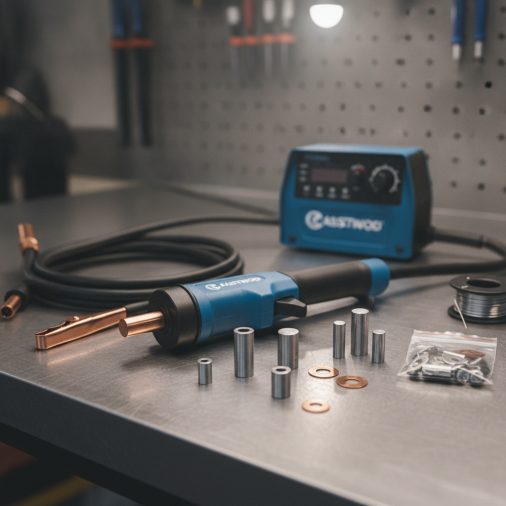
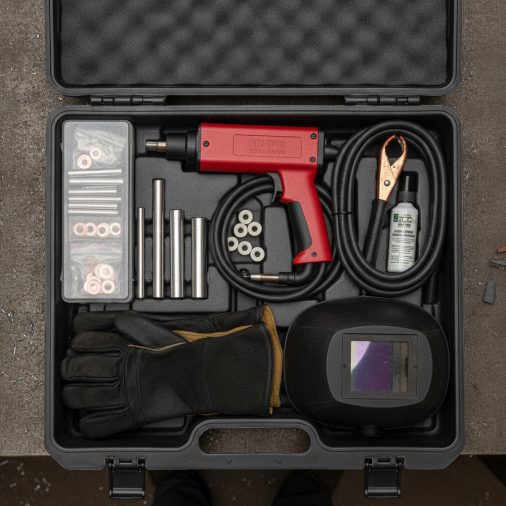
The Eastwood MIG Stud Weld Kit typically includes:
– A stud welding gun attachment that connects to your MIG welder’s output
– An assortment of weld-on studs (various sizes for different pull points)
– Pulling washers for wider surface pulls
– A slide hammer or pulling bar (depending on the kit version)
– A ground clamp for completing the welding circuit
– Stud removal pliers or twist-off tool
The gun body replaces your normal MIG torch for stud welding operations. You’re essentially using your MIG welder’s power source to spot-weld individual studs to the metal surface at precise pull points.
How the Stud Welding Process Works
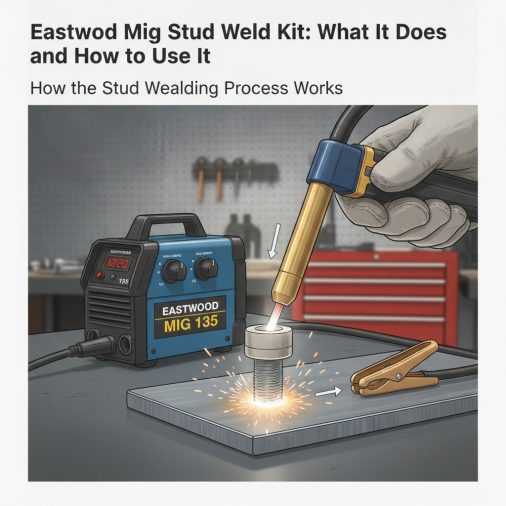
The concept is straightforward. Instead of running a continuous bead, you load a pin or washer into the stud gun tip, press it against the panel, and trigger a short burst of current. That burst fuses the stud to the sheet metal in under a second.
Here’s the basic sequence:
1. Clean the panel surface — grind or sand down to bare metal where you’ll weld
2. Connect the stud gun to your MIG welder’s electrode output
3. Attach the ground clamp directly to the panel near the work area
4. Load a stud into the gun tip
5. Press the tip firmly against the panel and pull the trigger
6. The stud welds in place — repeat across the dent at regular intervals
7. Attach the slide hammer to the welded studs and pull the dent
8. Twist off or grind down the studs once pulling is complete
The whole process works on thin body panels without burning through, provided your welder settings are dialed in correctly.
MIG Welder Compatibility and Settings
This is where most problems occur. The Eastwood stud kit is designed for use with standard MIG welders in the 90–140 amp range — machines common in home garages and body shops. The kit is not meant for flux-core welding; you’ll need shielding gas, typically 75% argon / 25% CO₂.
Recommended starting settings for mild steel body panels (18–20 gauge):
Parameter
Typical Range
Wire size
0.023" – 0.030"
Voltage
Low to medium (adjust by test)
Wire feed speed
Lower than normal MIG welding
Shielding gas
75/25 Ar/CO₂
Stud contact time
Brief trigger pulse only
The key is using a short, controlled pulse rather than holding the trigger. Holding too long burns the stud in deeply and can blow through thin panels. A well-welded stud takes almost no force to install and should withstand firm pulling without releasing.
Ideal Use Cases for the Eastwood Stud Kit
Stud welding makes the most sense when:
– The back side of a panel is inaccessible (door skins, quarter panels, hoods)
– You’re doing collision repair or hail damage work on shallow to moderate dents
– You don’t want to remove interior panels to use a traditional dent hammer
– You’re filling dents before applying body filler and need the metal pulled close to profile
It works particularly well on steel body panels in the 18–22 gauge range. It’s not designed for aluminum panels, which require a different stud welding method entirely.
If you’re working on MIG welding thin sheet metal for other repair applications, the low-heat, short-duration nature of stud welding follows similar principles — minimal heat input to avoid panel warping.
Common Mistakes and How to Avoid Them
Skipping surface prep is the most frequent error. Welding onto paint, primer, or rust produces a cold weld that pops off the moment you apply pull force. Always grind or sand to bare, clean metal at each stud location.
Holding the trigger too long overloads the weld contact and either burns through the panel or creates a mushroomed, oversized weld head that’s difficult to grind clean afterward.
Using too many studs close together concentrates heat and can warp the panel. Space studs out — typically 1–2 inches apart — and work progressively across the dent rather than clustering them.
Poor ground placement is another culprit. If the ground clamp is too far from the work area or clamped onto paint, the arc becomes inconsistent and studs won’t fuse properly. Clamp directly onto clean metal as close to the repair zone as practical.
Pulling the Dent Effectively
Once your studs are welded, the pulling technique matters as much as the welding itself.
– Use controlled, sharp taps with the slide hammer rather than long, forceful yanks
– Work from the outer edges of the dent inward to avoid over-pulling the center
– Check your progress frequently — overpulling creates a high spot that’s harder to fix than a remaining low spot
– For larger dents, use a dent puller bridge across multiple studs for more even force distribution
After pulling, twist off the studs using the included removal tool. Any remaining stud base gets ground flush with a small grinder or sanding disc. Final surface refinement with a body hammer and dolly typically brings the panel within range for skim coating with body filler.
Stud Kit vs. Dedicated Stud Welder
If you’re wondering whether to buy the Eastwood MIG Stud Weld Kit or a standalone stud welder, here’s an honest comparison:
Factor
MIG Stud Kit
Dedicated Stud Welder
Cost
Lower
Higher
Requires existing MIG welder
Yes
No
Weld consistency
Good (settings-dependent)
More consistent
Portability
Limited by MIG welder
More portable
Best for
Occasional repairs, home use
High-volume shop use
Learning curve
Moderate
Low
For a home garage or occasional bodywork, the MIG-based kit is genuinely effective. Field experience shows that once you dial in the settings for your specific welder and panel thickness, results are consistent and reliable. Shops doing daily collision repair typically prefer a standalone unit for speed and repeatability, but that’s a volume argument rather than a quality one.
The Eastwood Stud Welder Kit (their full kit version including slide hammer) is one of the more complete options in this category for home use. The Pro Spot i4s is a common choice at the professional level if you ever find yourself growing out of the MIG-based approach.
FAQ
Can I use the Eastwood MIG Stud Weld Kit with a flux-core welder?
No. Flux-core welding isn’t suitable for stud welding applications. The process requires shielding gas and precise arc control that flux-core setups can’t provide reliably. You need a MIG welder capable of running with 75/25 argon/CO₂ gas to get consistent stud welds on thin body panels.
What gauge sheet metal works best with a stud welding kit?
Stud welding works best on mild steel panels in the 18–22 gauge range, which covers most automotive body panels. Thicker structural steel is too heavy for pulling via studs, and thinner gauges risk burn-through if settings aren’t reduced accordingly.
How do I remove welded studs after pulling a dent?
Most kits include a twist-off tool designed to snap the stud at the panel surface. Alternatively, use locking pliers to twist the stud sideways until it breaks clean. Any remaining base material gets ground flush with a small angle grinder or sanding disc before applying primer or body filler.
Will stud welding warp my body panel?
Minimal warping is possible if too many studs are placed close together or the trigger is held too long. The heat input from a single stud weld is very brief — less than a second — so warping is far less of a concern than with traditional MIG bead welding. Spacing studs properly and working in stages prevents most heat-related distortion.
Can the Eastwood stud kit be used on aluminum panels?
No. This kit is designed for mild steel body panels only. Aluminum requires a specialized aluminum stud welding system that operates on completely different principles, including different electrode materials and process parameters. Attempting to use a standard stud kit on aluminum panels will not produce a reliable weld.
How deep of a dent can be fixed with stud welding?
Stud welding pulls work best on shallow to moderate dents — roughly up to 1–2 inches of depth. Very deep creases or sharp impact damage may require additional bodywork techniques, including slap hammering or sectioning, since the metal has likely stretched beyond what pulling alone can restore to proper profile.
Do I need to reset my MIG welder settings when switching to the stud kit?
Yes, always. Stud welding uses lower voltage and a much shorter trigger duration than standard MIG bead welding. Running your normal MIG settings will burn through panels or over-weld the studs. Start with your welder set to its lowest voltage range and test on a scrap piece of similar gauge steel before moving to the actual panel.
Stud welding with a MIG-based kit is a genuinely practical skill for anyone doing their own auto body work. The Eastwood MIG Stud Weld Kit gives a home-shop welder the ability to tackle front-access dent repair without investing in dedicated equipment — as long as your MIG welder is compatible and you take the time to get your settings right on scrap metal first. Clean prep, dialed-in settings, and a patient pulling technique are what separate clean results from frustrating ones.