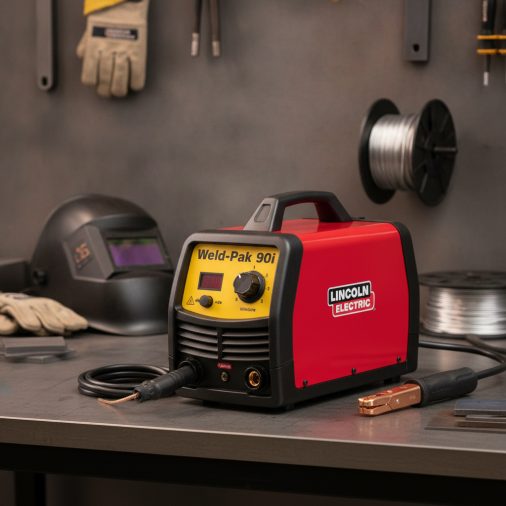
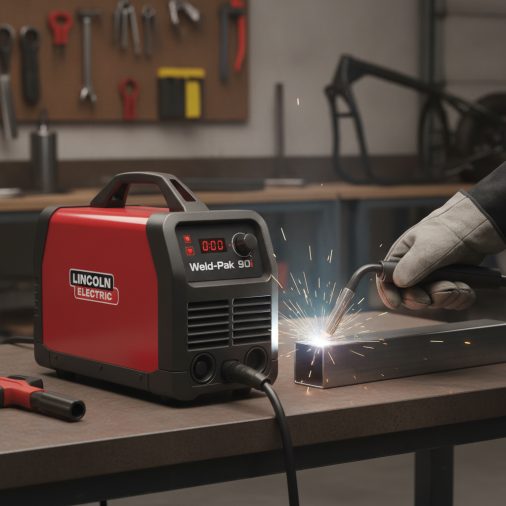
The Lincoln Electric Weld-Pak 90i is one of the more compact inverter-based MIG welders on the market, designed to run off a standard 120V household outlet. If you’re wondering whether it can handle your projects or how to get the best results from it, here’s what you need to know.
The Lincoln Electric Weld-Pak 90i is a 120V inverter-powered flux-core wire welder capable of welding mild steel up to 3/16 inch thick. It uses self-shielded flux-core wire, requires no external shielding gas, and is designed for portability and ease of use. It’s best suited for home repairs, light fabrication, outdoor projects, and beginners getting started with welding.
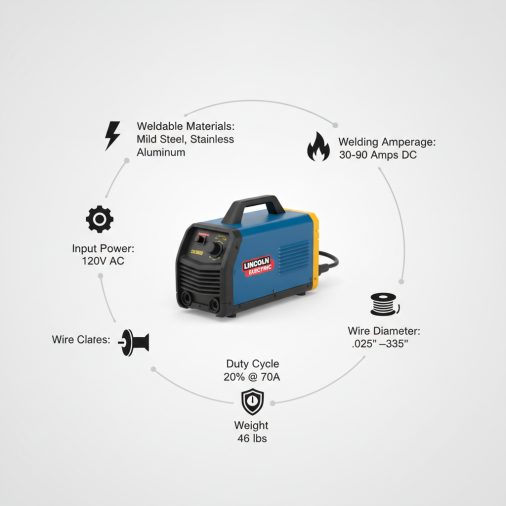
Key Specifications at a Glance
Before getting into the practical details, here’s a quick reference for the machine’s core specs:
Specification
Details
Input Power
120V / 20A
Output Range
30–90 Amps
Duty Cycle
20% @ 90A
Wire Diameter
0.030" – 0.035" flux-core
Weld Capacity
Up to 3/16" mild steel
Weight
Approximately 11 lbs
Process
Flux-Core Arc Welding (FCAW)
Wire Feed Speed
Adjustable
Inverter Technology
Yes
The inverter design is worth highlighting. Unlike older transformer-based machines, the Weld-Pak 90i converts and regulates power electronically, which means it’s significantly lighter and more energy-efficient than comparable output transformer welders.
What the Weld-Pak 90i Is Actually Built For
This machine sits in a specific niche — portable, no-gas, light-duty welding. That context matters a lot when evaluating whether it’s the right tool for your situation.
It excels at:
– Auto body repair patches and thin panels
– Farm equipment fixes and implement repairs
– Gate and fence fabrication
– Outdoor welding where dragging a gas cylinder isn’t practical
– Home workshop projects on mild steel
It is not the right machine for:
– Stainless steel or aluminum without significant setup changes
– Heavy structural welding or thick plate work
– High-volume production welding where duty cycle is a limiting factor
– Applications requiring spray transfer or precise gas-shielded MIG
The 20% duty cycle at 90 amps is a real limitation for longer, continuous welds. In practice, this means you’ll get roughly 2 minutes of welding followed by 8 minutes of cooling at maximum output. For most light repair and hobby work, this is rarely a practical problem, but for longer bead runs on thicker material, it becomes relevant.
Setting Up the Weld-Pak 90i for the First Time
Getting the machine running correctly the first time saves a lot of frustration. The setup is straightforward, but a few details matter.
Wire Installation
1. Open the wire compartment and mount the spool on the spindle
2. Feed the wire through the drive roll and into the liner
3. Tighten the drive roll tension — firm, but not so tight it crushes the wire
4. Press the trigger briefly to feed wire through the gun and out the tip
5. Clip the wire flush with the contact tip
Drive Roll Tension
A common beginner mistake is setting the tension too tight. If the drive roll marks or flattens the wire, it can cause erratic feeding and bird-nesting inside the gun. A simple test: the wire should slip if you pinch it firmly between two fingers while pressing the trigger.
Polarity Check
Flux-core welding typically requires DC electrode negative (DCEN) polarity. On the Weld-Pak 90i, this is set via the polarity connections inside the wire compartment. Check that the work clamp lead and gun lead are connected correctly before your first weld. Running reversed polarity produces a rough, spattery arc with poor fusion — a common cause of frustration during initial setup.
For anyone who’s also worked with setting up a Lincoln 140 MIG welder, the polarity configuration process is similar, just adapted for flux-core rather than gas-shielded wire.
Voltage and Wire Speed Settings
The Weld-Pak 90i uses a two-knob control setup: one for voltage (typically stepped or continuous) and one for wire feed speed. Getting both dialed in together is what produces a clean arc.
A general starting reference for mild steel:
Material Thickness
Approximate Amps
Wire Feed Speed
18 gauge (0.048")
30–40A
Slow
16 gauge (1/16")
40–55A
Slow–Medium
1/8"
60–75A
Medium
3/16"
80–90A
Medium–Fast
These are starting points, not absolutes. You’ll dial in from here based on how the arc sounds. A steady, consistent crackle — often compared to frying bacon — indicates a properly tuned arc. A loud, sputtery pop means too little wire speed or too much voltage. A harsh, stubby arc usually means too much wire speed relative to voltage.
For a more detailed breakdown of Lincoln-specific settings, the Lincoln MIG welder settings chart offers thickness-based guidance that transfers well to flux-core machines.
Flux-Core Wire Selection
The Weld-Pak 90i is designed to use self-shielded flux-core wire, most commonly E71T-GS or E71T-11.
E71T-GS is a single-pass wire, meaning it’s formulated for one-pass welds. It’s not suitable for multi-pass builds on thick material. It’s widely available and works well for thin to medium mild steel.
E71T-11 is a multi-pass wire and offers slightly better mechanical properties in finished welds. If you’re doing any repair work where the joint will see stress or vibration, E71T-11 is generally the better choice.
Lincoln Electric’s Innershield NR-211-MP is a well-regarded 0.035″ flux-core wire that pairs well with this machine. It produces smooth welds with manageable spatter and is available in the 1 lb spool sizes that fit the Weld-Pak 90i’s spool holder.
Push or Pull? Torch Technique for Flux-Core
With flux-core welding, technique direction matters for weld quality. The standard recommendation for flux-core is to drag (pull) the torch rather than push it.
Pulling means the gun angle points back toward the completed weld as you travel forward. This allows the flux shielding to work correctly and keeps the molten slag from running ahead of the arc. If you push, the slag tends to contaminate the weld pool and you’ll see more porosity and inclusions in finished beads.
Travel angle is typically 5–15 degrees from vertical, pointed back in the direction of travel. Work angle — the side-to-side angle — is usually 90 degrees on a flat butt joint, or 45 degrees on a T-joint or fillet weld.
If you’re unsure about technique direction, the practical breakdown in this article about whether to push or pull when MIG welding covers the reasoning clearly.
Common Problems and How to Fix Them
Excessive Spatter
Usually caused by voltage being too high relative to wire feed speed, or by running the wrong polarity. Check polarity first, then reduce voltage slightly while keeping wire speed steady.
Porosity (holes in the weld bead)
Often caused by welding on dirty, rusty, or painted steel. Flux-core wire is more tolerant than bare MIG wire, but it’s not immune. Grind or wire-brush the base metal before welding. Contaminated wire left on a damp spool can also cause porosity.
Wire Bird-Nesting
This happens when wire jams and tangles at the drive roll. Causes include: contact tip clogged or too large, liner blocked or kinked, or drive roll tension too tight. Clear the jam, check the tip size matches the wire diameter, and verify the liner is seated properly.
Weak Arc or No Penetration
On 3/16″ steel at 90A, the Weld-Pak 90i is at its upper limit. If penetration looks shallow, ensure the work clamp is making clean metal-to-metal contact, not clamped on paint or rust. Also confirm you’re running the maximum output setting and moving slowly enough to allow the arc to work.
Overheating / Thermal Cutout
At maximum output, if you exceed the 20% duty cycle, the machine’s thermal protection will shut it down temporarily. This is normal. Let it cool for 10–15 minutes before resuming. Trying to force it past the duty cycle limit will eventually damage the inverter circuitry.
What the Weld-Pak 90i Can and Can’t Weld
The machine handles mild steel well within its thickness range. For anything beyond that, understanding what this machine processes becomes important.
It will handle mild steel, some low-alloy steel, and basic structural steel. It cannot run gas-shielded MIG wire in its standard form, which means stainless steel and aluminum are off the table for practical purposes. If you’re curious about what materials MIG-type processes can handle more broadly, what you can weld with a MIG welder offers a useful reference for expanding your understanding.
Sheet metal under 18 gauge can be tricky — burn-through is a real risk at the Weld-Pak 90i’s lower voltage settings. For thin sheet metal work, short tack-and-skip patterns help manage heat input effectively.
How It Compares to Similar 120V Options
The Weld-Pak 90i is purely flux-core and 120V. Understanding where it fits relative to other compact machines helps set realistic expectations.
Welder
Process
Input
Max Output
Gas Required
Lincoln Electric Weld-Pak 90i
FCAW
120V
90A
No
Lincoln Electric Weld-Pak 140
MIG / FCAW
120V
140A
Optional
Hobart Handler 140
MIG / FCAW
120V
140A
Optional
YESWELDER Flux-135
FCAW
120V
135A
No
The Weld-Pak 90i trades output capacity for a smaller, lighter package. At around 11 lbs, it’s significantly more portable than any of the 140A machines. If portability and plug-in convenience matter more than thickness capacity, the 90i makes sense. If you expect to weld 1/4″ steel regularly or want to add gas shielding later, a 140A-class machine is a better investment.
Frequently Asked Questions
Can the Lincoln Electric Weld-Pak 90i weld 1/4-inch steel?
No, not reliably. The machine is rated for up to 3/16″ mild steel at maximum output. Attempting 1/4″ will result in poor penetration and a weak weld, regardless of technique. For 1/4″ plate, you need a machine with at least 140 amps of output, ideally on a 240V circuit.
Does the Weld-Pak 90i require shielding gas?
No. It uses self-shielded flux-core wire, which generates its own protective gas through the flux chemistry as it burns. This makes it well-suited for outdoor welding where wind would blow away external shielding gas. There is no gas port or solenoid on this machine.
What wire size does the Lincoln Weld-Pak 90i use?
The machine accepts 0.030″ and 0.035″ self-shielded flux-core wire on a standard 4-inch spool. Most users find 0.035″ E71T-GS or E71T-11 wire gives the best balance of bead appearance and penetration for the machine’s output range.
Can I plug the Weld-Pak 90i into a regular household outlet?
Yes, but it requires a 20-amp circuit. Standard household circuits are often 15-amp, especially in older homes. Plugging the machine into a 15-amp circuit can trip the breaker at higher output settings. Check your outlet and breaker rating before setting up.
Is the Weld-Pak 90i good for beginners?
It’s one of the more beginner-friendly options in this size class. The setup is simple, there’s no gas to manage, and the two-knob control keeps adjustments straightforward. The main learning curve is getting wire feed tension right and understanding flux-core technique, particularly the drag-angle requirement.
How long can I weld continuously with the Weld-Pak 90i?
At maximum output (90A), the duty cycle is 20% — roughly 2 minutes of welding per 10-minute cycle. At lower outputs like 50–60A, the duty cycle improves considerably. For typical repair and hobby welding with natural pauses, most users don’t hit the thermal limit in normal use.
Can the Lincoln Weld-Pak 90i weld sheet metal for auto body work?
Yes, with care. It works on sheet metal down to about 18 gauge. For thinner panels, use tack-stitch technique — short tacks spaced apart to let the metal cool — rather than continuous beads. This prevents burn-through and distortion. For anyone getting into MIG welding sheet metal for auto body work, the same heat management principles apply.
The Lincoln Electric Weld-Pak 90i is a purposeful, well-built machine that does exactly what it’s designed to do — light-duty flux-core welding from a standard wall outlet. Its real strength is simplicity and portability. Respect the duty cycle, use the right wire, nail the polarity setup, and this machine will handle most home workshop and repair tasks reliably for years.