
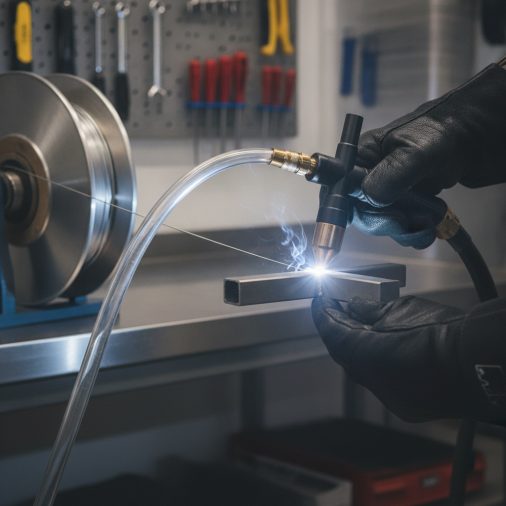
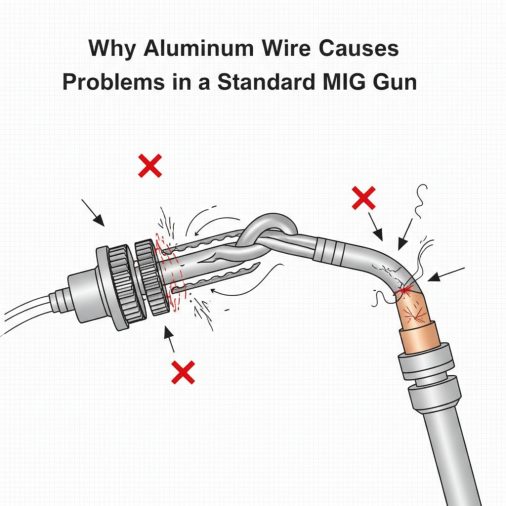
Why Aluminum Wire Causes Problems in a Standard MIG Gun
The Modifications That Make It Work
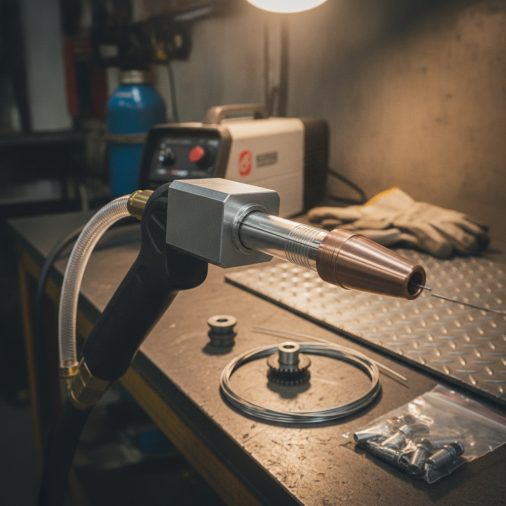
Liner Replacement
The single most effective change you can make is replacing the standard steel liner with a Teflon or nylon liner. Steel liners create friction that aluminum wire cannot handle over a long distance. A Teflon liner reduces drag dramatically and lets the softer wire slide through with much less resistance. Most welders running aluminum without a spool gun use a Tweco-style Teflon liner sized for 0.035″ aluminum wire. It needs to run the full length of the gun cable — a partial liner swap won’t eliminate the problem.Shorter Gun Length
A standard 15-foot MIG gun cable is too long for aluminum without a spool gun. In practice, welders who succeed with this method use a 10-foot gun at most, with some preferring a 6-foot cable for better control. Every extra foot of cable adds friction and increases the risk of a bird-nest jam at the drive rolls.Drive Roll Selection and Tension
Aluminum requires U-groove drive rolls rather than the standard V-groove rolls used for steel. V-groove edges can shave the softer aluminum wire and create debris inside the liner, causing blockages and inconsistent feeding. Wire feed consistency is critical with aluminum because any hesitation in the feed translates immediately to arc instability or weld porosity. Tension should be set just tight enough to feed without slipping — roughly the point where you can stop the wire with light thumb pressure. Too tight and you’ll deform the wire; too loose and it won’t feed reliably.Wire Diameter
Thinner aluminum wire is softer and more prone to tangling. When welding without a spool gun, 0.035″ wire tends to feed more reliably than 0.030″. The slightly stiffer 0.035″ wire handles the push better over a short gun cable. For thicker aluminum (above 3/16″), some welders use 3/64″ wire, which is even more rigid and less prone to bird-nesting.Shielding Gas and Machine Settings
Aluminum MIG welding requires 100% argon shielding gas. There’s no substitute here — mixed gases appropriate for steel welding will produce contaminated, porous welds on aluminum. The correct gas for aluminum MIG welding is straight argon, typically at a flow rate of 20–30 CFH. Machine settings vary by material thickness, but the general starting points for aluminum MIG welding are:| Material Thickness | Wire Speed (IPM) | Voltage (V) | Polarity |
|---|---|---|---|
| 1/8" (3mm) | 250–300 | 19–21 | DCEP |
| 3/16" (5mm) | 300–380 | 21–23 | DCEP |
| 1/4" (6mm) | 380–450 | 23–25 | DCEP |
Push-Pull Gun: The Best Middle Ground
If you’re not using a spool gun but still want reliable aluminum feeding, a push-pull gun system is worth serious consideration. A push-pull setup uses a motor at the gun end to actively pull the wire through the conduit while the drive rolls push from the machine side. This eliminates most of the friction and bird-nesting problems without requiring the wire spool to sit at the gun. It costs more than a standard liner swap but significantly less than replacing your entire workflow or welding system. Machines like the Lincoln Electric Power MIG 256 and the Miller Millermatic 350P are designed to run push-pull systems natively. Some mid-range multi-process machines can run push-pull guns through an adapter.What to Expect Compared to a Spool Gun
Honesty matters here. Even with all the right modifications, feeding aluminum through a standard MIG gun is less reliable than a spool gun. If you’re doing production work or long welds on thick aluminum, a spool gun is the correct tool. Where the no-spool-gun approach works well: – Short welds on thinner aluminum (1/8″ to 3/16″) – Occasional or hobby use where a spool gun isn’t cost-justified – Situations where you’ve already set up a short gun with a Teflon liner Where it regularly falls short: – Extended welds over 6–8 inches without stopping – Material thicker than 1/4″ (heat buildup accelerates wire softening in the liner) – Welding overhead or in tight positions where the cable bends sharply MIG welders can handle aluminum in the right configuration, but the physical limitations of a long push-only feed path become harder to overcome as demands increase.Common Failures and How to Diagnose Them
Bird-nesting at the drive rolls Wire piles up where the liner meets the drive housing. Usually caused by excess feed tension, a liner that’s too short, or a kink in the cable. Check for liner gaps, reduce tension, and straighten the cable. Stuttering or inconsistent arc Partial blockage in the liner or a drive roll that’s slipping. Inspect the liner for aluminum debris, clean the drive rolls, and verify the U-groove is seated correctly. Porosity in the weld bead Almost always a shielding gas issue — wrong gas type, insufficient flow rate, or a contaminated nozzle. Confirm you’re using 100% argon and clean the base metal thoroughly before welding. Welding aluminum without proper shielding gas is not a viable option. Wire burning back to the tip Wire speed is too low relative to voltage, or the contact tip is worn and aluminum has fused inside it. Replace the tip and increase wire speed incrementally. A failing wire feed motor can also cause erratic feeding that mimics a liner problem — worth ruling out before replacing components.Surface Preparation Is Non-Negotiable
Aluminum forms an oxide layer almost instantly when exposed to air. That oxide layer melts at roughly 3700°F, while the aluminum beneath it melts at around 1200°F. Welding through the oxide causes inclusions and contamination in the bead. Before welding, always: 1. Wipe the aluminum surface with acetone to remove oils and contaminants 2. Use a dedicated stainless steel wire brush (never one that’s been used on steel) to remove the oxide layer 3. Weld immediately after brushing — the oxide begins reforming within minutes Skipping this step is one of the most common reasons aluminum MIG welds fail, regardless of the gun setup used.FAQ
Can any MIG welder feed aluminum wire without a spool gun? Most MIG welders can attempt it with the right modifications — Teflon liner, U-groove drive rolls, and a shorter gun cable. However, machines with weaker wire drive motors or very long stock cables struggle more. Higher-amperage machines with robust drive systems generally handle it better. What is the best liner material for MIG welding aluminum without a spool gun? Teflon (PTFE) liners are the top choice for aluminum feeding without a spool gun. They offer the lowest friction of any liner material and resist the debris buildup that steel liners develop. Some welders also use graphite-coated nylon liners with good results. Can you use flux-core wire to MIG weld aluminum without shielding gas? No practical flux-core aluminum wire exists for MIG welding in the way that flux-core steel wire does. Aluminum welding inherently requires 100% argon shielding gas to prevent oxidation and porosity. There is no comparable gasless option that produces structurally reliable aluminum welds. How do you prevent bird-nesting when feeding aluminum wire through a standard MIG gun? Use the shortest possible gun cable, replace the liner with Teflon, use U-groove drive rolls, and set feed tension at the minimum needed to reliably advance the wire. Keeping the cable as straight as possible during welding also reduces the risk significantly. Does wire diameter really matter when MIG welding aluminum without a spool gun? Yes, meaningfully so. Thinner wire like 0.030″ is softer and more prone to buckling over a long feed path. The 0.035″ diameter strikes a better balance between feedability and the flexibility to weld thinner base material without excess heat input. For thicker aluminum, 3/64″ offers even more rigidity. Is a push-pull gun the same as a spool gun? No. A spool gun holds the wire spool at the gun itself, completely eliminating the feed path. A push-pull gun still feeds wire from the machine’s spool but uses a motor at the gun end to assist pulling it through the liner. Push-pull systems are more versatile but require compatible machines and cost more than a basic spool gun setup. Can I weld 1/4-inch aluminum without a spool gun? It’s possible but significantly harder. Thicker aluminum requires higher wire speed and more heat, which increases the chance of wire softening inside the liner and bird-nesting. Short welds with frequent stops to cool the liner are more manageable. For consistent work on 1/4″ aluminum and above, a spool gun or push-pull system is strongly recommended.Welding aluminum without a spool gun is a legitimate technique with real limitations. The combination of a Teflon liner, U-groove drive rolls, a short gun cable, and proper argon shielding gas gives you a workable setup for lighter aluminum jobs. Going in with realistic expectations — shorter welds, more frequent interruptions, careful surface prep — makes the difference between a frustrating experience and one that actually works.


