If you’re considering a career in maintenance and repair welding — or you’re already in the trades and wondering if you’re being paid fairly — knowing the real hourly numbers is the first step.
Maintenance and repair welders in the United States typically earn between $18 and $35 per hour, with the national median sitting around $22 to $26 per hour. Entry-level positions often start near $17–$19/hr, while experienced welders in industrial maintenance roles, specialized facilities, or high-cost states can earn $35–$45/hr or more. Overtime, union membership, and certifications can push total compensation significantly higher.
What the Bureau of Labor Statistics Actually Shows
The U.S. Bureau of Labor Statistics (BLS) classifies maintenance welders under the broader “Welders, Cutters, Solderers, and Brazers” occupational group. As of the most recent data available, the median hourly wage for this group sits around $22–$23 per hour, with the top 10% of earners exceeding $34 per hour.
Maintenance and repair welders specifically tend to cluster in the middle-to-upper portion of that range. Unlike production welders running the same bead on an assembly line, maintenance welders must diagnose problems, work in awkward positions, and handle a wider variety of materials — skills that generally command higher pay.
The annual salary equivalent at median wages lands roughly between $46,000 and $55,000 for full-time positions, though overtime can meaningfully raise that ceiling.
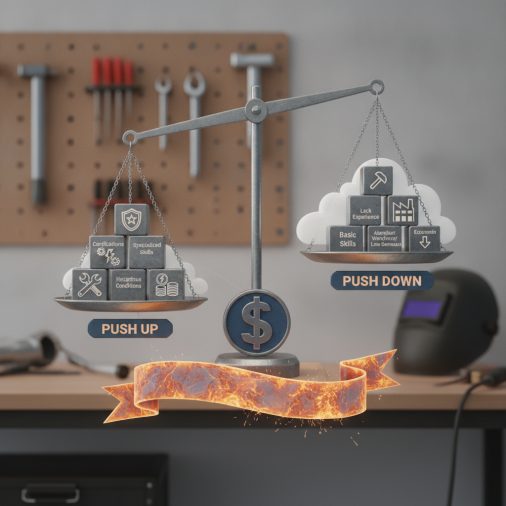
Factors That Push Hourly Pay Up or Down
Several real-world variables determine where a maintenance welder falls on the pay scale. These aren’t abstract considerations — they directly affect your paycheck.
Experience level
– Entry-level (0–2 years): $17–$21/hr
– Mid-level (3–7 years): $22–$30/hr
– Senior/specialist (8+ years): $30–$45/hr
Industry and employer type
– Manufacturing plants and paper mills tend to pay above the median
– Oil refineries and petrochemical facilities are among the highest-paying employers
– Municipal maintenance and school districts tend to pay toward the lower end
Geographic location plays an enormous role. A maintenance welder in Alaska, North Dakota, or Washington state typically earns substantially more than one doing the same work in rural Mississippi or Arkansas. Cost of living and industrial demand drive these gaps.
Union membership is another significant factor. Union welders often earn 15–30% more than non-union counterparts in the same region, along with better benefits packages and pension contributions.
Highest-Paying Industries for Maintenance Welders
Not all maintenance welding jobs are equal. The industry you work in matters as much as your skill level.
Industry
Typical Hourly Range
Oil and gas extraction
$28–$50/hr
Petrochemical plants
$27–$48/hr
Aerospace and defense
$26–$42/hr
Shipbuilding and repair
$24–$38/hr
Heavy manufacturing
$22–$36/hr
General industrial maintenance
$20–$32/hr
Municipal/government facilities
$18–$27/hr
Oil refineries and chemical plants sit at the top because the stakes are high — faulty welds in those environments create serious safety risks, so employers pay for skill and reliability.
How Certifications Affect Your Hourly Rate
Holding a welding certification from the American Welding Society (AWS) or meeting specific code qualifications can add $2–$8 per hour to your base rate in many industrial settings. This isn’t theoretical — employers often have pay grades tied directly to certification levels.
Relevant certifications include:
– AWS Certified Welder (CW) — the baseline credential
– AWS Certified Welding Inspector (CWI) — commands some of the highest hourly rates, often $35–$65/hr
– ASME code qualifications — commonly required in pressure vessel and piping work
– API 1104 pipeline qualification — opens doors to some of the highest-paying maintenance roles
Maintenance welders who can pass multiple process qualifications — particularly TIG on stainless and pipe — are consistently hired at the top of posted wage ranges. If you’re curious about why certain processes command more respect and pay, understanding why TIG welding produces cleaner, more precise welds helps explain why those skills are valued differently than basic MIG work.
State-by-State Pay Differences
Geography affects wages more than most welders expect. Here’s a practical comparison of how hourly pay varies across states:
Higher-paying states (typically $26–$38/hr median for maintenance welders):
– Alaska
– Washington
– Oregon
– Hawaii
– Wyoming (oil and gas driven)
– North Dakota
Mid-range states (typically $21–$27/hr):
– Texas
– Ohio
– Pennsylvania
– Michigan
– Minnesota
Lower-paying states (typically $17–$22/hr):
– Mississippi
– Arkansas
– South Carolina
– West Virginia
These ranges reflect cost-of-living differences as well as local industrial demand. Texas is a unique case — wages look moderate on paper, but the volume of oil and gas work means maintenance welders willing to travel to remote sites often earn significantly more.
Overtime and Shift Premiums
Maintenance welding in industrial settings frequently involves overtime, especially during planned shutdowns, turnarounds, and emergency repairs. At time-and-a-half rates, a welder earning $25/hr base pulls $37.50/hr for those extra hours.
In refinery and plant turnaround work, 60–70 hour weeks are common for weeks at a time. Those premium hours can double a welder’s effective annual income compared to straight-time estimates.
Night shift differentials typically add $1–$3/hr on top of base rates. Hazardous material environments and confined space work often carry additional pay premiums as well.
How Maintenance Welding Pay Compares to Other Welding Roles
Maintenance welders generally earn more than production welders but often earn less than pipeline welders and certified welding inspectors.
Welding Role
Typical Hourly Range
Production welder (assembly line)
$16–$24/hr
Maintenance and repair welder
$18–$35/hr
Structural welder
$22–$38/hr
Pipeline welder
$28–$55/hr
Underwater welder
$26–$80/hr
Certified Welding Inspector
$35–$65/hr
Pipeline welding is one of the highest-compensation paths in the trade. If you’re thinking about that direction, there’s a detailed breakdown of how to start a pipeline welding career that covers what’s actually required to break into that field.
What Equipment Familiarity Does to Your Earning Potential
Employers hiring maintenance welders want versatility. A welder comfortable with only one process is less valuable than one who can MIG weld sheet metal in the morning and TIG weld stainless pipe in the afternoon.
In practice, welders familiar with MIG, TIG, stick (SMAW), and flux-core processes have a measurable advantage in hiring and negotiation. Plasma cutting competency is also valued in many maintenance shops — knowing what a plasma cutter is capable of beyond simple cuts helps maintenance welders handle a wider variety of fabrication and repair tasks on the floor.
For welders building out their own home setup to practice multiple processes, understanding how to put together a capable home welding setup is a practical way to develop those skills outside of work.
FAQ
What is the starting hourly pay for a maintenance welder with no experience?
Most entry-level maintenance welder positions start between $17 and $21 per hour. Some apprenticeship programs begin even lower, around $14–$16/hr, but include paid training and step increases. Employers in high-demand industries like manufacturing and oil services often start higher to attract candidates, particularly in areas with tight labor markets.
Do maintenance welders make more than production welders?
Generally, yes. Maintenance welders are expected to troubleshoot, work across different materials and processes, and perform non-routine repairs — skills that command a premium over repetitive production work. In most industrial facilities, maintenance welders earn $3–$8 more per hour than production welders doing fixed-position assembly welding on an assembly line.
Can a maintenance welder earn $40 an hour or more?
Absolutely, though it typically requires a combination of factors: several years of experience, multi-process certifications, working in a high-paying industry like oil refining or aerospace, or being employed at a union facility in a high-cost region. Welders in turnaround and shutdown crews working heavy overtime routinely see effective hourly rates above $40/hr when overtime is factored in.
Does welding certification actually increase hourly pay in practice?
Yes, in most industrial settings. AWS Certified Welder status alone may add $1–$3/hr. ASME and API code qualifications add more — sometimes $3–$8/hr in pressure piping and pipeline environments. CWI certification opens inspector roles that typically pay $35–$60/hr. In unionized environments, pay scales are often directly tied to certification tiers.
What states pay maintenance welders the most?
Alaska, Washington, Oregon, Wyoming, and North Dakota consistently rank among the highest-paying states for maintenance welders. Alaska tops most lists due to its remote industrial work and cost-of-living adjustments. Wyoming and North Dakota are driven largely by oil and gas activity, where skilled maintenance welders are in consistent demand and often earn well above the national median.
How does plant turnaround work affect annual earnings?
Turnaround and shutdown work is one of the fastest ways maintenance welders increase their annual income. These projects run around the clock for weeks, generating significant overtime. A welder earning $26/hr base can realistically gross $70,000–$90,000 in a year if they work two or three major turnarounds. The trade-off is long hours, travel, and physically demanding conditions.
Is maintenance welding physically harder than production welding?
In most cases, yes. Production welding often involves fixed, ergonomic setups on a stable surface. Maintenance welders work in tight spaces, overhead positions, outdoors in weather, and on equipment that isn’t designed with welding access in mind. That physical demand is part of why the pay sits higher — and why experienced maintenance welders are valued for their ability to produce quality work in difficult conditions.
The Bottom Line
Maintenance and repair welders occupy a solid middle-to-upper tier in the welding pay scale. The median hourly rate runs $22–$26, but skilled welders with certifications, multi-process experience, and the right industry connections regularly earn $30–$45/hr or more. Overtime, shift premiums, and union membership can push effective annual compensation well above what base hourly figures suggest. The clearest path to higher pay combines multi-process skill, recognized certifications, and positioning yourself in industries where the stakes of a failed weld are high enough that employers pay well to avoid them.