
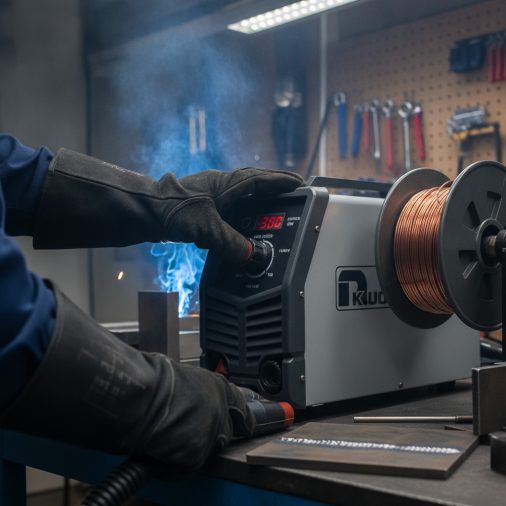
Why Wire Speed Matters So Much in Flux Core Welding
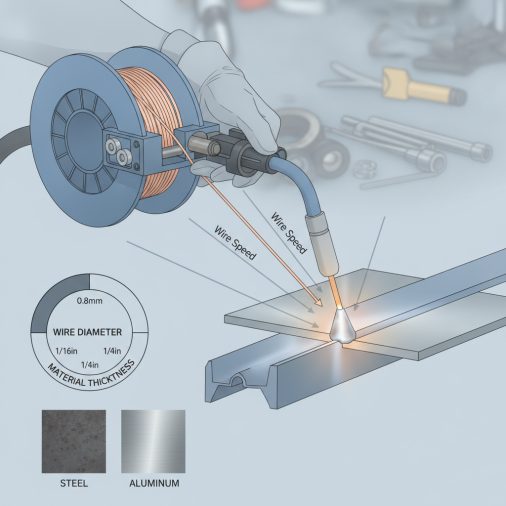
Wire Speed Reference by Wire Diameter and Material Thickness
| Wire Diameter | Material Thickness | Starting Wire Speed (IPM) | Approximate Voltage |
|---|---|---|---|
| 0.030" | 16–18 gauge | 75–125 | 14–16V |
| 0.030" | 1/8" | 150–200 | 16–18V |
| 0.035" | 1/8" | 130–175 | 17–19V |
| 0.035" | 3/16" | 175–225 | 18–20V |
| 0.035" | 1/4" | 200–275 | 19–21V |
| 0.045" | 1/4" | 200–275 | 20–23V |
| 0.045" | 3/8"+ | 250–350 | 22–26V |
How to Set Wire Speed Without a Chart
Charts are useful starting points, but in the field you’ll often need to tune by ear and by eye. Here’s a reliable method: 1. Set your voltage first based on material thickness. Most machines have a recommended voltage range on the inside panel. 2. Start wire speed at the low end of the recommended range for your wire diameter. 3. Strike an arc on scrap material and listen to the sound. 4. Adjust wire speed up or down until you hear a steady, consistent crackle — similar to bacon frying. 5. Inspect the bead — it should be smooth, slightly convex, with minimal spatter and consistent width. 6. Fine-tune from there for the joint position, travel speed, and material condition. A good arc sounds rhythmic and even. If it sounds like it’s popping or stuttering, wire speed is likely too low. If it sounds harsh and spitty with heavy spatter, wire speed may be too high relative to voltage.Signs Your Wire Speed Is Off
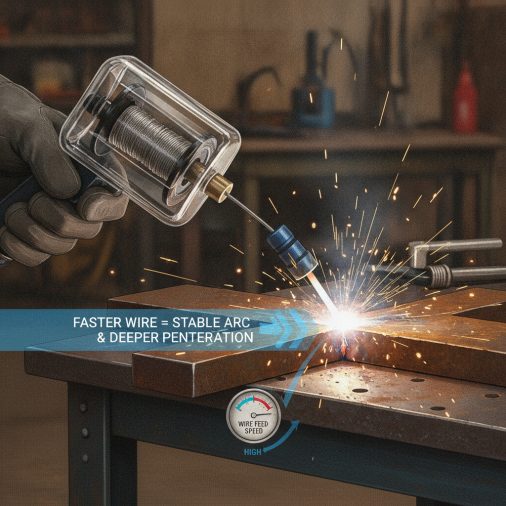
Wire speed too low: – Arc becomes unstable and difficult to maintain – Wire burns back to the contact tip – Bead is narrow, lacks fusion, appears cold – Porosity in the finished weld Wire speed too high: – Wire stubs into the puddle instead of melting – Heavy spatter across the work surface – Arc sounds harsh and irregular – Bead is wide, flat, and often undercut Both problems get worse if voltage isn’t balanced with wire speed. Excessive spatter when MIG welding is frequently a wire speed and voltage mismatch issue rather than a technique problem.How Wire Diameter Affects Speed Selection
Smaller diameter flux core wire — typically 0.030″ — melts faster and requires lower wire speeds to achieve the right deposition rate. It’s well-suited for thinner materials and out-of-position welding. Larger diameter wire — 0.045″ or 0.052″ — carries more current per inch of melt and is designed for higher deposition rates on thicker steel. These larger wires generally need higher wire speeds to maintain a stable arc, but each inch of wire deposited contains more filler metal. Choosing the right wire size before worrying about speed is important. Running 0.045″ wire on 16-gauge sheet metal creates problems that no wire speed adjustment can fully fix. The guide to choosing the right MIG wire size explains this relationship in detail.Self-Shielded vs. Gas-Shielded Flux Core Wire Speeds
There are two types of flux core wire, and they behave differently in terms of speed requirements. Self-shielded flux core (FCAW-S): – Contains flux compounds that generate their own shielding gas when the flux burns – Generally runs at slightly lower wire speeds for equivalent current levels – More forgiving outdoors due to wind resistance – Common wires: Lincoln Electric Innershield NR-211-MP Gas-shielded flux core (FCAW-G): – Requires external shielding gas (typically 75/25 Ar/CO₂) – Often runs at slightly higher wire speeds for equivalent deposition – Produces cleaner, smoother beads with less spatter – Preferred for structural and production welding For most hobbyist and small shop applications, self-shielded flux core wire is more common since it doesn’t require a gas cylinder. If you’re unsure which type you’re using, gasless MIG welding and how flux core works covers the shielding mechanism clearly.Wire Speed and Polarity — A Connection Most Beginners Miss
Flux core wire — particularly self-shielded types — typically runs on DCEN (Direct Current Electrode Negative), also called straight polarity. This is the opposite of standard solid wire MIG welding, which runs on DCEP. Running flux core wire on the wrong polarity significantly affects the arc. The wire will appear to behave as if the speed is wrong — the arc becomes erratic, spatter increases dramatically, and penetration suffers. Before adjusting wire speed, always confirm your polarity is correct for the wire type you’re using. MIG welding polarity and how it affects your setup is worth reviewing if you’re switching between solid wire and flux core on the same machine.Practical Wire Speed Tips From the Field
– Always test on scrap first. Set up on a piece of the same material and thickness before welding your actual workpiece. – Account for joint position. Overhead and vertical welding typically require slightly lower wire speeds to control the puddle against gravity. – Don’t overlook contact tip wear. A worn contact tip creates inconsistent electrical contact, which makes the arc behave as if wire speed is fluctuating even when the setting is steady. – Wire brand matters. Different flux core wire brands have different flux formulas. Lincoln Electric Innershield NR-211-MP behaves differently than an off-brand wire at the same IPM setting. – Check the manufacturer data sheet. Most wire manufacturers publish recommended parameter ranges by wire diameter and thickness. These are a more reliable starting point than generic charts. For machines with a wire speed and voltage chart on the inside panel — like the Hobart Handler 140 — use that chart as the baseline. It’s calibrated for that specific machine’s drive system and is usually close to optimal.FAQ
What is a good wire feed speed for 0.035″ flux core wire on 1/4″ steel? For 0.035″ flux core wire on 1/4″ mild steel, a starting range of 200–250 IPM with voltage around 19–21V is typical. Adjust from there based on bead appearance and arc sound. If penetration looks shallow, increase both wire speed and voltage together rather than changing just one variable. Why does my flux core wire keep stubbing into the work? Wire stubbing usually means wire speed is too high for the voltage level, or voltage is set too low for the wire speed. The wire feeds into the puddle faster than it can melt. Try reducing wire speed slightly or increasing voltage by 1–2V while keeping wire speed the same, then evaluate the arc sound and bead profile. Does flux core wire speed work the same as solid MIG wire? The principle is the same — faster speed increases amperage and deposition rate — but flux core wire typically runs at higher amperage for a given speed compared to solid wire. Flux core wire also generates more spatter, so balancing wire speed and voltage is especially important. Don’t use solid wire settings as a direct starting point for flux core. How do I know if my wire speed is set correctly without welding a test bead? You can’t reliably determine correct wire speed without actually striking an arc. There’s no reliable visual method to confirm it before welding. The only accurate check is listening to the arc and inspecting the bead. Setting up on scrap material takes less than a minute and removes guesswork from the real workpiece. What wire speed should I use for flux core welding out of position? Out-of-position welding — vertical, overhead — generally requires a 10–20% reduction in wire speed compared to flat position settings. Lower deposition keeps the puddle smaller and more controllable. For vertical up, some welders reduce both voltage and wire speed to maintain a tighter arc and more controlled puddle. Can wire speed affect porosity in flux core welds? Yes. Wire speed that’s too low can lead to inadequate heat input, which means the flux doesn’t fully activate and shielding is incomplete. This creates porosity. Too-fast wire speed can also cause instability in the arc and inconsistent shielding. Both extremes increase the risk of gas pockets in the finished bead. What happens if I increase wire speed without changing voltage? The amperage increases while voltage stays fixed. The arc becomes shorter and more stubbing-prone. Spatter increases noticeably. The bead tends to be wider and flatter, and penetration may actually decrease because the arc becomes less stable. Wire speed and voltage always need to be adjusted in proportion to each other.Wire speed in flux core welding isn’t a single setting — it’s one half of a balanced equation with voltage. Start with a reference range for your wire diameter and material thickness, listen to the arc, and adjust from there. Clean, consistent welds come from a tuned relationship between speed and voltage, not from chasing a specific number on a dial.


