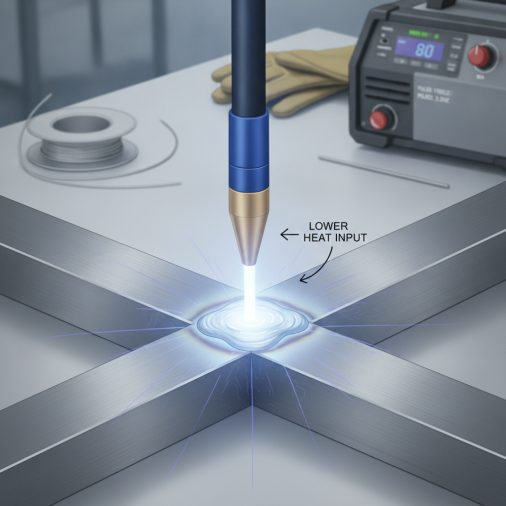
Cold welding stainless steel is one of those topics where small setting changes make a big difference. Get it wrong and you end up with warped panels, sugary edges, or a weld that looks fine on the surface but fails under load.
Cold welding stainless steel refers to welding at reduced heat input to minimize warping, discoloration, and heat-affected zone damage. For MIG, this typically means lower voltage (14–18V), reduced wire speed, and tri-mix shielding gas. For TIG, use around 1 amp per 0.001 inch of thickness with a pointed tungsten electrode. The goal is controlled, fast passes with minimal dwell time on the base metal.
Why Stainless Steel Demands Lower Heat Input
Stainless steel conducts heat roughly three times slower than mild steel. That sounds like an advantage, but it isn’t. Heat builds up and stays concentrated near the weld, which causes warping, carbide precipitation, and the characteristic blue or gold discoloration that ruins a clean finish.
Cold welding — sometimes called cold pass welding or low heat input welding — compensates by keeping energy delivery tight and travel speed fast. The metal doesn’t soak heat from a slow, hot puddle. Instead, the weld is completed quickly and cleanly before the surrounding material has a chance to absorb and spread that energy.
This matters most for 304 and 316 stainless in gauges under 3mm, where heat distortion happens almost instantly if settings are off.
MIG Settings for Cold Welding Stainless Steel
For most shop applications involving stainless sheet or thin-wall tubing, these are realistic starting points:
Parameter
Thin Gauge (0.8–1.5mm)
Medium Gauge (1.5–3mm)
Voltage
14–16V
16–18V
Wire Feed Speed
140–180 IPM
180–220 IPM
Wire Diameter
0.023" (0.6mm)
0.030" (0.8mm)
Travel Speed
Fast — minimize dwell
Moderate
Shielding Gas
90/7.5/2.5 tri-mix
90/7.5/2.5 tri-mix
The shielding gas combination of 90% helium, 7.5% argon, and 2.5% CO₂ is the standard choice for stainless MIG. It produces a stable arc with low spatter and preserves the corrosion-resistant surface layer. CO₂-heavy mixes used for mild steel will oxidize stainless and create porosity.
For detailed wire and gas selection decisions, the article on MIG welding stainless steel settings covers voltage and wire speed combinations across multiple thickness ranges.
Keep your contact tip-to-work distance (CTWD) shorter than you might with mild steel — typically 10–13mm. A longer stickout increases resistance heating in the wire itself, which artificially raises heat input at the puddle.
TIG Settings for Cold Welding Stainless Steel
TIG is generally the preferred method for cold welding stainless because the welder controls heat input directly with the foot pedal. That real-time control is difficult to replicate with a fixed MIG setup.
Key TIG settings for stainless:
– Polarity: DCEN (Direct Current Electrode Negative)
– Tungsten type: 2% lanthanated or ceriated (pointed tip, not balled)
– Amperage baseline: 1 amp per 0.001 inch of material thickness
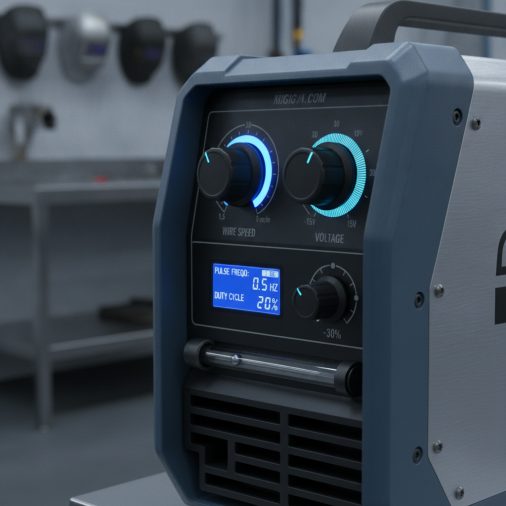
– Pulse frequency: 1–2 Hz for thin material; helps control heat between pulses
– Shielding gas: 100% argon at 15–20 CFH
– Filler rod: ER308L for 304 stainless; ER316L for 316 stainless
The pointed tungsten tip is critical for stainless. A balled tungsten (used for AC aluminum welding) produces a wider, softer arc that spreads heat unnecessarily. A sharp point concentrates the arc and keeps the heat-affected zone narrow.
TIG welding amperage to metal thickness charts provide a reliable reference for dialing in the baseline amp range before you fine-tune with the pedal.
Pulse TIG is particularly effective for cold welding stainless. Setting the background amperage to around 30–40% of peak amperage and running a 50% duty cycle allows the puddle to cool slightly between pulses, which reduces overall heat accumulation.
Electrode and Wire Selection
Using the wrong filler material with stainless steel is a surprisingly common mistake, especially when welders assume that any stainless wire will work on any stainless base metal.
– ER308L — Most common choice for 304 stainless. The “L” grade means low carbon, which reduces carbide precipitation in the heat-affected zone.
– ER316L — Required for 316 stainless, especially in food-grade or marine applications where molybdenum content matters for corrosion resistance.
– ER309L — Used when welding stainless to mild steel, or when joining dissimilar grades.
For MIG, 0.023-inch wire handles most thin stainless work better than 0.030-inch because it carries less heat into the puddle at equivalent wire feed speeds. Some welders working with sheet metal under 1mm use the Lincoln Electric SuperGlaze ER308L 0.023″ specifically for its consistent feed and minimal spatter on tri-mix gas.
If you’re unsure whether standard stainless wire is appropriate for your base metal, the article on using normal MIG wire on stainless steel explains the compatibility issues clearly.
Shielding Gas: What Changes in Cold Welding Applications
The shielding gas choice directly affects how much heat enters the weld pool and how well the stainless surface is protected.
For cold MIG welding stainless steel, the three practical gas options are:
Gas Mix
Arc Character
Heat Input
Surface Result
90He/7.5Ar/2.5CO₂ (Tri-mix)
Stable, fluid
Moderate-low
Clean, low discoloration
98Ar/2CO₂
Softer arc
Lower
Acceptable finish
100% CO₂
Harsh, spatter
Higher oxidation
Not suitable for stainless
Tri-mix remains the industry standard for stainless MIG because the helium component improves puddle fluidity without requiring higher voltage settings. That means cleaner fusion at lower overall heat input — exactly what cold welding demands.
For a thorough breakdown of gas selection beyond settings, the guide on what gas to use for MIG welding stainless steel covers flow rates, bottle sizes, and common mixing errors.
Common Cold Welding Mistakes on Stainless
Dwelling too long on the puddle. Even with correct voltage settings, moving too slowly defeats the entire purpose of cold welding. The heat still accumulates. Travel speed is as important as machine settings.
Skipping interpass cooling. On multi-pass welds, many welders underestimate how quickly stainless retains heat between passes. Letting the joint cool to below 150°F (65°C) between passes is a practical standard in precision fabrication.
Using the wrong gas. Running straight CO₂ or a standard C25 mix (75% argon / 25% CO₂) used for mild steel will oxidize stainless instantly. The weld may look acceptable on top but the chrome oxide layer underneath is compromised, reducing corrosion resistance.
Contaminated tungsten (TIG). Stainless is sensitive to contamination. A tungsten that has touched the puddle even once needs to be reground before continuing. The contaminated tip produces an erratic arc that widens the heat-affected zone unpredictably.
Wrong polarity. Running DCEP instead of DCEN on TIG puts the heat at the tungsten rather than the workpiece. Settings that otherwise look correct will produce poor fusion and rapid tungsten consumption.
Pulse MIG as an Alternative Cold Welding Method
Standard MIG struggles with consistent low-heat performance on stainless because the arc can become unstable at reduced voltage. Pulse MIG addresses this by alternating between a high peak current (for fusion) and a low background current (for cooling), which maintains arc stability while controlling heat input.
In practice, pulse MIG settings for stainless follow a similar voltage baseline but use a wire feed speed that’s 10–15% lower than standard short-circuit MIG. The machine handles the current switching automatically.
The Miller Multimatic 235 and similar multi-process units with built-in pulse programs are commonly used in fabrication shops for exactly this reason — the pulse programs are pre-tuned for stainless and take much of the guesswork out of cold welding thin material.
For a full explanation of how pulse settings work across different metals, the pulse MIG welding settings guide is worth reviewing before adjusting those parameters on stainless.
FAQ
What does “cold welding” mean for stainless steel?
Cold welding stainless steel refers to using lower heat input settings — reduced voltage, faster travel speed, and controlled amperage — to minimize distortion, discoloration, and damage to the corrosion-resistant surface layer. It does not mean welding at room temperature or without an electrical arc. The goal is controlled fusion with as little excess heat as possible.
What voltage should I use for cold welding 1.5mm stainless steel with MIG?
For 1.5mm stainless steel, a starting voltage of 15–16V with a wire feed speed of around 160–180 IPM using 0.023″ ER308L wire and tri-mix shielding gas is a practical baseline. Adjust slightly based on your specific machine and joint configuration. Short tack welds and fast travel speed are just as important as the voltage setting itself.
Can I cold weld stainless steel with a flux core welder?
Flux core welding is generally not recommended for stainless steel in cold welding applications. Standard flux core wire is formulated for carbon steel, and the slag system can compromise stainless surface chemistry. Gas-shielded stainless flux core wires exist but are less common and still produce more heat and spatter than solid wire MIG or TIG at equivalent settings.
Why does my stainless weld turn blue or gold even with low settings?
Discoloration on stainless indicates oxidation of the chrome layer from excess heat or inadequate shielding gas coverage. Even at low voltage settings, slow travel speed or insufficient gas flow allows oxygen to reach the hot weld zone. Increase travel speed, check your gas flow rate (15–20 CFH is typical), and ensure there are no drafts interrupting the shielding gas envelope around the arc.
Is TIG or MIG better for cold welding thin stainless steel?
TIG is generally better for cold welding thin stainless because the foot pedal gives real-time control over heat input, and the narrow arc concentrates fusion precisely where needed. MIG is faster and more practical for longer seams or production work, but requires careful setup to achieve similar low-heat results. For material under 1.5mm, TIG is usually the more reliable choice. You can read more about why TIG welding produces cleaner, more precise welds on thin material.
What filler rod should I use for cold TIG welding 304 stainless?
ER308L is the standard filler for 304 stainless. The low-carbon designation helps prevent carbide precipitation in the heat-affected zone, which becomes more important when heat input is deliberately controlled. For 316 stainless, use ER316L. Avoid standard (non-L) grades for cold welding applications where preserving the full corrosion resistance of the base metal is the priority.
How do I prevent warping when cold welding stainless steel panels?
Use short, intermittent tack welds spaced evenly before running full seams. Weld in a back-step pattern to distribute heat away from a single area. Clamp the panel firmly to a flat backing surface during welding. Allow each pass to cool before continuing. Keeping the interpass temperature below 150°F (65°C) is a practical benchmark for minimizing panel distortion on thin stainless.
Cold welding stainless steel comes down to three things: correct machine settings, appropriate filler and gas, and disciplined technique. Dialing in voltage and amperage is straightforward once you understand why stainless behaves differently from mild steel. The real skill is maintaining fast travel speed and proper heat management throughout the weld, not just at the start. Get those fundamentals right and the settings become much easier to fine-tune for each specific job.