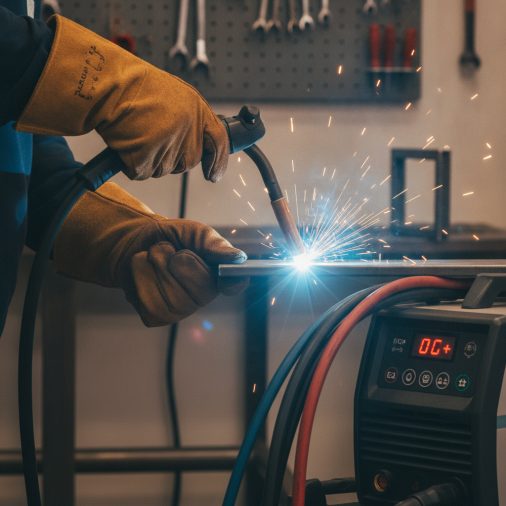
Mild steel is the most commonly welded material in fabrication, repair, and construction work. Getting the current type right has a direct impact on arc stability, penetration, and weld quality.
For most mild steel welding, direct current (DC) is the preferred choice. MIG welding always uses DC, TIG welding on mild steel uses DC electrode negative (DCEN), and stick welding typically uses DC electrode positive (DCEP) for the best penetration and arc stability. Alternating current (AC) is occasionally used with stick welding but produces a rougher arc and is less common for mild steel.
DC vs. AC: What the Difference Actually Means for Mild Steel
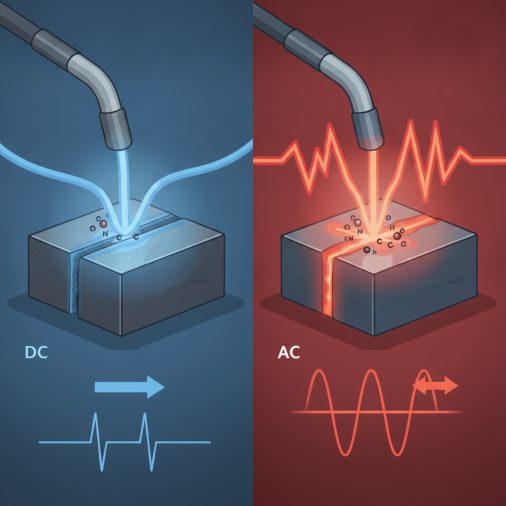
Direct current flows in one direction only. Alternating current reverses direction rapidly, typically 50 or 60 times per second depending on your region.
For welding, this matters because current direction affects how heat is distributed between the electrode and the base metal. DC provides a steadier, more controllable arc, which is why it dominates mild steel applications across all three major welding processes.
AC welding creates a more erratic arc with a slight pause each time the current reverses polarity. On mild steel, this makes spatter control harder and produces a less consistent bead profile. AC does have legitimate uses in welding, particularly for aluminum TIG welding where the AC arc provides oxide-cleaning action, but that benefit doesn’t apply to mild steel.
MIG Welding Mild Steel: Always DC Electrode Positive
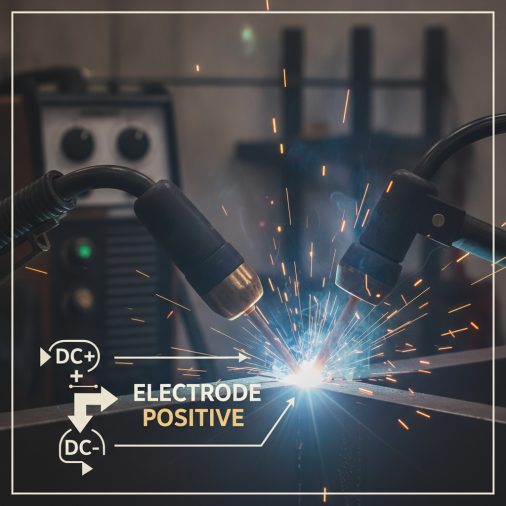
MIG welding (GMAW) runs exclusively on DC. The wire electrode is connected to the positive terminal, making it DC electrode positive (DCEP), also called reverse polarity.
DCEP concentrates approximately two-thirds of the arc heat at the wire tip and workpiece contact point. This produces good fusion into the base metal and clean transfer of filler metal across the arc.
Running DCEN on a MIG welder for mild steel would reduce penetration and produce an unstable arc with increased spatter. There is no practical reason to do this. The shielding gas selection for MIG welding mild steel also plays a significant role in arc quality and bead appearance alongside current polarity.
Stick Welding Mild Steel: DCEP Is Standard
Stick welding (SMAW) offers the most polarity options, and the correct choice depends on the electrode type.
For the most common mild steel stick electrodes:
Electrode
Recommended Polarity
Notes
E6010
DCEP
Deep penetration, fast-freeze slag
E6011
AC or DCEP
Versatile, works on rusty or dirty steel
E6013
AC or DCEP
Smooth arc, beginner-friendly
E7018
DCEP
Low hydrogen, strong welds, common structural use
E7024
AC or DCEP
High deposition, flat/horizontal only
DCEP (reverse polarity) is the default for most mild steel electrodes because it produces deeper penetration and a more stable arc. E6011 and E6013 are notable exceptions that also perform reliably on AC, which is useful when only a basic AC transformer welder is available.
In practice, welders using an older AC-only transformer welder often choose E6011 or E6013 electrodes specifically because of this AC compatibility.
TIG Welding Mild Steel: DCEN for Clean Arcs
TIG welding (GTAW) mild steel uses DC electrode negative (DCEN), also called straight polarity. The tungsten electrode connects to the negative terminal.
With DCEN, approximately two-thirds of the arc heat concentrates on the workpiece rather than the tungsten. This produces deeper penetration relative to heat input and preserves the tungsten electrode life significantly. A sharp tungsten point is maintained more easily on DCEN.
DCEP is used for TIG welding aluminum because the reversed polarity generates oxide-cleaning action on the surface. Mild steel doesn’t have this oxide challenge in the same way, so DCEN is always the correct choice.
A common issue in TIG setups is accidentally running DCEP on mild steel — the tungsten will ball up quickly and the arc becomes wide and shallow instead of focused and penetrating. If you notice this happening, check the polarity setting before assuming the tungsten or gas is the problem. TIG arc instability sometimes traces back to incorrect polarity rather than gas flow or tungsten contamination.
Why Polarity Affects Weld Penetration
Understanding the heat distribution principle helps explain why polarity matters practically.
In any DC arc:
– Electrode positive (DCEP / reverse polarity): More heat at the electrode end. Better fusion into the base metal, better penetration.
– Electrode negative (DCEN / straight polarity): More heat on the workpiece. Higher deposition rates, less electrode wear in TIG, shallower penetration in stick.
This is why stick welding uses DCEP for most mild steel electrodes — deeper fusion into the joint is a priority. TIG welding uses DCEN because the tungsten electrode must not be consumed, and penetration is controlled precisely through technique and amperage.
What Happens If You Use the Wrong Current
Incorrect polarity or current type doesn’t always produce an obvious failure. Sometimes it just makes welding harder.
Common symptoms of wrong polarity in stick welding:
– Electrode keeps sticking to the workpiece
– Excessive spatter
– Arc that keeps extinguishing
– Shallow, wide bead with poor fusion
For TIG welding with incorrect polarity:
– Tungsten electrode balling rapidly
– Wide, shallow arc puddle
– Reduced control over the molten pool
If you experience any of these issues on mild steel, verifying current type and polarity should be one of the first things you check. Many common welding mistakes come down to incorrect machine settings rather than technique problems.
Flux-Core Welding: DC with Polarity Depending on Wire Type
Flux-core arc welding (FCAW) uses DC, but polarity depends on the wire type.
– Self-shielded flux-core wire (FCAW-S): Typically runs DCEN (electrode negative). The Lincoln Electric NR-211-MP is one of the most widely used self-shielded wires for mild steel and runs on DCEN.
– Gas-shielded flux-core wire (FCAW-G): Runs DCEP (electrode positive), same as solid MIG wire.
This is a point where many welders make mistakes, especially when switching between solid wire MIG and flux-core. Running self-shielded flux-core wire on DCEP produces excessive spatter, porosity, and a rough bead. Always check the wire manufacturer’s specification sheet for the correct polarity.
Quick Reference: Current Settings for Mild Steel by Process
Welding Process
Current Type
Polarity
Notes
MIG (solid wire)
DC
DCEP
Always reverse polarity
Stick (E6010, E7018)
DC
DCEP
Standard for most electrodes
Stick (E6011, E6013)
AC or DC
DCEP or AC
Versatile; works on AC transformers
TIG
DC
DCEN
Straight polarity; preserves tungsten
Flux-core self-shielded
DC
DCEN
Reverse from solid wire MIG
Flux-core gas-shielded
DC
DCEP
Same as solid wire MIG
FAQ
Does it matter if I use AC or DC for mild steel stick welding?
It does matter, but the impact depends on the electrode. With E6010 or E7018, DC is required — these electrodes simply won’t run properly on AC. With E6011 or E6013, AC is acceptable and produces usable results, though DC generally provides a smoother, more stable arc. If you have a DC welder available, use it for better arc control on mild steel regardless of electrode type.
What polarity should I set for a beginner welding mild steel with a stick welder?
Start with DCEP (reverse polarity) using an E6013 electrode. The E6013 produces a soft, easy-to-control arc with a self-cleaning slag that lifts cleanly after each pass. DCEP gives better fusion into the base metal compared to straight polarity. Most entry-level DC inverter welders have the polarity labeled clearly on the clamp connection points.
Can I TIG weld mild steel with AC current?
Technically possible, but not recommended. AC TIG produces a less focused arc and causes excessive tungsten wear on mild steel because there’s no oxidized surface layer that would benefit from the cleaning cycle. DCEN provides a tighter arc, better penetration control, and much longer tungsten life. Always use DCEN for mild steel TIG work.
Why does my flux-core wire produce so much spatter on mild steel?
Incorrect polarity is one of the most common causes. Self-shielded flux-core wires like the Lincoln Electric NR-211-MP require DCEN (electrode negative), not DCEP. Many welders assume flux-core runs the same polarity as solid wire MIG, which it doesn’t. Check your wire’s specification and swap the torch and ground clamp connections on the welder if needed.
What current is used for thin mild steel to avoid burn-through?
Lower amperage DC is the correct approach. For thin mild steel under 3mm (roughly 1/8 inch), TIG welding with DCEN gives the most precise heat control. Welding thin metal without burning through relies heavily on reducing heat input, which DC with lower amperage settings handles better than AC. MIG with short-circuit transfer (low voltage, low wire speed) also works well for thin sections.
Is DC+ the same as DCEP?
Yes. DC+ and DCEP (DC electrode positive) refer to the same polarity — the electrode or wire is connected to the positive terminal of the power source. Some machines label it as DC+ and others as DCEP or “reverse polarity.” All three terms mean the same thing in practice.
Can an AC-only welder produce good results on mild steel?
With the right electrode, yes — but with limitations. E6011 and E6013 electrodes are designed to run on AC and produce acceptable welds on clean mild steel. However, AC welders tend to be older transformer-style machines with limited amperage control and no duty cycle flexibility. For most practical mild steel work today, a basic DC inverter welder delivers better arc stability, lighter portability, and broader electrode compatibility.
Mild steel is forgiving in many ways, but using the wrong current or polarity works against you from the start. DC is the foundation for almost all mild steel welding — DCEP for MIG and most stick electrodes, DCEN for TIG and self-shielded flux-core. Getting polarity right before striking an arc eliminates a whole category of problems before they appear.