Reading a welding drawing and running into numbers after the weld symbol can stop a fabricator cold. Two of those numbers — the weld length and the pitch — control exactly how an intermittent weld gets laid down, and misreading them leads to costly rework.
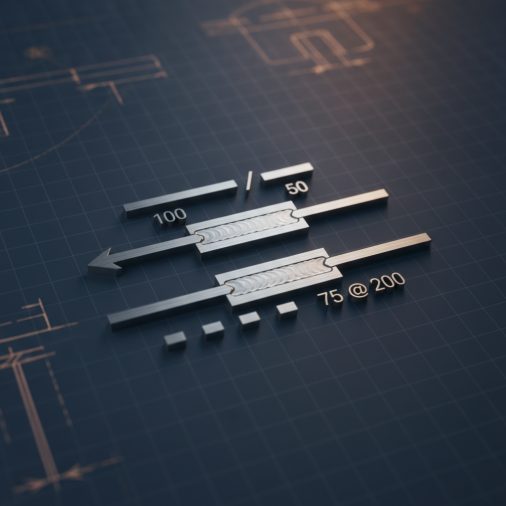
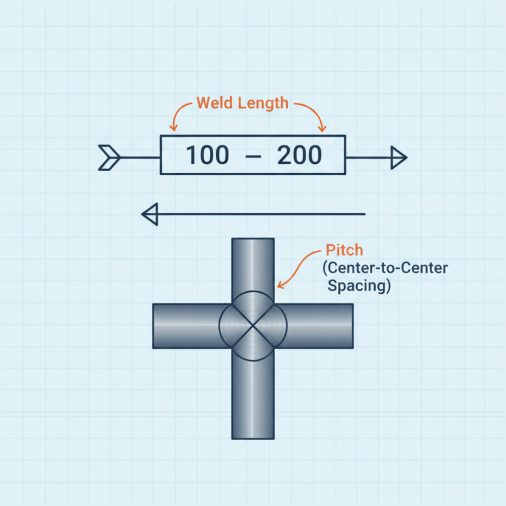
On a welding symbol, the length indicates how long each individual weld segment should be, and the pitch indicates the center-to-center spacing between segments. They appear together to the right of the weld symbol as: length – pitch (for example, 50-150). This notation is used specifically for intermittent welds — fillet or groove welds that are not continuous along the joint.
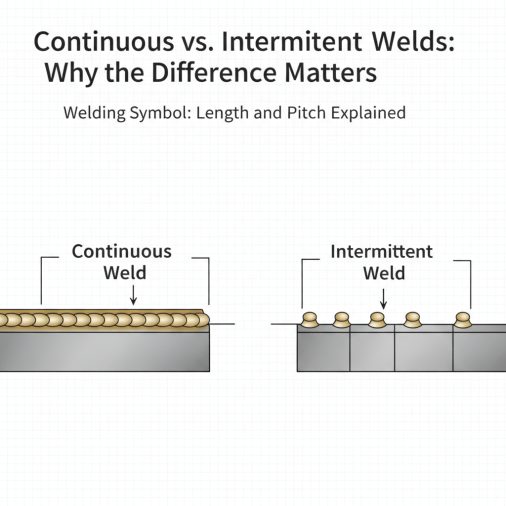
Continuous vs. Intermittent Welds: Why the Difference Matters
Not every joint requires a full-length weld. Continuous welds are strong, but they also add heat, distortion, and cost. On lighter structural applications, chassis frames, enclosures, and non-critical joints, intermittent welds reduce all three without meaningfully compromising strength.
That’s where length and pitch become essential. They give the fabricator a precise, repeatable pattern to follow — no guessing, no inconsistency between operators.
Where Length and Pitch Appear on the Symbol
On a standard welding symbol (per AWS A2.4 and ISO 2553), the length and pitch are placed to the right of the weld symbol, on the same side as the symbol itself.
The format is:
> [weld size] [weld symbol] [length] – [pitch]
So a symbol might read: 6 ⌐ 40-120
That translates to:
– 6 = 6mm fillet weld size
– 40 = each weld segment is 40mm long
– 120 = center-to-center spacing between segments is 120mm
The gap between welds is therefore 120 − 40 = 80mm.
If you want a deeper look at how these numbers fit into the full symbol layout, the welding symbols chart and complete reading guide covers the full reference line, arrow, and tail system.
Pitch Is Center-to-Center, Not Gap-to-Gap
This is the single most common misreading in the field.
Pitch = center of one weld to center of the next weld.
It is NOT the open gap between segments. If a drawing calls for a 50-150 fillet weld:
– Each segment is 50mm long
– The gap between segments is 150 − 50 = 100mm
– The next segment starts 150mm from where the previous one started
Treating pitch as gap — instead of center-to-center — throws off the entire pattern and produces a different weld distribution than the engineer intended.
Chain Intermittent vs. Staggered Intermittent Welds
When both sides of a joint are welded intermittently, two patterns are possible.
Type
Description
Symbol Appearance
Chain Intermittent
Weld segments on both sides align directly opposite each other
Length-pitch shown on both reference lines, aligned
Staggered Intermittent
Weld segments on one side are offset by half a pitch from the other side
Length-pitch shown on both sides; symbol positions are offset on the reference line
Staggered intermittent welds are often preferred in structural applications because they distribute heat and stress more evenly along the joint. The symbol makes the pattern explicit — an experienced fabricator will immediately recognize the offset positioning on the drawing.
Reading the Symbol Step by Step
When you encounter a length-pitch notation on a drawing, work through it in this order:
1. Identify which side — is the symbol on the arrow side, other side, or both?
2. Read the weld size — the number to the left of the weld symbol
3. Read the length — the first number to the right of the weld symbol
4. Read the pitch — the second number after the dash
5. Calculate the gap — pitch minus length
6. Confirm the weld type — chain or staggered, based on symbol position on both lines
In practice, it helps to sketch the pattern quickly on scrap paper before starting. A 40-150 pattern on a 600mm joint means you’ll have roughly four 40mm welds, spaced at 150mm centers.
Units: Metric vs. Imperial
AWS A2.4 (used predominantly in the United States) typically uses inches. ISO 2553 (common in Europe and international work) uses millimeters.
On imperial drawings, a notation like 3/16 – 2-6 means:
– 3/16 inch fillet size
– 2 inch weld length
– 6 inch pitch (center-to-center)
– 4 inch gap between segments
Always confirm the drawing standard before fabricating. Confusing millimeter and inch values on a pitch notation produces segments that are dramatically wrong in both length and spacing.
Common Mistakes When Applying Length and Pitch
Misreading pitch as gap — Already covered, but worth restating. It’s the most frequent field error.
Starting the pattern incorrectly — Some fabricators begin the first weld at the very end of the joint. Others start half a pitch in. The drawing should specify where the pattern begins. If it doesn’t, most shops default to starting with a weld at the joint end.
Drifting pattern over long runs — On a 2-meter joint, small placement errors accumulate. Using a soapstone or marker to pre-mark segment positions before welding keeps the pattern consistent.
Ignoring the stagger offset — On staggered intermittent welds, the offset on the opposite side is typically half the pitch. Missing this makes both sides chain intermittent, which changes the structural behavior of the joint.
FAQ
What does 50-150 mean on a welding symbol?
A 50-150 notation means each weld segment is 50mm (or 50 inches depending on the drawing standard) long, with a center-to-center spacing of 150mm between segments. The gap between the end of one weld and the start of the next is 100mm. This is an intermittent weld specification commonly used to reduce heat input and material cost on non-critical or lightly loaded joints.
Is pitch the same as the gap between welds?
No. Pitch is the center-to-center distance between weld segments, not the open gap. To find the actual gap, subtract the weld length from the pitch value. For a 40-120 weld, the gap is 80mm (120 minus 40). Confusing pitch with gap is one of the most common errors fabricators make when first reading intermittent weld symbols.
Where exactly does the length-pitch notation go on the welding symbol?
The length and pitch are placed to the right of the weld symbol on the reference line. The format is: weld length followed by a dash, then the pitch value — for example, 40-120. The weld size appears to the left of the weld symbol, and all other modifiers like tail, contour, and finish are placed in their standard positions per AWS A2.4 or ISO 2553.
What is the difference between chain and staggered intermittent welds?
Chain intermittent welds have segments on both sides of the joint that directly oppose each other. Staggered intermittent welds offset the segments on each side by half the pitch, so no two weld segments face each other. Staggered welds distribute thermal stress more evenly and are often preferred in structural fabrication. The distinction is visible on the symbol by the relative positions of the length-pitch notations on each side of the reference line.
Can length and pitch be used for groove welds as well as fillet welds?
Yes. Although intermittent fillet welds are far more common in practice, the length-pitch notation can technically apply to intermittent groove welds as well. The same reading rules apply: the first number is segment length, the second is center-to-center pitch. In most structural and fabrication work, intermittent groove welds are less common than intermittent fillets due to joint preparation costs.
How do I calculate how many weld segments fit on a joint?
Divide the total joint length by the pitch to find the number of segments. For a 900mm joint with a 50-150 pattern: 900 ÷ 150 = 6 segments, each 50mm long. This gives you a quick material and time estimate before starting. Always check whether the drawing specifies where the pattern begins — at the joint end, or offset from it.
What happens if pitch is less than weld length on a symbol?
That would be a drawing error. Pitch must always be greater than or equal to the weld length, since pitch is the center-to-center spacing. If pitch equals length, the welds would be continuous with no gap. If pitch were smaller than length, segments would overlap, which is geometrically impossible. Flag any such notation to the design engineer before proceeding.
Practical Takeaway
Length and pitch control the pattern, spacing, and total weld volume on any intermittent weld joint. Remembering that pitch is always center-to-center — not gap-to-gap — solves the most common field misread instantly. When in doubt, calculate the gap explicitly (pitch minus length) and sketch the pattern before striking an arc. A few seconds of verification prevents a full joint of weld removal.