
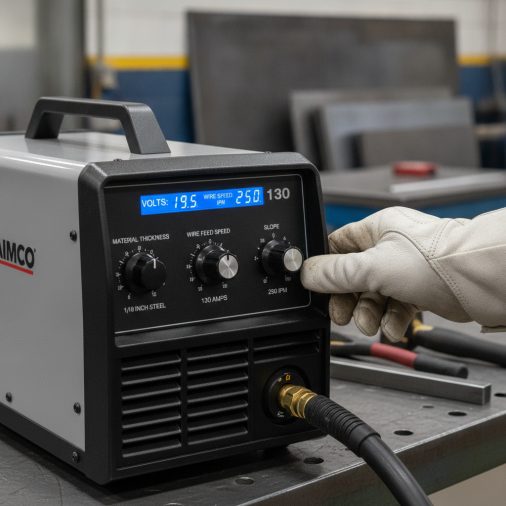
How the Aimco 130 Handles 1/8″ Steel
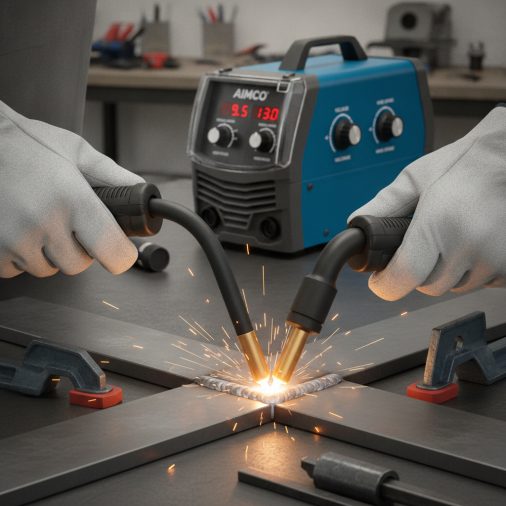
Recommended Settings at a Glance
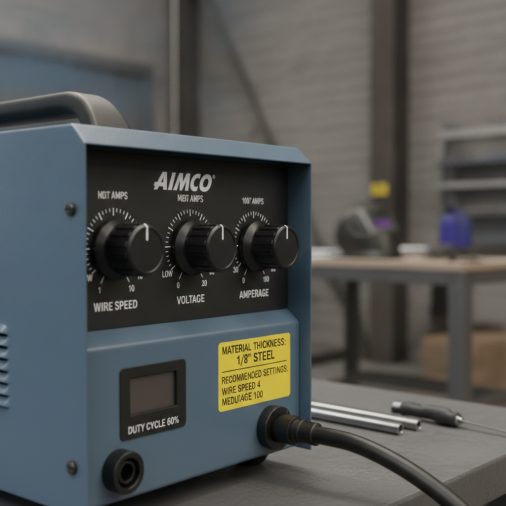
| Parameter | Recommended Setting |
|---|---|
| Voltage | High (maximum position) |
| Wire Speed | 5–7 (start at 6) |
| Wire Diameter | 0.030" or 0.035" E71T-GS |
| Polarity | DCEN (electrode negative) |
| Travel Speed | Moderate, steady |
| Work Angle | 15–20° drag angle |
| Stick-Out | 3/8" to 1/2" |
Polarity Setup You Cannot Skip
The Aimco 130 is a flux-core machine, which means it runs DCEN — direct current, electrode negative. The work clamp connects to the positive terminal and the gun lead to the negative. Some users accidentally swap these terminals when loading a new wire spool or setting up for the first time. Running DCEP (electrode positive) on flux-core wire causes excessive spatter, a ragged bead, and poor penetration. If your welds look rough even at correct wire speed settings, check polarity first. This is one of the most overlooked setup errors on compact flux-core machines.Wire Selection for 1/8″ Steel
For the Aimco 130, E71T-GS flux-core wire in 0.030″ or 0.035″ diameter is the standard choice for mild steel. The “GS” designation means single-pass wire — it’s formulated for outdoor or shop use without shielding gas. – 0.030″ — Better for thinner material and precise control; works well on 1/8″ steel at full output – 0.035″ — Slightly more deposition, a bit more forgiving on fit-up gaps, and well-suited for 1/8″ and thicker Avoid E71T-11 wire unless you’ve confirmed the Aimco 130 supports multi-pass welding with that wire type. For most single-pass work on 1/8″ steel, E71T-GS from brands like Lincoln Electric or INETUB gets the job done cleanly.Finding the Right Wire Speed
Wire speed is arguably the most sensitive setting on the Aimco 130. Too slow and the arc pops and stutters — you won’t get good fusion. Too fast and the wire stubbing into the puddle creates a harsh, spatter-heavy arc. Signs your wire speed is too low: – Popping, irregular arc sound – Wire burning back toward the tip – Undercut along the bead edges Signs your wire speed is too high: – Wire stubbing into the work – Loud, splattering arc – Wire balling up at the tip Start at 6 on the dial, run a short test bead on scrap 1/8″ steel, and listen to the arc. A smooth, steady crackling sound — often compared to frying bacon — means you’re in the right range. Adjust in half-step increments from there.Technique Tips for Cleaner Welds at This Thickness
Settings alone won’t produce a quality weld. On 1/8″ steel with the Aimco 130, a few technique adjustments make a real difference. Use a drag (backhand) technique. Pull the gun away from the weld puddle rather than pushing toward it. This gives better visibility of the puddle and allows flux slag to trail behind without contaminating the weld. Keep stick-out consistent. The distance from the contact tip to the work should stay at 3/8″ to 1/2″. Longer stick-out reduces heat and penetration; shorter stick-out can cause tip burn-back. Don’t rush the travel speed. At 1/8″ thickness, moving too fast leaves a narrow, convex bead with poor tie-in at the toes. A steady, moderate pace lets the puddle fill the joint properly. Let the machine warm up. On cold starts — especially in a cool garage — the first few inches of weld may run inconsistently. Run a warm-up bead on scrap before tackling the actual joint.Troubleshooting Weak or Porous Welds
If your welds on 1/8″ steel look porous, have pin holes, or lack fusion even at maximum settings, these are the likely causes: – Dirty base metal — Mill scale, rust, paint, or oil contaminates the weld pool. Grind or wire-brush the joint area to clean bare metal before welding. – Wrong polarity — Recheck terminal connections (DCEN for flux-core). – Wire feed issue — A kinked liner, worn drive roll, or incorrect tension causes inconsistent wire delivery and arc instability. – Extension cord voltage drop — Running the Aimco 130 on a long or undersized extension cord reduces available voltage significantly. Use a heavy-gauge (12 AWG or heavier) extension cord no longer than 25 feet, or run directly from the outlet. – Joint gap too wide — Gaps larger than 1/16″ on 1/8″ material can cause burn-through or lack of fill. Fit joints tightly or use a slight weave to bridge the gap. For a broader reference on matching amps to material thickness across different processes, the welding rod amperage chart provides a useful comparison point.FAQ
What wire speed should I use on the Aimco 130 for 1/8″ steel? Start at wire speed 6 on the dial, running the voltage at its highest setting. This gives a balanced arc on 1/8″ mild steel. If the arc sounds choppy or the wire keeps burning back, bump wire speed up to 6.5 or 7. If you’re getting excessive spatter or wire stubbing, back it down to 5.5. Always fine-tune on scrap material before welding the actual joint. Can the Aimco 130 weld 1/8″ steel in a single pass? Yes, the Aimco 130 can weld 1/8″ mild steel in a single pass when running at maximum output. The machine is rated up to 130 amps, which is sufficient for single-pass flat or horizontal welds on 1/8″ material. For vertical or overhead positions, consider two lighter passes or preheat the material slightly in cold environments. Why does my Aimco 130 keep sputtering on 1/8″ steel? Sputtering is usually caused by wire speed set too low, incorrect polarity (DCEP instead of DCEN), a dirty contact tip, or a kinked wire liner. Check polarity first, then verify wire speed is at 6 or above at full voltage. Clean or replace the contact tip if it shows signs of spatter buildup inside the bore. What is the best flux-core wire for an Aimco 130? E71T-GS flux-core wire in 0.030″ or 0.035″ diameter works best for general mild steel welding on the Aimco 130. This wire is rated for single-pass welds without shielding gas. For 1/8″ steel, 0.035″ offers slightly better deposition and is more forgiving on imperfect fit-up. Avoid multi-pass wire designations unless confirmed compatible with the machine. How do I know if I have enough penetration when welding 1/8″ steel? Cut a sample bead, grind it down to the cross-section, and look at fusion into the base metal. A properly penetrated bead on 1/8″ steel should fuse into the root of the joint without visible cold lap lines. At maximum voltage with correct wire speed on the Aimco 130, you should see a slightly convex bead with clean tie-in at both toes and no visible gaps along the fusion line. Does the length of extension cord affect the Aimco 130’s welding output? Yes, significantly. Long or undersized extension cords create voltage drop under load, which reduces the effective output of the welder. For best results, plug the Aimco 130 directly into a 20-amp outlet. If you must use an extension cord, use 12 AWG minimum and keep it under 25 feet. Thin or long cords are a common reason why settings that should work for 1/8″ steel produce weak, cold-looking welds. Is the Aimco 130 good enough for regular 1/8″ steel fabrication work? For light fabrication, repairs, brackets, and general shop projects, the Aimco 130 handles 1/8″ steel adequately at maximum settings. It’s not a production-grade machine, and it needs short cooling intervals on longer welds. For consistent heavy work on 1/8″ and thicker material, a higher-amperage 240V machine would be more reliable long-term. The Aimco 130 fits best in a hobby or occasional-use context.The Aimco 130 is capable on 1/8″ steel when you respect its limits. Run it at full voltage, set wire speed around 6, use E71T-GS wire, confirm DCEN polarity, and keep your base metal clean. Most problems with this machine at that thickness come down to extension cord voltage drop, dirty metal, or polarity swapped during setup — fix those first before changing any settings.


