
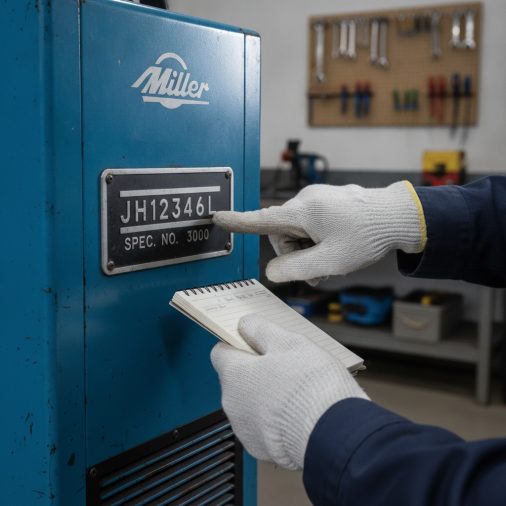
If you own a Miller Big 40 welder-generator and need to track down warranty coverage, order parts, or verify the machine’s production date, the serial number is the starting point for everything.
To look up a Miller Big 40 serial number, locate the ID plate on the machine (typically on the front panel or side enclosure), then visit Miller Electric’s official website at millerwelds.com and use the “Find My Machine” or parts lookup tool. You can also call Miller’s customer service at 1-800-4-A-MILLER with the serial number ready. The serial number reveals the production date, model configuration, and compatible parts.
Where to Find the Serial Number on a Miller Big 40
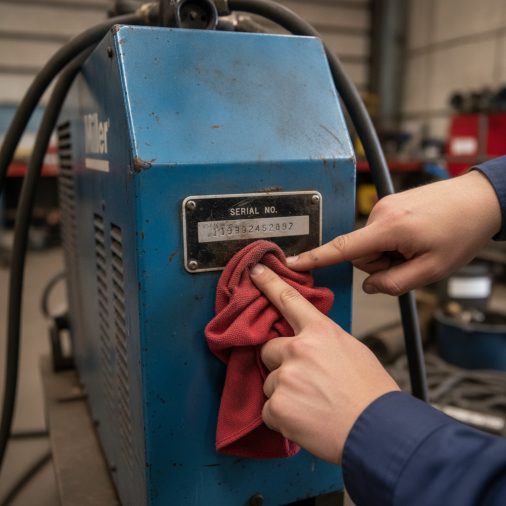
The Miller Big 40 is a combined engine-driven welder and air compressor unit, and the serial number plate is usually in one of these locations:
- Front control panel — near the output terminals or behind the main panel door
- Side enclosure panel — often on the left-hand side near the bottom
- Inside the engine compartment — on a metal ID tag near the alternator or engine block
- Frame rail — on older or heavily used units where the panel plate may have been damaged or painted over
The ID plate will show both the model number and the serial number. On most Miller units, the serial number follows the format of a letter code followed by a numerical sequence — for example, something like LG123456A. The letter prefix typically identifies the manufacturing plant location, and the numerical string encodes the production sequence.
If the ID plate is missing, corroded, or unreadable — which is common on used or field-worn machines — Miller’s service team can sometimes trace units through warranty registration records or dealer purchase history.
How to Use the Miller Serial Number Lookup Tool
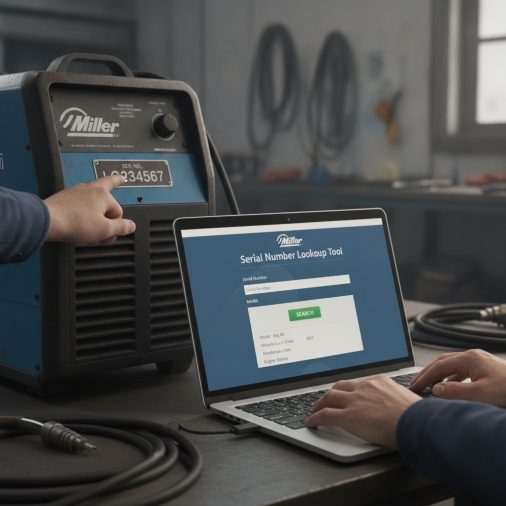
Miller Electric’s website provides a self-service parts and machine identification portal. Here’s the practical process:
- Go to millerwelds.com and navigate to “Support” or “Parts & Service.”
- Click “Find My Machine” or go directly to the parts lookup section.
- Enter the complete model number (e.g., Big 40 or Big 40G) followed by the serial number from the ID plate.
- Review the results — the system will return the production date, available parts diagrams, and any applicable owner’s manuals.
- Download the parts diagram relevant to your serial range, since component variations exist across different production years.
A common mistake is entering only part of the serial number or transposing characters. The lookup tool is case-sensitive and character-sensitive, so double-check each digit and letter before submitting.
If the online tool doesn’t return results — which occasionally happens for very old units or when a serial format doesn’t match the current database — calling Miller directly at 1-800-4-A-MILLER is the most reliable fallback. Their technical support team can manually trace older serial ranges.
What the Serial Number Actually Tells You
Miller serial numbers aren’t just tracking codes. They carry meaningful production data that directly affects parts compatibility and service decisions.
| Serial Number Component | What It Indicates |
|---|---|
| Letter prefix (e.g., LG, KD, LC) | Manufacturing facility location |
| Numerical sequence | Unit production order within that facility |
| Date code embedded in sequence | Approximate manufacture date (month/year) |
| Model suffix on ID plate | Configuration variant (e.g., diesel vs. gasoline) |
This matters practically because the Miller Big 40 has been produced across multiple decades and engine configurations, including versions powered by Continental, Kubota, and other engines. Parts for a 1998 Big 40 with a Continental engine are not interchangeable with a 2010 Big 40 using a Kubota powerplant — even if the exterior looks similar.
Field experience with older machines shows that misidentifying the production year is one of the most common reasons technicians order wrong parts. The serial number eliminates that guesswork.
Decoding the Production Date from Your Serial Number
Miller uses a consistent internal coding system, though the exact format has changed over the years. Generally:
- Units manufactured before the mid-1990s use older alpha-numeric conventions that require manual lookup or direct contact with Miller.
- Units from the mid-1990s onward often embed a two-digit year and two-digit week code within the serial string.
- Newer units (post-2005) typically have the manufacture date explicitly printed on the ID plate alongside the serial number.
For older machines, Miller’s technical support can decode the production date from the serial number directly. Having the full serial number, the model designation, and the engine model number (found on the engine block itself) ready before you call speeds up this process considerably.
When You Need the Serial Number Most
The serial number becomes critical in several practical situations:
- Ordering replacement parts — The parts diagram tied to your serial range ensures you’re buying components designed for your exact unit configuration.
- Warranty claims — Miller’s warranty period is tracked against the serial number and original purchase date.
- Engine service — The engine on a Big 40 has its own serial number and documentation separate from the welder unit. You’ll need both when ordering engine-specific components.
- Resale and verification — A buyer of a used Big 40 should always verify the serial number matches the documentation to confirm it hasn’t been rebuilt from multiple units.
- Recall and service bulletin checks — Miller occasionally issues service bulletins for specific serial ranges. Checking your number against active bulletins can prevent field failures.
Common Problems When Looking Up Older Miller Big 40 Units
Older machines present specific challenges worth knowing before you start:
Corroded or missing ID plates — The ID plate is typically riveted aluminum. On machines that have worked outdoors for years, the plate may be corroded to the point of illegibility. In these cases, check whether the serial number is stamped directly on the frame or alternator housing, which some units have as a secondary marking.
Database gaps for pre-1990 units — Miller’s online tool may not return results for very early Big 40 models. For these, a dealer with access to Miller’s legacy database or a direct call to Miller’s service line is necessary.
Engine serial number confusion — The engine number and the welder serial number are different. When searching for welding-specific parts, use the welder serial number. When searching for engine parts (fuel filters, oil filters, starters), use the engine’s own serial plate.
Aftermarket modifications — Some older Big 40 units have been re-engined or modified in the field, which can create mismatches between the original serial number record and the actual components installed. In these cases, visual inspection and direct comparison to the parts diagram is essential.
Using the Serial Number for Service Manual Access
Once you have the serial number, you can access the correct service documentation. Miller provides owner’s manuals and service literature tied to specific serial ranges at no cost through their website.
Entering your serial number into the literature search returns the exact manual revision applicable to your unit. This is important because wiring diagrams, torque specifications, and maintenance intervals have changed across production runs of the Big 40.
For complex electrical troubleshooting or alternator diagnostics, having the correct wiring diagram for your serial range is essential — not just a general Big 40 manual.
FAQ
Where exactly is the serial number located on a Miller Big 40?
The serial number is printed on the ID plate, which is most commonly found on the front control panel, the left side enclosure panel, or inside the engine compartment on a metal tag. On heavily used or field-worn machines, the plate may be damaged. In those cases, check the frame rail or look for a stamped number on the alternator housing.
Can I look up a Miller Big 40 serial number online without calling Miller?
Yes. Miller Electric’s website at millerwelds.com has a parts and machine lookup tool that accepts the model number and serial number. However, for units manufactured before the mid-1990s or units with non-standard serial formats, the online tool may not return results, and a direct call to Miller’s support line at 1-800-4-A-MILLER is typically more effective.
What does the letter prefix in a Miller serial number mean?
The letter prefix in a Miller serial number identifies the manufacturing facility where the unit was built. Different plant locations use different letter codes. This doesn’t affect parts compatibility directly, but it’s part of the production record Miller uses to track batches and service bulletins.
How do I find the production year of my Miller Big 40 from the serial number?
On newer units (post-2005), the manufacture date is often printed explicitly on the ID plate alongside the serial number. On older units, the production year is embedded within the numerical sequence of the serial number. Miller’s technical support team can decode the production date for any unit when given the complete serial number and model designation.
What information should I have ready before calling Miller about a serial number?
Have the complete serial number, the full model name (e.g., Miller Big 40G), the engine model and serial number from the engine block, and if possible, the dealer or purchase information if the unit is relatively recent. This allows Miller’s support team to pull the full production record quickly without multiple callbacks.
Can a Miller Big 40 serial number tell me which engine is installed?
The welder serial number tells you the configuration at the time of manufacture, including the original engine type. However, if the machine has been re-engined or significantly modified, the original record may not reflect the current configuration. Always cross-reference the engine block’s own serial plate to confirm what’s actually installed.
What happens if the ID plate on my Miller Big 40 is completely missing?
If the ID plate is gone, check for any secondary stamped numbers on the frame, alternator, or engine compartment. If nothing is legible, a Miller dealer with access to the legacy production database may be able to help identify the unit through purchase records, distributor history, or physical inspection of the alternator configuration and build characteristics.
The serial number on a Miller Big 40 is more than an administrative detail — it’s the key to accurate parts ordering, correct service documentation, and confirmed warranty status. Before ordering any major component or scheduling a repair, verify your serial number and confirm the parts diagram matches your production range. That single step prevents most of the costly ordering mistakes that slow down field repairs.


