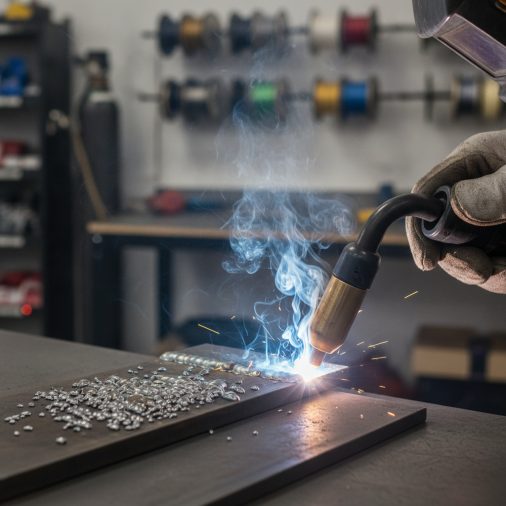
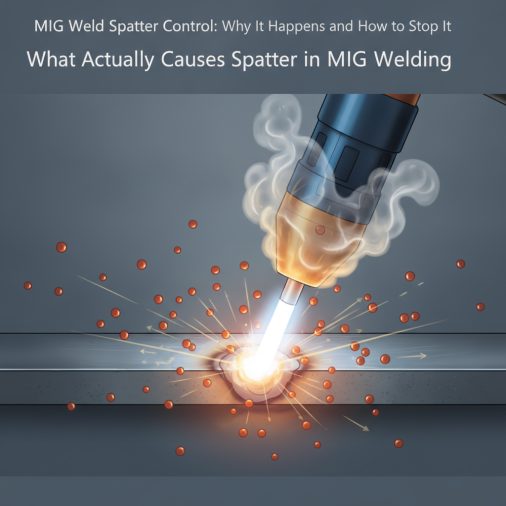
Spatter is one of the most common complaints in MIG welding. Those tiny molten balls that fly off the arc and stick to your base metal, nozzle, and workbench aren’t just annoying — they cost you time in cleanup and indicate something isn’t quite right with your setup or technique.
MIG weld spatter is caused by an unstable arc, incorrect voltage or wire feed speed, poor shielding gas coverage, contaminated base metal, or wrong polarity. Controlling it means dialing in your settings accurately, using the right gas mix, keeping your consumables clean, and maintaining proper torch angle and travel speed. Most spatter problems are solvable at the machine before they reach the weld.
What Actually Causes Spatter in MIG Welding
Spatter isn’t random. Every burst of expelled molten metal has a cause, and understanding those causes makes troubleshooting much faster.
Voltage too low is one of the most common culprits. When voltage is insufficient, the wire dips into the puddle repeatedly without fully melting, creating short-circuit interruptions that explode molten droplets outward.
Wire feed speed too high relative to voltage creates a similar problem. The wire can’t burn off fast enough, so it buries into the puddle and spatters on contact.
Other common causes include:
– Wrong shielding gas — 100% CO₂ runs hotter and produces significantly more spatter than a 75/25 Argon/CO₂ blend
– Contaminated base metal — rust, mill scale, oil, paint, and moisture all disrupt arc stability
– Incorrect polarity — MIG welding requires DCEP (electrode positive); reversed polarity causes a harsh, spattery arc
– Worn or recessed contact tip — inconsistent electrical contact creates arc instability
– Excessive stick-out — a contact-tip-to-work distance beyond 3/4 inch increases electrical resistance and destabilizes the arc
– Wrong inductance setting — on machines that offer inductance control, too little inductance causes a harsh, spatter-prone arc in short-circuit transfer
Voltage and Wire Speed: The Two Controls That Matter Most
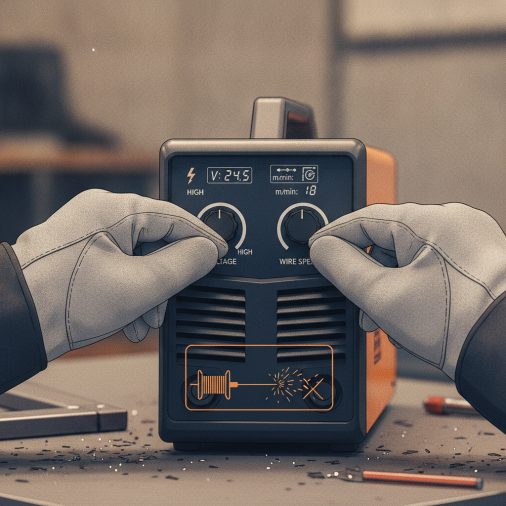
Most spatter issues trace back to voltage and wire feed speed being out of balance. These two settings must work together.
A useful rule of thumb: if the arc sounds like loud, irregular popping or crackling, voltage is likely too low for your wire speed. A properly balanced arc sounds like a steady, smooth frying or buzzing — sometimes described as bacon sizzling.
Practical reference for common wire diameters (mild steel, 75/25 gas):
Wire Diameter
Typical Voltage Range
Wire Feed Speed
0.023"
14–18V
150–250 IPM
0.030"
16–22V
200–350 IPM
0.035"
18–26V
175–300 IPM
0.045"
22–30V
150–250 IPM
These are starting points. Always fine-tune based on material thickness, joint type, and position.
Small voltage adjustments make a noticeable difference. Bumping voltage up by 0.5–1V at a time while listening to the arc is often enough to dramatically reduce spatter without changing wire speed.
Shielding Gas Choices and Their Effect on Spatter
Gas selection has a bigger effect on spatter than many welders expect. Using 100% argon for MIG welding on steel creates its own problems, but 100% CO₂ — while cheap — runs significantly hotter and produces noticeably more spatter than a blended gas.
75% Argon / 25% CO₂ (C25) is the most widely used blend for mild steel MIG welding and strikes a strong balance between arc stability, penetration, and spatter reduction.
90% Argon / 10% CO₂ produces even less spatter and a softer arc, making it useful for thinner material or where appearance matters most. It doesn’t penetrate as aggressively as C25.
For stainless steel, a tri-mix gas (typically 90% He / 7.5% Ar / 2.5% CO₂) or a 98% Argon / 2% CO₂ blend dramatically reduces spatter compared to higher CO₂ mixtures. If you’re working with MIG welding stainless steel settings, getting the gas right is one of the first things to address.
Base Metal Preparation Makes a Real Difference
A clean surface is often the simplest fix for excessive spatter. Contaminants act as arc disruptors — they vaporize or combust under the arc and cause the puddle to pop and spit.
Before welding:
1. Remove rust and mill scale with a flap disc or wire wheel
2. Degrease with acetone or a dedicated metal cleaner — never skip this on anything that’s been handled or stored in a shop environment
3. Remove paint from the weld zone entirely, not just the top layer
4. Dry the metal — moisture on cold metal in humid conditions can cause porosity and spatter
In practice, skipping prep is where many hobbyist welders lose the most spatter control. Even a light pass with a flap disc on cold-rolled steel can noticeably improve arc behavior.
Torch Angle, Stick-Out, and Travel Speed
Technique variables matter almost as much as machine settings. Three areas stand out:
Contact-tip-to-work distance (CTWD) — also called stick-out — should typically be maintained between 1/2 inch and 3/4 inch for most mild steel MIG work. Longer stick-out increases resistance and heats the wire prematurely, making the arc erratic. Whether you push or pull the MIG torch also affects heat input and bead profile, which indirectly influences spatter.
Torch angle — a slight 5–15° drag angle (pushing slightly ahead of the puddle) is standard for MIG. Excessive angle tilts the arc away from proper shielding coverage and increases spatter.
Travel speed — moving too slowly lets the puddle grow excessively and can cause the arc to become buried. Too fast and the arc becomes unstable. A consistent, moderate pace keeps the arc in the right zone.
Consumables, Nozzle Condition, and Anti-Spatter Products
A spatter-clogged nozzle restricts gas flow, and restricted gas flow means poor shielding — which causes more spatter. It becomes a cycle.
Clean the nozzle frequently with nozzle cleaning pliers or a brass reamer. Replace contact tips that show wear, elongation, or excessive buildup. A worn tip that no longer makes solid electrical contact with the wire is a direct spatter generator.
Anti-spatter spray is widely used in production environments and body shops. Products like the Lincoln Electric Anti-Spatter Spray create a release coating on the nozzle and surrounding metal that prevents spatter from bonding, making post-weld cleanup significantly faster. Apply it to the nozzle before welding, not as a substitute for proper settings.
Anti-spatter gel compounds work the same way and tend to be less messy in confined workspaces.
Pulse MIG: The Technology-Based Solution
When dialing in settings isn’t enough — or when the application demands very low spatter consistently — pulse MIG welding is the most effective technical solution.
Pulse MIG alternates between a high peak current that pinches off a droplet and a low background current that keeps the arc alive without transferring metal. This controlled droplet transfer virtually eliminates short-circuit spatter events.
It’s commonly used in:
– Automotive fabrication
– Aluminum MIG welding
– Thin stainless steel applications
– Any job where post-weld cleanup time is a real cost
The tradeoff is cost — pulse MIG machines are significantly more expensive than standard CV welders. For shops doing high-volume work, though, the reduction in cleanup labor often justifies the investment quickly.
Common Spatter Troubleshooting Reference
Symptom
Likely Cause
Fix
Loud popping, irregular arc
Voltage too low
Increase voltage 0.5–1V at a time
Wire stubbing into puddle
Wire feed too fast or voltage too low
Reduce WFS or increase voltage
Spatter on both sides of bead
Contaminated base metal
Clean and degrease before welding
Heavy spatter with 100% CO₂
Gas type
Switch to 75/25 Argon/CO₂ blend
Spatter increases mid-weld
Clogged nozzle
Clean nozzle, check gas flow
Inconsistent arc despite good settings
Worn contact tip
Replace contact tip
Spatter despite good settings
Long stick-out
Reduce CTWD to 1/2"–3/4"
FAQ
Why does my MIG welder produce so much spatter on thin metal?
Thin metal typically requires lower voltage and wire feed speeds. Running settings that are too hot for the gauge causes the arc to penetrate aggressively and the puddle to splash outward. Switching to 0.023″ or 0.025″ wire, reducing heat settings, and using a 90/10 Argon/CO₂ blend usually resolves most spatter on thin MIG welding applications.
Does MIG wire type affect spatter?
Yes. ER70S-6 wire has higher levels of silicon and manganese deoxidizers compared to ER70S-3, which helps it handle mildly contaminated or rusty surfaces with less spatter. In cleaner applications, the difference is smaller, but on less-than-perfect base metal, S-6 is the better choice for spatter control.
How does inductance control affect spatter on a MIG welder?
Inductance controls how quickly current rises during a short circuit. Higher inductance softens the arc and reduces violent spatter during short-circuit transfer mode. Machines with this adjustment — common on mid-range and professional units — allow fine-tuning the arc behavior beyond just voltage and wire feed speed.
Can wrong polarity really cause that much spatter?
Yes. Reversed polarity (DCEN instead of DCEP) causes the arc to behave erratically, produces a poor bead profile, and generates extreme spatter. This mistake sometimes happens after switching from flux-core wire — which runs DCEN — back to solid wire without changing the machine’s polarity leads.
Is spatter always a sign of bad technique or settings?
Not always. Some processes inherently produce more spatter. Flux-core welding produces more than solid wire MIG. Short-circuit transfer produces more than spray transfer. Even properly dialed-in settings on 100% CO₂ will produce more spatter than the same settings on C25. Knowing which process you’re running helps set the right expectations and approach.
Does travel speed affect spatter levels?
Travel speed affects heat input per inch of weld. Moving too slowly increases heat concentration, which can cause excessive puddle turbulence and spatter. Faster travel reduces heat input but can cause arc instability if taken too far. A consistent, moderate travel speed matched to your wire feed rate is part of the same balancing act as voltage.
How do I know if my contact tip is causing spatter?
Signs of a failing contact tip include inconsistent arc start, irregular wire feeding, and spatter that appears suddenly after previously stable welding. Remove the tip and inspect the bore — if it’s elongated into an oval shape instead of round, or shows heavy internal buildup, it needs replacement. Most tips should be checked every few hours of arc time.
Controlling MIG spatter ultimately comes down to three things working together: balanced machine settings, clean base metal, and maintained consumables. Fix those and most spatter problems disappear without any special products or techniques. When the application demands near-zero spatter consistently — think automotive body panels or thin stainless — pulse MIG or a high-argon gas blend takes control to the next level. Start with the basics, listen to the arc, and adjust from there.