
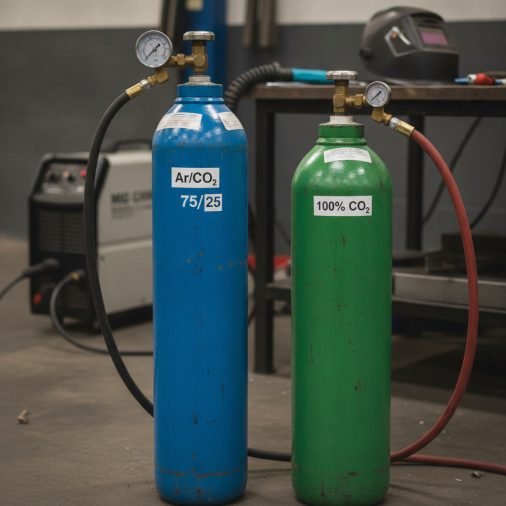
If you’re setting up a MIG welder for the first time, one of the first decisions you’ll face is which shielding gas to use. The choice matters more than most beginners expect.
The two most widely used MIG welding gases are pure argon (Ar) and carbon dioxide (CO₂). In practice, the most popular option for mild steel is a mixed gas combining both — typically 75% argon and 25% CO₂, often called C25. Pure argon is generally reserved for aluminum and some other non-ferrous metals, while pure CO₂ offers deep penetration on steel at a lower cost.
What Shielding Gas Does in MIG Welding
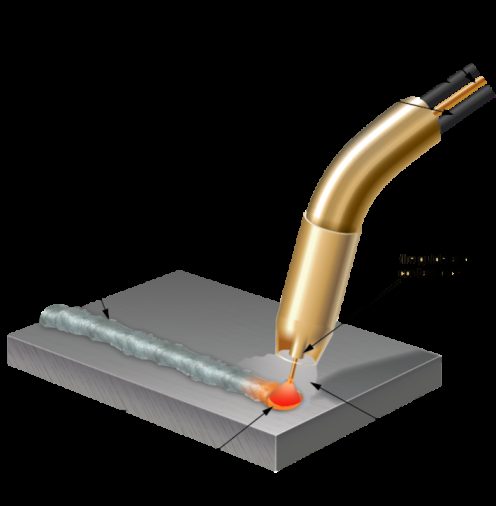
MIG welding — Metal Inert Gas welding, also called Gas Metal Arc Welding (GMAW) — uses a continuous wire electrode and a shielding gas flowing through the gun nozzle. That gas blankets the molten weld pool and protects it from oxygen, nitrogen, and moisture in the surrounding air.
Without adequate shielding, the weld pool absorbs atmospheric gases and the finished weld can suffer from porosity, brittleness, and poor fusion. Choosing the right type of MIG welding gas directly affects weld quality, arc stability, spatter levels, and penetration profile.
Gas Type 1: Argon (Ar)
Argon is a noble gas, meaning it is chemically inert. It does not react with the weld pool or the electrode under any normal welding condition. That inert quality makes it an excellent shield for materials that are sensitive to contamination.
Where Pure Argon Is Used
Pure argon is the standard shielding gas for MIG welding aluminum. It produces a stable, smooth arc and keeps the heat input controlled, which matters because aluminum has a low melting point and can distort quickly. If you’re choosing a gas for aluminum MIG welding, pure argon is generally the correct starting point.
Pure argon is also used for copper, magnesium, titanium, and certain other non-ferrous metals in GMAW applications.
Why Pure Argon Doesn’t Work Well on Steel
On mild or carbon steel, pure argon tends to produce an erratic arc, poor fusion at the toes of the weld, and an uneven bead profile. Steel generally needs some oxidizing component in the shielding gas mix to stabilize the arc and encourage proper wetting. This is why blended gases are far more common for steel MIG work.
Gas Type 2: Carbon Dioxide (CO₂)
Carbon dioxide is an active gas rather than an inert one. It reacts with the molten metal during welding, which gives it different characteristics compared to argon.
Advantages of Pure CO₂
Pure CO₂ is generally the least expensive MIG shielding gas. It provides deep weld penetration, which can be useful on thicker steel sections. It also tends to be widely available in most welding supply outlets.
Disadvantages of Pure CO₂
The trade-off is a rougher arc, significantly more spatter, and a less refined bead appearance compared to argon-rich blends. Pure CO₂ also limits the transfer mode — spray transfer is generally not achievable with 100% CO₂, whereas argon-rich mixes support it. If reducing spatter in MIG welding is a priority, a blended gas will typically perform better.
The Most Practical Choice: Argon-CO₂ Blends

The most commonly used MIG shielding gas for mild steel in most workshops is a blended mix of argon and carbon dioxide. The blend combines the arc stability of argon with the penetration and cost benefits of CO₂.
The 75% argon / 25% CO₂ blend (C25) is the most popular general-purpose choice for short-circuit MIG welding on mild steel. It produces a stable arc, manageable spatter, good bead appearance, and adequate penetration for most fabrication and repair work.
Higher argon content blends, such as 90% Ar / 10% CO₂, are sometimes used when spray transfer or a finer bead profile is needed. For MIG welding mild steel, the right blend depends on your transfer mode, wire diameter, and the application.
Quick Comparison: Argon vs CO₂ vs Ar/CO₂ Blend
| Gas | Best For | Arc Quality | Spatter | Penetration | Cost (Relative) |
|---|---|---|---|---|---|
| Pure Argon | Aluminum, non-ferrous metals | Very stable | Low | Moderate | Moderate |
| Pure CO₂ | Thick mild steel, budget work | Rough | High | Deep | Low |
| 75% Ar / 25% CO₂ (C25) | Mild steel, general fabrication | Stable | Low–moderate | Good | Moderate |
What About Stainless Steel?
Stainless steel MIG welding typically uses a tri-mix gas or a specialized argon-based blend. A common choice is an argon-rich mix with a small percentage of CO₂ or oxygen. Pure CO₂ is generally avoided on stainless because of its effect on corrosion resistance and weld chemistry.
If you’re working with stainless, it’s worth reviewing the specific gas requirements for stainless MIG welding before purchasing a cylinder, as the blend is different from what you’d use on mild steel.
Gas Flow Rate and Cylinder Safety
Regardless of which gas you choose, flow rate needs to be set correctly at the regulator. Too low a flow rate leaves the weld pool unprotected; too high can cause turbulence that draws in atmospheric air. Most shop applications fall somewhere in the range of 15–25 cubic feet per hour (CFH) as a general starting point, though your specific setup, nozzle size, and welding position may shift that. Always follow your equipment manufacturer’s guidance.
Always store and transport gas cylinders secured upright. Never use a cylinder without a proper regulator, and keep protective caps in place when the cylinder is not connected. Understanding how MIG welding gas costs are structured can help you plan for both cylinder rental and refill expenses.
Welding Without Gas
If a shielding gas cylinder isn’t available or practical, flux-core wire (FCAW-S) offers an alternative for steel welding. Self-shielded flux-core wire generates its own protective atmosphere from flux within the wire. This approach has different characteristics and limitations compared to gas-shielded MIG. For a full breakdown, MIG welding without gas using flux-core wire explains the process and when it applies.
Safety Considerations
Both argon and CO₂ are non-toxic but can displace oxygen in enclosed or poorly ventilated spaces, creating an asphyxiation hazard. Always weld in a well-ventilated area or use local fume extraction.
Wear an appropriate auto-darkening or fixed-shade welding helmet, leather gloves, and flame-resistant clothing. Keep gas cylinders chained or strapped to a wall or cart at all times, and close the cylinder valve when work is finished.
Frequently Asked Questions
Can I use pure argon for MIG welding mild steel?
Pure argon is generally not recommended for MIG welding mild steel. It tends to produce an unstable arc, poor weld toe fusion, and an irregular bead profile. Steel typically needs an argon-CO₂ blend or pure CO₂ to achieve a stable arc and proper penetration. Pure argon is suited to aluminum and other non-ferrous metals.
What does C25 mean in MIG welding gas?
C25 refers to a pre-mixed shielding gas containing 75% argon and 25% carbon dioxide. It is one of the most commonly used blends for short-circuit MIG welding on mild steel. The designation comes from the CO₂ percentage — C for carbon dioxide, 25 for 25%. It offers good arc stability, lower spatter, and reasonable penetration for general fabrication work.
Is CO₂ or argon better for MIG welding?
Neither is universally better — it depends on the base material and application. Pure CO₂ offers deeper penetration and a lower cost for steel welding but produces more spatter and a rougher arc. Pure argon is best for aluminum and non-ferrous metals. For most mild steel work, a 75/25 argon-CO₂ blend gives a better balance of arc quality, spatter control, and penetration.
What happens if I use the wrong shielding gas?
Using an incompatible shielding gas can cause porosity, poor fusion, excessive spatter, arc instability, or weld contamination. For example, using pure CO₂ on aluminum can lead to severe oxidation and a contaminated weld pool. Always match the shielding gas to the base material and consult the wire manufacturer’s recommendations for the specific wire classification you are using.
How do I know when my MIG gas cylinder is running low?
Most MIG gas setups use a two-gauge regulator — one shows cylinder pressure and one shows flow rate. Monitoring cylinder pressure gives you the clearest indication of remaining gas. As the cylinder empties, the pressure will drop noticeably. It’s good practice to track usage and arrange a refill before the cylinder runs completely out mid-weld.
Choosing the Right Gas for Your Situation
For most beginners and intermediate welders working with mild steel, a 75% argon / 25% CO₂ blend is the most practical starting point. It handles a wide range of thicknesses, produces a clean bead, and is available at most welding supply outlets. Pure argon is the right choice when you move to aluminum or other non-ferrous metals.
Always match the gas to the base material and the wire classification you are running. When in doubt, check the wire manufacturer’s data sheet — it will typically specify the recommended shielding gas options for that electrode.


