
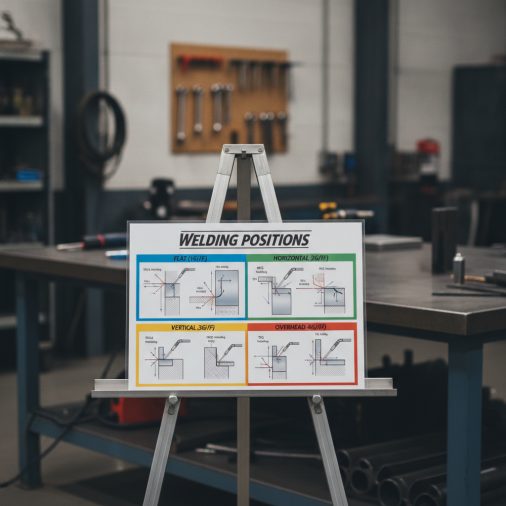
Whether you’re new to welding or studying for a certification, understanding welding positions is essential. This article explains every standard welding position, what the number and letter codes mean, and how each position affects your technique and results. You’ll also find a clear reference chart and answers to the most common questions welders ask.
—
Quick Answer
Welding positions are standardized orientations used when joining metal. They are coded by number (1–4) and letter (F for fillet, G for groove). The four main positions are flat (1), horizontal (2), vertical (3), and overhead (4). A “3G” weld, for example, means a groove weld performed in the vertical position.
—
Why Welding Positions Matter
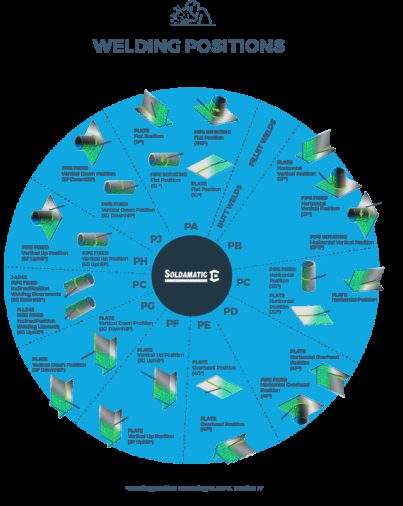
The position you weld in directly affects how molten metal behaves. Gravity pulls the weld pool differently depending on the angle of the joint and the direction of travel.
Flat welding is the easiest because gravity works in your favor. Overhead welding is the most challenging because the molten pool wants to fall away from the joint.
Knowing your position helps you adjust travel speed, electrode angle, amperage, and technique. Welding in the wrong position without adjusting settings is one of the most common causes of porosity, undercut, and incomplete fusion.
—
The Standard Welding Position Codes Explained
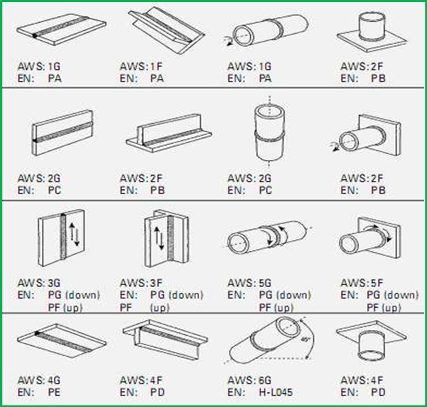
The American Welding Society (AWS) uses a simple numbering and lettering system to classify positions.
– Number = the position (1 = flat, 2 = horizontal, 3 = vertical, 4 = overhead)
– Letter = the joint type (F = fillet weld, G = groove weld)
So “1F” means a fillet weld in the flat position, and “4G” means a groove weld overhead. Pipe welding adds “6G” and “5G” codes, which are discussed separately below.
—
Complete Welding Positions Chart
This chart covers the positions used in structural and pipe welding qualifications under AWS D1.1 and ASME Section IX standards.
—
Flat Position (1F and 1G)
In the flat position, the workpiece lies horizontally and you weld from above. The weld pool sits in a natural “cup” formed by the joint, making it easy to control.
This is the position used on most production floors and fabrication shops when parts can be repositioned. It allows for higher travel speeds and produces consistent, clean beads with less skill required.
For groove welds (1G), the plate lies flat and you run the bead along the joint from one end to the other. For fillet welds (1F), the two pieces form a T-joint and you weld into the corner from above.
—
Horizontal Position (2F and 2G)
In the horizontal position, the weld axis runs horizontally but the face of the weld is vertical. Gravity pulls the molten pool downward, which can cause the bead to sag or undercut the upper plate.
Field experience shows that reducing amperage slightly and angling the electrode upward by 5–15 degrees helps counteract this sagging tendency. Travel speed also needs to increase compared to flat welding.
The 2G position is commonly tested in structural welding certifications because it represents a realistic condition when welding beams, columns, and structural connections that cannot be repositioned.
—
Vertical Position (3F and 3G)
Vertical welding involves running a bead up or down a vertical surface. Welding uphill (3G up) produces better penetration and is required for most structural certifications. Welding downhill is faster but gives shallower penetration.
A common issue technicians encounter in vertical welding is the weld pool running ahead of the arc. Using a weaving motion or a “Christmas tree” pattern helps control the pool and build the bead evenly.
In practice, vertical welding requires more electrode manipulation than flat or horizontal positions. Reducing heat input and using a slightly steeper work angle helps maintain control throughout the pass.
—
Overhead Position (4F and 4G)
Overhead welding is performed with the joint above the welder’s head. The molten pool must be held in place against gravity, which demands precise arc length control and faster travel speed.
Spatter increases significantly in this position. Protecting yourself with proper PPE — including a leather jacket and gloves — is critical, not just recommended.
Shorter arc length is the most important adjustment for overhead welding. A longer arc in this position causes the pool to drip and creates an inconsistent bead profile.
—
Pipe Welding Positions (5G and 6G)
Pipe welding positions are unique because the pipe itself is fixed and the welder moves around it.
5G means the pipe is fixed with its axis horizontal. The welder must weld in all positions — flat at the top, vertical on the sides, and overhead at the bottom — without rotating the pipe.
6G is the most demanding certification test. The pipe is fixed at a 45-degree angle, requiring the welder to transition through every position in a single pass. Passing a 6G test qualifies a welder for nearly all other positions under most codes.
There is also a 6GR designation, which adds a restriction ring near the joint to simulate welding in tight spaces, such as inside pipe racks or structural nodes.
—
How Welding Process Affects Position Performance
Not every welding process performs equally well in all positions. The process you use changes what positions are practical or even possible.
*Short-circuit transfer mode required for out-of-position MIG welding. Spray transfer is limited to flat and horizontal only.
Submerged arc welding (SAW) uses a granular flux that cannot be used out of position — the flux simply falls away. This is why SAW is only practical in flat or slightly inclined positions.
—
Common Mistakes When Welding Out of Position
Even experienced welders make avoidable errors when working in challenging positions. These are the most frequent problems:
– Using flat-position settings in overhead or vertical work — this causes excessive heat and pool dripping
– Incorrect electrode angle — even a few degrees off can cause undercut or overlap
– Moving too slowly — out-of-position welding generally requires faster travel than flat welding
– Ignoring gravity — not anticipating how the pool will move leads to inconsistent bead profiles
– Skipping tack welds — parts can shift during out-of-position welding if not properly secured first
Adjusting your machine settings before starting each position change is a habit that separates consistent welders from inconsistent ones.
A proper home welding setup can help beginners avoid common mistakes when welding out of position.
—
FAQ
What does 3G and 4G mean in welding?
3G means a groove weld performed in the vertical position. 4G means a groove weld performed overhead. These are common certification test positions under AWS standards.
Does passing a 6G test qualify you for all positions?
Yes. A 6G pipe welding certification qualifies the welder for all positions and most joint types under AWS and ASME codes, making it the most valuable single qualification test.
What is the hardest welding position?
6G is generally considered the hardest because it requires welding at a 45-degree pipe angle, forcing the welder through every position in a single continuous weld.
Can you MIG weld in all positions?
Yes, but only using short-circuit transfer mode for vertical and overhead positions. Spray transfer is limited to flat and horizontal because the larger, hotter pool cannot be controlled out of position.
What is the difference between 1F and 1G?
Both are flat position welds. 1F is a fillet weld (T-joint or lap joint), while 1G is a groove weld (butt joint). The position is the same, but the joint geometry differs.
Why is vertical welding done uphill for structural work?
Uphill vertical welding produces deeper penetration and better fusion at the root. Downhill welding is faster but leaves a shallower weld, which does not meet structural code requirements in most applications.
What does the “R” mean in 6GR?
The “R” stands for restriction. A steel ring is placed near the joint to simulate confined-space welding conditions. It is used in offshore and structural pipe qualification tests.
—
Final Thoughts
Welding positions are not just test categories — they reflect real-world conditions that every welder encounters on the job. The number-letter coding system (1F, 3G, 6G, etc.) gives a precise way to communicate joint orientation, and understanding what each code means helps you prepare the right technique before striking an arc.
Flat welding is the starting point, but true welding competency means being comfortable in horizontal, vertical, and overhead positions. For pipe welders, the 6G certification remains the gold standard. Matching your process settings to the position you’re working in is what separates a clean, code-quality weld from a reject.


