
MIG welding produces clean, strong welds — but only when your machine is dialed in correctly. Getting the settings wrong leads to weak joints, excessive spatter, burn-through, or poor fusion. This guide walks you through every key setting on a MIG welder, explains how each one affects your weld, and gives you practical reference points so you can set up confidently for any job.
The settings for MIG welding are influenced by three primary factors: wire feed speed, voltage, and the Oxy Acetylene Welding Pressure Settings. For most mild steel work, start with the manufacturer’s chart inside your welder’s door, then fine-tune based on the metal thickness, wire diameter, and position. A good starting point for 1/8″ mild steel is around 19–21V with 200–250 IPM wire feed speed.
The Three Core Settings Every MIG Welder Controls
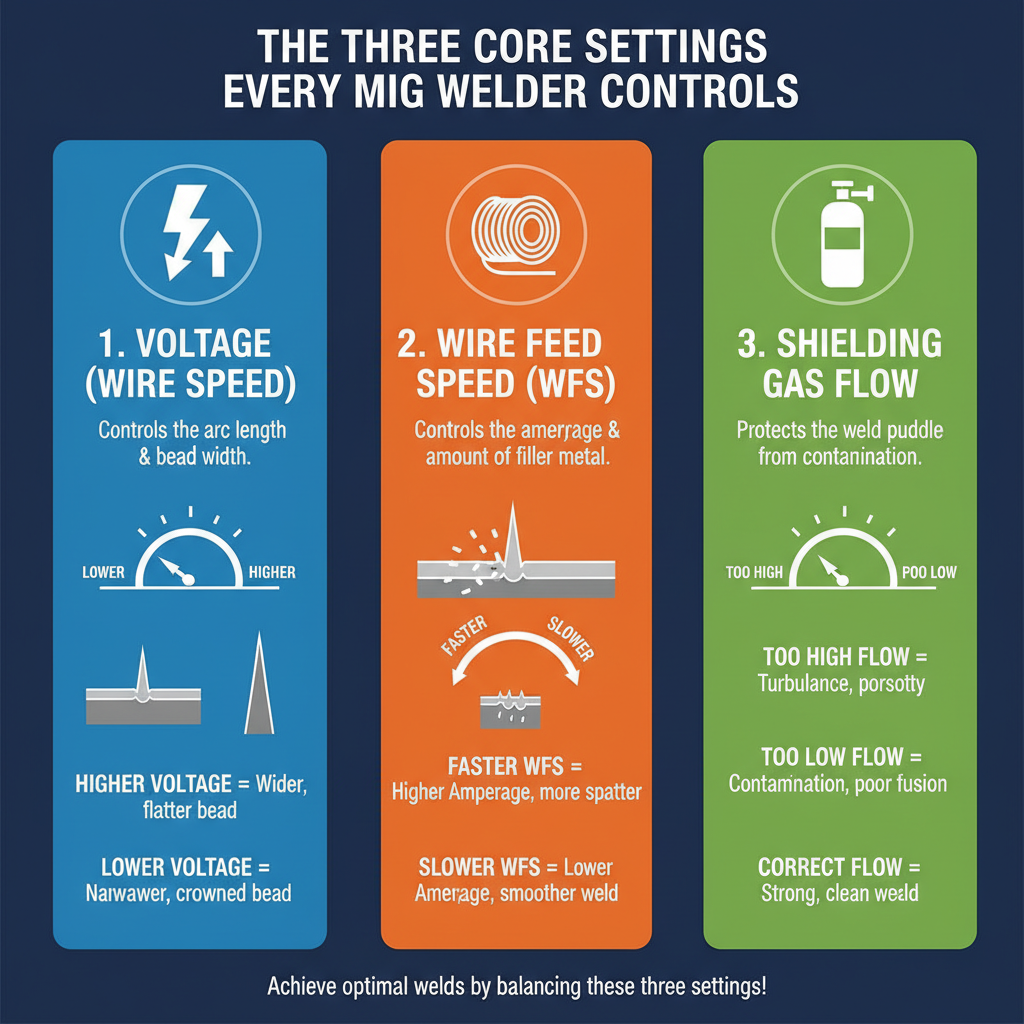
Every MIG welder — from a basic 110V machine to a professional 220V unit — revolves around three adjustable parameters.
Voltage controls the arc length and bead profile. Higher voltage produces a flatter, wider bead. Lower voltage creates a narrower, more convex bead. Voltage is measured in volts (V) and typically ranges from 14V to 30V depending on the machine.
Wire Feed Speed (WFS) controls how fast the wire electrode feeds into the weld pool. It directly determines amperage — faster wire feed means more current. WFS is measured in inches per minute (IPM) and typically ranges from 100 to 500+ IPM.
Shielding Gas Flow Rate protects the molten weld pool from atmospheric contamination. It’s measured in cubic feet per hour (CFH) and usually set between 15 and 25 CFH for most applications.
—
How Metal Thickness Determines Your Starting Settings
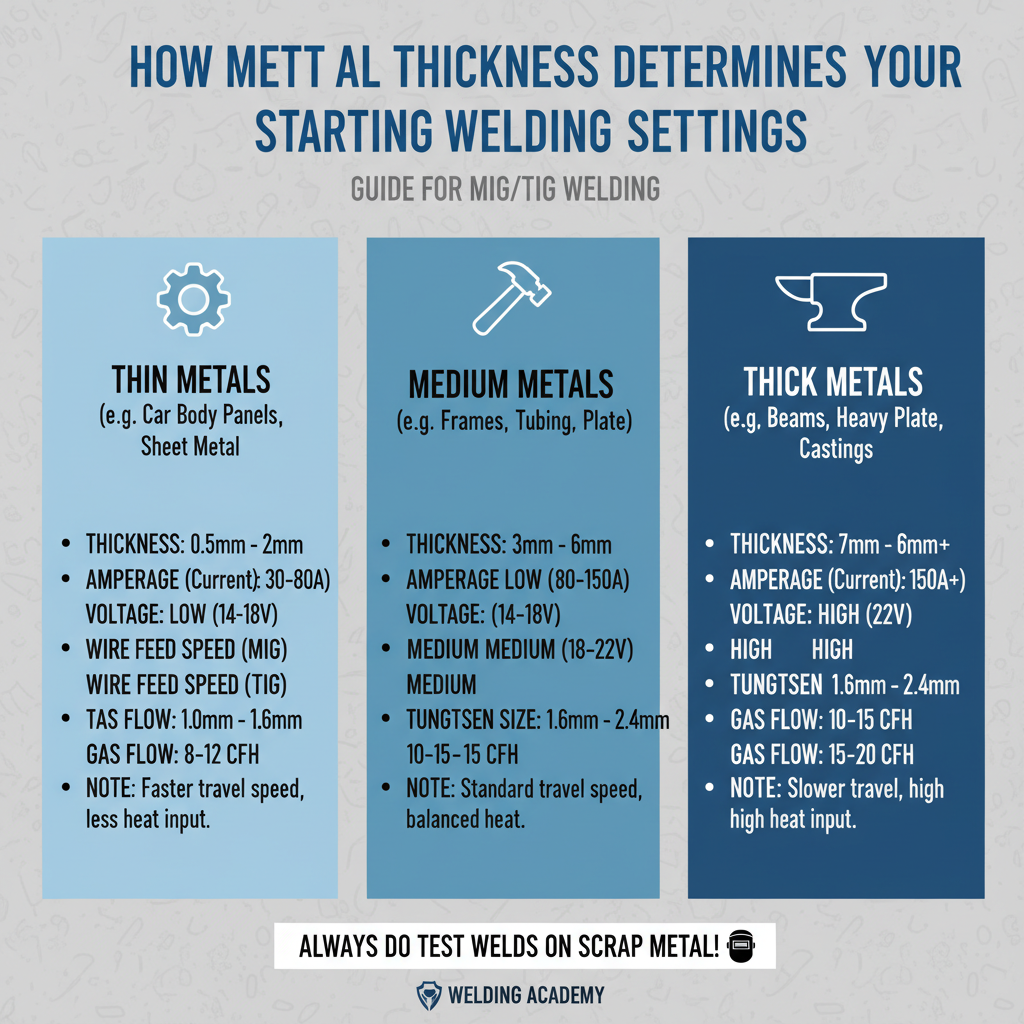
Plate thickness is the most important factor to consider when selecting your MIG settings. When working with thin metal, it’s essential to use lower heat, while thicker metal requires more penetration.
A widely used rule of thumb: 1 amp per 0.001″ of material thickness. So 1/8″ (0.125″) steel needs roughly 125 amps, which corresponds to a specific wire feed speed depending on your wire diameter.
Here’s a practical reference table for mild steel using ER70S-6 wire:
| Metal Thickness | Wire Diameter | Voltage (V) | Wire Feed Speed (IPM) | Amperage (Approx.) |
|---|---|---|---|---|
| 24 gauge (0.024″) | 0.023″ | 13–15 | 100–130 | 40–60A |
| 18 gauge (0.048″) | 0.030″ | 15–17 | 150–180 | 75–100A |
| 1/16″ (0.063″) | 0.030″ | 17–18 | 175–210 | 100–120A |
| 1/8″ (0.125″) | 0.035″ | 19–21 | 200–250 | 130–160A |
| 3/16″ (0.188″) | 0.035″ | 21–23 | 250–300 | 160–200A |
| 1/4″ (0.250″) | 0.035″–0.045″ | 23–26 | 300–380 | 200–250A |
MIG welder settings depend on three main variables: wire feed speed, voltage, and shielding gas flow rate.
| <p> | Problem | Likely Cause | Fix |
|---|---|---|---|
| Excessive spatter | Voltage too low or wire speed too high | Increase voltage or reduce WFS | |
| Porosity (holes in bead) | Gas coverage issue or contaminated metal | Check flow rate, clean base metal | |
| Burn-through | Too much heat on thin material | Lower voltage, increase travel speed, use smaller wire | |
| Poor fusion | Voltage too low or travel speed too fast | Increase voltage slightly, slow travel | |
| Wire stubbing | Wire speed too high for voltage | Reduce WFS or increase voltage | |
| Convex, ropy bead | Voltage too low | Increase voltage in 0.5V increments | |
| Flat, wide bead with undercut | Voltage too high | Reduce voltage | </p> |
—
Inductance and Other Secondary Settings
Some MIG welders include an inductance or arc control adjustment. This setting controls how quickly the arc responds to changes in arc length.
Higher inductance creates a softer, more fluid arc with less spatter — useful for short-circuit transfer on thin material. Lower inductance produces a crisper, stiffer arc better suited for spray transfer or thicker material.
Not all machines have this control, but if yours does, start at the midpoint and adjust based on spatter levels and bead profile.
—
FAQ
What settings should I use for MIG welding 1/4″ steel?
For 1/4″ mild steel with 0.035″ wire and 75/25 gas, start around 23–25V and 300–350 IPM wire feed speed. Preheat the material if it’s cold or if you’re welding in a cold environment.
Why does my MIG welder produce so much spatter?
Spatter usually means the voltage is too low for the wire speed, or the shielding gas flow is inadequate. Try increasing voltage by 0.5–1V increments and verify your gas flow is 15–20 CFH.
Can I MIG weld aluminum with the same settings as steel?
No. Aluminum requires 100% Argon shielding gas, a spool gun or push-pull system, and different wire (ER4043 or ER5356). Voltage and wire speed settings are also different and typically higher.
What’s the difference between voltage and wire feed speed on a MIG welder?
Voltage controls arc length and bead width. Wire feed speed controls amperage and penetration depth. Both must be balanced together for a stable arc.
How do I know if my MIG settings are correct?
Run a test bead on scrap metal of the same thickness. The arc should sound like steady frying bacon. The bead should be flat, evenly wide, and show good fusion at the edges without undercut or excessive buildup.
Should I use 75/25 or 100% CO₂ for MIG welding?
75/25 Argon/CO₂ is better for most applications — cleaner welds, less spatter, better appearance. 100% CO₂ is cheaper and penetrates deeper, making it a reasonable choice for structural work where appearance isn’t critical.
What wire feed speed should I start with for thin sheet metal?
For 18–20 gauge sheet metal with 0.023″ or 0.030″ wire, start around 150–180 IPM and 15–17V. Use short, controlled passes to manage heat input.
—
Final Thoughts
Getting MIG welder settings right comes down to matching voltage, wire feed speed, and gas flow to your specific material thickness and wire diameter. Start with the reference chart inside your machine’s door or the table in this guide, then run a test bead on scrap and listen to the arc. A smooth, consistent buzzing sound means you’re dialed in. Small adjustments — half a volt here, 10 IPM there — make a bigger difference than most beginners expect. Master the relationship between these three settings, and consistent, clean welds become repeatable rather than accidental.


