
What Virginia Welders Actually Earn on Average
| Experience Level | Typical Hourly Rate (VA) |
|---|---|
| Entry-level (0–2 years) | $18 – $22/hour |
| Mid-level (3–7 years) | $24 – $35/hour |
| Senior/Specialized (8+ years) | $36 – $55/hour |
| Certified Pipe/Structural Welder | $45 – $70+/hour |
| Underwater Welder (contract) | $75 – $150+/hour |
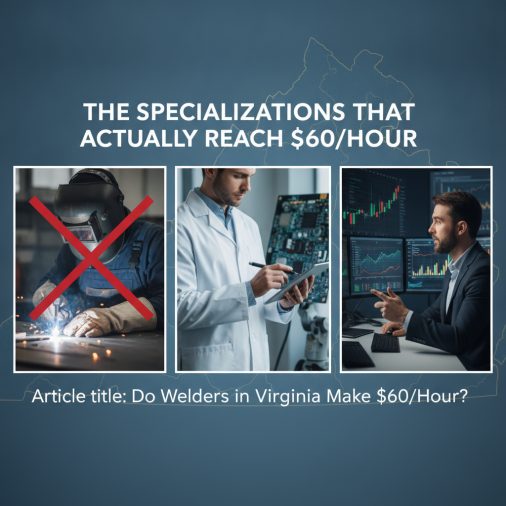
The Specializations That Actually Reach $60/Hour
Why Virginia Specifically Matters for Welding Pay
Virginia’s geographic diversity creates unusually varied welding opportunities within a single state. – Hampton Roads / Norfolk area — Heavy shipbuilding and naval repair work through contractors connected to Naval Station Norfolk. This is one of the more consistently well-paying regions for welders in the Southeast. – Northern Virginia / DC Metro — Commercial construction, government contractor fabrication shops, and infrastructure projects. Pay is elevated here partly due to the regional cost of living. – Shenandoah Valley / Roanoke — Manufacturing and industrial maintenance roles. Solid wages but typically lower than coastal or urban markets. – Southwest Virginia — Energy-related welding, often tied to pipeline maintenance. Pay can spike significantly for experienced pipe welders. Location inside Virginia often matters as much as specialization when it comes to hitting higher pay brackets.Certifications That Push Pay Above the Average
Welding certifications from the American Welding Society (AWS) are the most direct way to justify higher pay rates. Employers in Virginia — particularly defense contractors and industrial facilities — actively seek certified welders and are willing to pay significantly more for documented skill. The certifications most likely to move your hourly rate: – AWS Certified Welder (CW) — Entry credential, improves hire-ability – AWS D1.1 Structural Steel — Frequently required for construction and government contracts – ASME Section IX — Required for pressure vessel and piping work; major pay increase – 6G pipe position certification — One of the hardest to pass, commands top-tier pay – AWS Certified Welding Inspector (CWI) — Moves welders into inspection roles, often $35–$60+/hour The 6G pipe position test, in particular, is considered a benchmark for serious pipe welders. Passing it opens doors to the most lucrative welding contracts in Virginia and nationally.Contract vs. Salaried Welding: Why It Changes Everything
Much of the confusion around the $60/hour figure comes from mixing up contract wages with salaried positions. A welder employed full-time at a manufacturing plant in Richmond might earn $28–$35/hour with benefits. The same welder doing contract work for a shipyard or industrial shutdown earns significantly more per hour — but without paid time off, health insurance, or retirement contributions. Contract and shutdown welders also often work overtime-heavy schedules — 10–12 hour days, six or seven days a week during active projects. The high hourly rate reflects both skill and the temporary, high-demand nature of that work. Self-employed welders and mobile welding service operators can also reach $60/hour and above, particularly when factoring in service call rates for mobile fabrication, equipment repair, and specialty welding for farms, construction sites, or automotive shops.Industries in Virginia Paying Top Welding Wages
Not all industries value welding skill equally. In practice, the industries most likely to pay $60/hour or above in Virginia include: – Shipbuilding and ship repair (Huntington Ingalls Industries, BAE Systems) – Nuclear and power generation (Dominion Energy facilities require extremely precise welding certifications) – Defense contracting and aerospace – Oil and gas pipeline maintenance – Industrial plant shutdown and turnaround work – Underwater and commercial diving operations General manufacturing, auto body shops, and small fabrication shops are less likely to approach those numbers — though skilled welders in any sector earn more than the entry-level averages suggest.How to Move From Average Pay to Premium Pay
Reaching $60/hour as a welder in Virginia is a realistic goal, but it takes deliberate steps. 1. Start with a solid foundation — Community college welding programs and vocational training set the technical baseline. 2. Get AWS certified — Even the basic CW certification signals credibility to employers. 3. Pursue pipe welding — The 6G certification is challenging, but it separates mid-tier welders from premium earners. 4. Target high-demand sectors — Apply to shipyards, defense contractors, and energy companies rather than general fab shops. 5. Consider contract work — Traveling for industrial shutdowns or offshore contracts accelerates income dramatically. 6. Build inspection credentials — A CWI designation can transition a skilled welder into a $45–$65/hour inspection role. Most welders who reach top-tier pay didn’t follow a single straight path. Field experience shows that the combination of hands-on expertise, certifications, and willingness to work demanding contract schedules is what consistently produces the highest earnings.FAQ
What is the average annual salary for a welder in Virginia? Most full-time welders in Virginia earn between $46,000 and $65,000 per year. That translates to roughly $22–$31/hour for salaried positions. Specialized welders — particularly certified pipe and structural welders — can push well above that range, especially through overtime and contract work. Can beginner welders in Virginia realistically earn $60/hour? Not immediately. Entry-level welders in Virginia typically start around $18–$22/hour. Reaching $60/hour generally requires 5–10 years of experience, advanced certifications like ASME Section IX or 6G pipe, and placement in a specialized or contract-based role. It’s a realistic long-term target, not a starting wage. Which Virginia city pays welders the most? The Hampton Roads metro area — particularly Newport News and Norfolk — tends to pay welders among the highest rates in the state due to shipbuilding and naval repair demand. Northern Virginia also offers elevated wages driven by commercial construction and defense contracting, though the cost of living is significantly higher. Do welders in Virginia need a state license? Virginia does not require a general state welding license for most applications. However, specific work contexts — like pressure vessels, boiler systems, or certain government contracts — may require AWS or ASME certifications. Always verify requirements with the specific employer or project specifications. How does pipeline welding pay compare to shop welding in Virginia? Pipeline and field welding pays considerably more than shop welding in most cases. A shop welder in Virginia might earn $25–$35/hour, while a certified pipeline welder working contractor projects can earn $50–$75/hour or more. The trade-off involves travel, physical demands, and inconsistent schedules. What certifications matter most for high-paying welding jobs in Virginia? The AWS 6G pipe certification, ASME Section IX, and AWS D1.1 structural certification are the most valued credentials for premium positions. The AWS Certified Welding Inspector (CWI) designation is also highly sought-after and can move a welder into supervisory and inspection roles that command strong pay. Is underwater welding available in Virginia, and what does it pay? Yes. Virginia’s coastal geography and proximity to major naval facilities creates genuine demand for commercial diving welders. Underwater welding is one of the highest-risk and highest-paid specialties in the trade — experienced commercial dive welders can earn $75–$150+/hour on contract, though the work is physically demanding and requires specialized training beyond standard welding programs.Virginia genuinely offers pathways to $60/hour welding wages, but they run through specific specializations, certifications, and industry sectors — not the average shop floor. The welders consistently earning at that level have combined technical mastery with credentials that prove it. For most welders, getting there is a five-to-ten year process of deliberate skill-building rather than a quick jump.


