

What “Through Plate” Actually Means in Practice
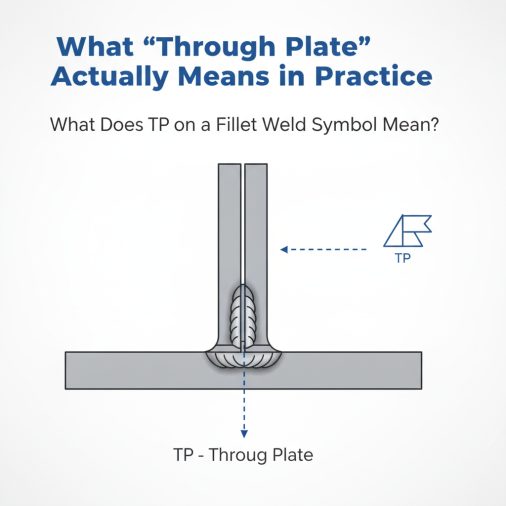
Where You’ll See the TP Notation on a Drawing
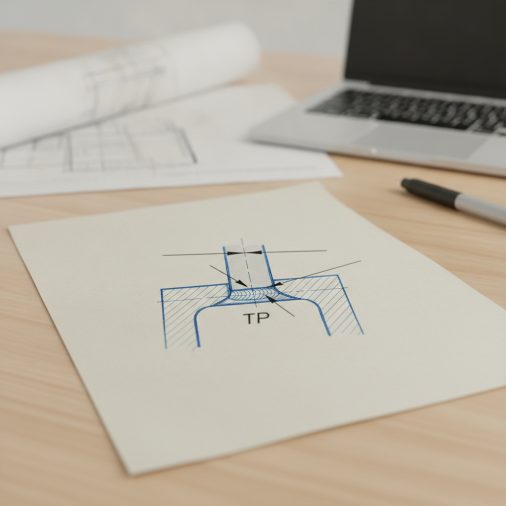
Why Through Plate Welds Are Specified
Engineers don’t add “TP” to a drawing without reason. Through plate connections are typically called out when: – High shear loads are expected at the joint – Moment connections require continuous load paths through the member – Structural codes mandate full penetration or continuity for seismic or fatigue applications – Column base plates or beam-to-column connections require transfer of axial and lateral forces The through plate configuration significantly increases the effective load-carrying capacity of the connection because the force path travels through the plate material itself rather than depending entirely on the weld throat size. This is especially important in high-stress structural steel applications governed by AISC or AWS D1.1 provisions.How TP Affects Fillet Weld Size and Execution
The presence of a TP designation changes how the welder approaches the joint. Rather than simply laying a fillet at an inside corner, the process typically involves: 1. Cutting a slot in the receiving member to accommodate the plate thickness plus clearance 2. Fitting the through plate so it extends fully through the member 3. Welding both exposed faces of the plate to the member faces on each side 4. Grinding or finishing the weld faces flush if required by the drawing callout The fillet weld size shown on the symbol still applies — it specifies the leg size of each individual fillet. The TP notation adds the requirement that these fillets exist on both sides of the through plate, not just one. Proper fillet weld sizing becomes critical here, because undersizing either weld reduces the joint’s ability to transfer load as designed. For structural applications, it’s worth noting that minimum fillet weld sizes per AWS specifications still apply to each individual weld leg, regardless of the through plate condition.Common Mistakes When Reading TP on a Fillet Weld Symbol
Field experience shows that misreading or ignoring the TP callout is more common than it should be, particularly when a welder is working from a crowded drawing with multiple weld callouts. The most frequent errors include: – Welding only one side of the through plate instead of both faces – Confusing TP with a process abbreviation — it is not related to tungsten plasma or any electrode type – Skipping the slot preparation and attempting a surface fillet only, which defeats the purpose of the through plate requirement – Undersizing the weld on one side because both sides weren’t noted on the symbol clearly When the TP callout appears, the welder and fabricator should confirm with the engineer or inspector whether the slot dimensions, fit-up tolerance, and finishing requirements are also specified in the general notes or WPS before starting.TP vs. Other Weld Symbol Supplementary Notations
It helps to know how TP compares to other common supplementary notations you might see near a fillet weld symbol.| Notation | Meaning | Affects Weld Profile? |
|---|---|---|
| TP | Through Plate | Yes — requires plate penetration |
| ALL AROUND | Weld continues around entire joint perimeter | Yes — scope of weld |
| FIELD | Weld is made in the field, not the shop | No — location only |
| CJP | Complete Joint Penetration | Yes — full depth fusion |
| PJP | Partial Joint Penetration | Yes — partial depth fusion |
| BSP | Back or Backing Strip used | Yes — joint preparation |
FAQ
What does TP mean on a structural steel drawing? On a structural steel drawing, TP stands for Through Plate. It indicates a connecting plate that passes completely through a structural member, such as a column or beam web. The fillet welds are then applied to both exposed faces of the plate on either side of the member, creating a continuous load path through the joint. Is a through plate weld the same as a full penetration weld? Not exactly. A through plate weld refers to the physical configuration of the joint — the plate passes through the member. A complete joint penetration (CJP) weld refers to the weld itself fusing through the full depth of the joint. A through plate connection can use fillet welds on each face without requiring CJP of the plate itself, though the combination is sometimes specified together. Does the TP notation appear in AWS D1.1? The through plate concept is addressed within AWS D1.1 structural welding code requirements for certain connection types, but the specific “TP” abbreviation is most commonly found in engineering firm drawing standards and AISC connection design references. Always verify the definition in the drawing’s general notes or weld symbol legend before fabrication. How do I determine the correct fillet weld size for a through plate connection? The fillet weld size for a through plate joint is determined by the structural engineer based on the applied loads, plate thickness, and material grade. The drawing will specify the leg size on the weld symbol. As a general starting point, practical fillet weld sizing rules can help contextualize what the engineer’s callout represents, but never substitute a rule of thumb for the engineered value on a structural drawing. Can a fillet weld on a through plate be inspected the same way as a standard fillet? Yes, the individual fillet welds on each side of a through plate are inspected using the same criteria — weld size, profile, and surface condition. A proper fillet weld measurement technique applies to each face separately. Inspectors will also verify that the plate itself is fully inserted through the member and that no side is unwelded or undersize. What happens if the TP requirement is missed during fabrication? Missing a through plate requirement is a significant non-conformance in structural fabrication. The joint will not achieve the intended load path, and depending on the connection type, it may be structurally unsafe. The fabricator typically needs to disassemble or modify the joint and re-weld to specification, which is far more costly than reading the drawing correctly the first time. Does TP always mean the plate goes completely through the member? In the vast majority of cases, yes. The through plate must physically extend through the full thickness of the receiving member. Partial insertion defeats the purpose of the connection type. If there’s any ambiguity about insertion depth or slot dimensions on the drawing, clarify with the engineer of record before cutting or fitting.The “TP” callout is easy to overlook on a busy fabrication drawing, but ignoring it creates a joint that looks complete and isn’t. When you see it, treat it as a geometry requirement first — the plate goes through the member, and both sides get welded. Get that step right, and the rest of the fillet weld work follows standard practice.


