
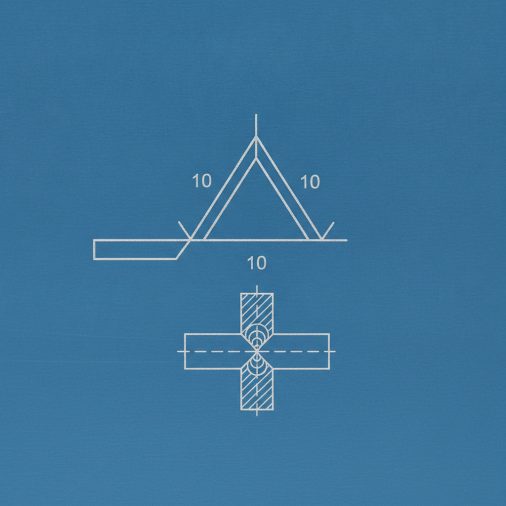
What the Fillet Weld Symbol Actually Shows
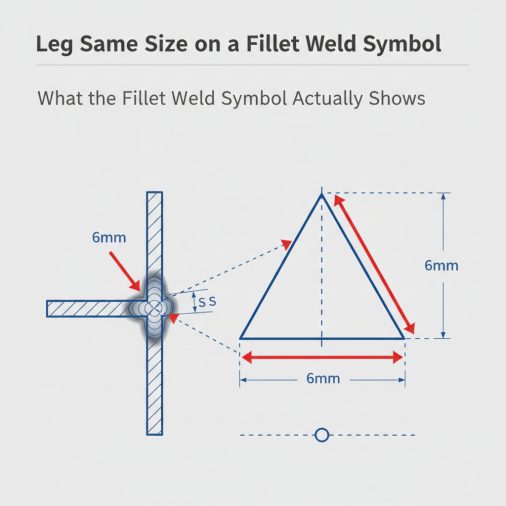
Why Equal-Leg Fillet Welds Are the Default
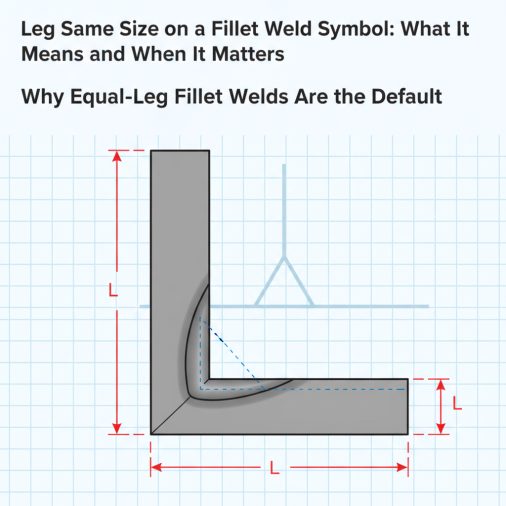
Reading the Symbol: Equal Legs vs. Unequal Legs
This is where confusion often happens on the shop floor. Here’s how to distinguish the two cases: Equal-leg fillet weld symbol: – Single size value shown: e.g., (3/8) – Both legs are 3/8″ – Standard 45° face assumed Unequal-leg fillet weld symbol: – Two size values shown, separated by a multiplication sign or parentheses: e.g., (1/4 × 1/2) – The first value is the leg along the base plate; the second is the leg along the vertical member – The orientation of the longer leg must be noted or shown clearly on the drawing In practice, if you only see one number and no other notation, always weld equal legs. Assuming unequal legs when equal legs are specified — or vice versa — creates a weld that either undershoots the required throat or misdirects load transfer. Understanding how to measure a fillet weld size correctly is essential for confirming compliance after the bead is laid.How Leg Size Connects to Weld Throat and Strength
The leg size isn’t just a geometric number — it directly controls the weld’s load-carrying capacity through the effective throat. For an equal-leg fillet weld: > Effective Throat = 0.707 × Leg Size So a 1/2″ equal-leg fillet weld has an effective throat of approximately 0.354″. This throat dimension is what structural calculations actually use to determine shear strength at the weld interface. If legs were unequal — say, 1/4″ × 1/2″ — the effective throat drops to 0.707 × the shorter leg, which is 0.177″. That’s a significant reduction in capacity compared to a true 1/2″ equal-leg weld. This is why specifying and depositing the correct leg size matters. A weld that looks large on one side but is undersized on the other still fails by the shorter leg. For applications where leg size is code-driven, AWS minimum fillet weld size requirements set a floor based on the thicker base material.Common Mistakes When Leg Sizes Are Assumed Equal
Most errors happen during interpretation, not deposition. – Ignoring the symbol entirely — Some welders run a fillet by eye without checking the specified leg size. This produces inconsistent welds that may be undersized or oversized. – Depositing an unequal weld when equal is specified — Usually happens when the fit-up is poor or the welder compensates for a gap by pulling toward one member. The resulting weld may look acceptable but fails geometric inspection. – Confusing leg size with throat — A weld gauge reads leg size. Some inspectors or newer welders confuse the 45° throat dimension with the leg. They’re related but not the same. – Assuming the symbol matches the joint orientation — The arrow side and other side designations on the welding symbol tell you where the weld goes. The leg size shown is for the specified weld location, not both sides automatically unless both sides are called out. Oversized welds are also a real problem. A weld that’s larger than required wastes filler metal and can induce unnecessary heat input into the base material. There are established limits for this — the maximum fillet weld size relative to plate thickness is a critical boundary that’s easy to overlook.Inspecting Equal-Leg Fillet Welds in the Field
Verifying that a fillet weld has equal legs requires a fillet weld gauge, not just a visual pass. Common gauges like the Bridge Cam Gauge (BCG) or the GAL Gage Model FW allow inspectors to quickly confirm both leg sizes and the throat dimension simultaneously. The inspection process for equal-leg welds is straightforward: 1. Place the gauge against the weld face at a 45° angle. 2. Confirm both legs contact the base materials at the specified dimension. 3. Check throat measurement if the procedure requires it. 4. Look for convexity or concavity — a flat or slightly convex face is acceptable; excessive convexity reduces effective throat. Convex equal-leg welds are a frequent finding during visual inspection. The weld may have adequate leg sizes on both sides but a crowned face that reduces the actual throat below the minimum required.When Unequal Legs Are Intentionally Specified
Not every fillet weld needs equal legs. Unequal-leg welds appear in specific design scenarios: – Thin plate to thick plate connections — The longer leg runs along the thinner member to distribute heat and avoid burn-through. – Restricted access joints — Where torch or electrode angle limits fusion on one side, a longer leg compensates. – Asymmetric load paths — Where stress concentrates along one member, a larger leg on that side improves the load path. When unequal legs are required, the drawing must be explicit. Practical rules for selecting fillet weld size can help when a drawing leaves room for engineering judgment, but they don’t override an explicit specification.FAQ
What does “leg same size” mean on a fillet weld symbol? It means both legs of the fillet weld triangle are equal in length. When a weld symbol shows a single size value — such as 5/16″ — that dimension applies to both legs. The weld will have a 45-degree face and a throat equal to 0.707 times the leg size. This is the standard default for fillet welds unless the drawing specifically calls out two different leg dimensions. How do you read a fillet weld symbol with equal legs? Look to the left of the fillet weld triangle on the reference line. A single number — like 1/4 or 6mm — indicates equal legs at that size. If the symbol shows two numbers (e.g., 1/4 × 3/8), the legs are unequal and orientation must be confirmed from the drawing. No extra notation is needed for equal-leg welds; a single size callout is sufficient. Does the fillet weld symbol assume equal legs if no size is given? If the symbol appears but no size is specified, the weld size is typically defined in a general weld note, specification sheet, or welding procedure. The equal-leg assumption still applies unless unequal sizes are explicitly noted. Always reference the project’s weld schedule or procedure before defaulting to any assumed size. What is the difference between leg size and throat size in a fillet weld? Leg size is the distance from the weld root to the weld toe along each base material. Throat size is the perpendicular distance from the weld root to the face of the weld. For an equal-leg fillet weld, the throat = 0.707 × leg size. Structural strength calculations use the throat, but inspection gauges typically measure leg size on the job. Can two fillet welds on the same joint have different leg sizes on each side? Yes. If both sides of a joint are welded, each side can have its own leg size. The welding symbol uses the arrow side and other side locations on the reference line to specify different sizes independently. This is common in connections where one side has better access or where load distribution is asymmetric. Why would an engineer specify unequal fillet weld legs instead of equal? Unequal legs are typically specified when one base material is significantly thinner, when access limits the electrode angle on one side, or when the load path is asymmetric. In these cases, the longer leg is placed on the member that needs more fusion or heat distribution. Equal legs remain the default because they’re easier to specify, inspect, and weld consistently. How do I know if my fillet weld has truly equal legs? Use a calibrated fillet weld gauge. Visual inspection alone is unreliable — a weld can look symmetrical but have one leg 1/8″ longer than the other due to travel speed variation or poor fit-up. Gauges like the Bridge Cam Gauge or a simple fillet weld sizing gauge confirm both legs at the required dimension and detect convexity that reduces effective throat.Equal-leg fillet welds are the foundation of most structural welded connections, and the “leg same size” condition is the assumed default whenever a single dimension appears on a weld symbol. Getting that assumption right — and verifying it in the field — keeps joints within spec and eliminates the kind of sizing errors that don’t show up until something fails. When in doubt, measure both legs, check the throat, and confirm against the drawing before signing off.


