
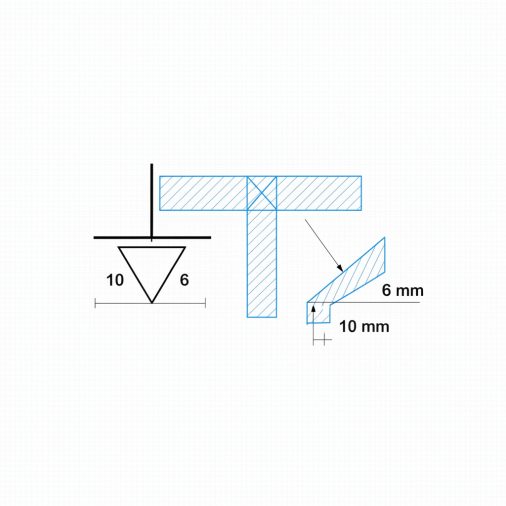
What Makes a Fillet Weld “Unequal Leg”
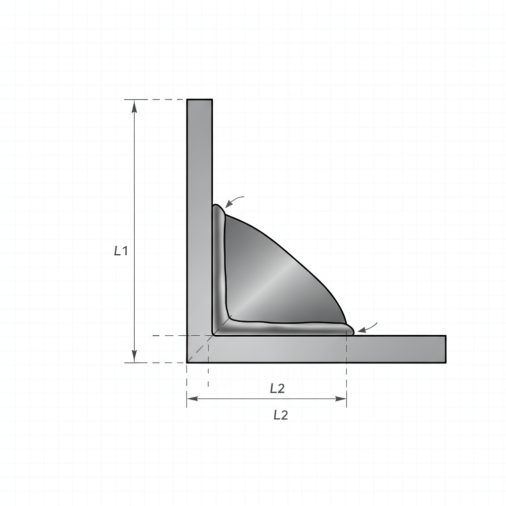
Where the Leg Sizes Appear on the Symbol
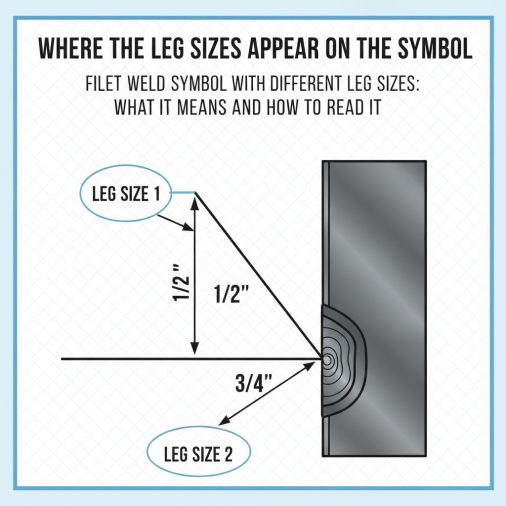
How the Symbol Specifies Which Leg Goes Where
This is where many readers get confused. The welding symbol alone tells you the two sizes, but the drawing orientation tells you which leg goes on which member. The perpendicular leg of the weld corresponds to the vertical member of the joint, and the horizontal leg corresponds to the base or horizontal member. The arrow side versus other side convention still applies — the symbol position relative to the reference line tells you which face of the joint receives the weld. A few practical rules: – If the weld symbol is below the reference line, the weld goes on the arrow side – If the weld symbol is above the reference line, the weld goes on the other side – The first dimension in the parentheses corresponds to the vertical leg (the leg running along the vertical member) – The second dimension corresponds to the horizontal leg (the leg along the base) Some drawings also include an orientation note or a detail view to eliminate any ambiguity, especially on complex structural assemblies.Theoretical Throat of an Unequal Leg Fillet Weld
The throat of the weld — the distance from the root to the face — determines weld strength. For equal-leg fillet welds, the throat is simply 0.707 × leg size. For unequal legs, the calculation is slightly different. Throat formula for unequal leg fillet welds: > Throat = (S1 × S2) / √(S1² + S2²) Where S1 and S2 are the two leg sizes. For example, if S1 = 3/8 inch and S2 = 1/4 inch: – S1² = 0.140625 – S2² = 0.0625 – √(S1² + S2²) = √0.203125 ≈ 0.4507 – Throat = (0.375 × 0.25) / 0.4507 ≈ 0.208 inches This throat value is smaller than what you’d get from a 3/8-inch equal-leg weld (≈ 0.265 inches), which is why structural engineers carefully select both leg sizes when fatigue loading or strength is critical. For more context on how weld size affects joint performance, it helps to understand how engineers determine proper weld size for a given application.Common Mistakes When Reading Unequal Leg Symbols
Field experience shows several recurring errors when welders or fabricators encounter this symbol type: Treating the two dimensions as equal. Some welders default to the larger number for both legs, assuming it’s a conservative choice. That’s wrong — it creates an oversized weld on one side that may not fit within the joint geometry and wastes filler material. Reversing the leg assignments. Applying the longer leg to the horizontal member when it should go on the vertical member (or vice versa) changes the load path entirely. Ignoring the parentheses. A symbol reading (5/16 × 1/2) is very different from 1/2 alone. Missing the parentheses means you’re potentially putting in a completely different weld. Using a fillet weld gauge designed for equal legs. Standard fillet weld gauges measure equal-leg welds. For unequal legs, you need a gauge that can measure each leg independently. The Hobart Fillet Weld Gauge Set is one option that includes adjustable gauges for this purpose — though verifying unequal legs typically still requires measuring each leg separately rather than using a single go/no-go gauge. To avoid gauge-related errors on inspections, it’s also worth reviewing how to accurately measure a fillet weld size in practice.When Engineers Specify Unequal Legs
Engineers don’t specify unequal legs arbitrarily. There are specific structural and geometric reasons behind the call: – Thin-to-thick connections — When welding a thin gusset to a thick plate, a larger leg on the thick side improves fusion and reduces the risk of burn-through on the thinner piece. – Code minimum size requirements — AWS D1.1 requires minimum fillet weld sizes based on the thicker member. Unequal legs allow the weld to meet minimums on the thick side without over-welding on the thin side. This connects directly to AWS minimum fillet weld size requirements that govern structural fabrication. – Restricted throat size — An engineer may need a specific throat without using equal legs, and an unequal configuration achieves that target throat at lower overall weld volume. – Edge distance limitations — When one member has limited edge distance, the leg on that member must stay short, requiring the other leg to compensate.Comparison: Equal Leg vs. Unequal Leg Fillet Weld Symbol
| Feature | Equal Leg | Unequal Leg |
|---|---|---|
| Symbol notation | Single size (e.g., 3/8) | Two sizes in parentheses (e.g., 3/8 × 1/2) |
| Throat calculation | 0.707 × leg size | (S1 × S2) / √(S1² + S2²) |
| Weld volume | Predictable | Lower per throat depth |
| Drawing complexity | Simple | Requires orientation clarity |
| Typical use | General structural welds | Unequal thickness joints, load optimization |
| Gauging | Standard fillet gauge | Independent leg measurement required |
How to Verify an Unequal Leg Fillet Weld in the Field
Inspection of an unequal leg fillet weld requires measuring each leg independently. The steps are straightforward: 1. Identify the weld legs — Determine which leg runs along which member. 2. Measure the first leg — Using a fillet weld gauge or ruler, measure from the root to the toe along the vertical member. 3. Measure the second leg — Measure from the root to the toe along the horizontal member. 4. Compare to the drawing — Verify both measurements match the parenthetical dimensions on the welding symbol. 5. Check the throat — For critical welds, calculate or gauge the actual throat and compare it to the design throat. A common issue technicians encounter is that visual inspection alone doesn’t reveal an unequal leg. The weld can look symmetrical while actually being off on one side. Physical measurement is non-negotiable. If you spot irregularities in the bead profile during inspection, it’s also worth checking whether common weld defects are affecting the leg geometry.FAQ
What does (3/8 × 1/2) mean on a fillet weld symbol? It means the fillet weld has two unequal legs: one leg measures 3/8 inch and the other measures 1/2 inch. The parentheses indicate these are two distinct dimensions. The first number typically corresponds to the perpendicular (vertical) leg, and the second to the horizontal leg. This notation follows AWS A2.4 standards and must be read in context with the joint orientation shown on the drawing. How do I know which leg size goes on which member? The drawing orientation determines this. The first dimension in the parentheses generally corresponds to the leg along the vertical member, and the second to the leg along the horizontal member. When the drawing doesn’t make this clear, look for a detail view, a section callout, or an orientation note. If you’re in doubt on a structural job, confirm with the engineer or fabrication supervisor before welding. Can you use a standard fillet weld gauge for unequal leg welds? Most standard gauges are designed for equal-leg welds and won’t give you accurate readings on unequal legs. You need to measure each leg individually using a straight-edge gauge or adjustable fillet gauge. The Starrett W438 Fillet Weld Gauge is often used for this since it allows independent measurement of each leg rather than assuming symmetry. Why would an engineer choose an unequal leg fillet weld over an equal leg weld? The main reasons are load path optimization, thickness mismatches between joined members, and minimizing weld volume while meeting a required throat size. Unequal legs can achieve the same effective throat as a larger equal-leg weld using less filler metal, which reduces heat input and distortion — important factors in precision fabrication and practical fillet weld sizing decisions. Does AWS D1.1 allow unequal leg fillet welds? Yes. AWS D1.1 and AWS A2.4 both support unequal leg fillet welds. The symbols and specifications are well defined. The engineer must specify the dimensions clearly on the drawing, and the fabricator must verify both leg sizes during inspection. Size requirements based on base metal thickness still apply to each leg independently. What happens if the wrong leg size is welded? If the leg sizes are reversed or one is built to the wrong dimension, the actual throat of the weld will differ from the design throat. This changes the weld’s load capacity, possibly reducing it below the design requirement. Depending on the application, this can be a safety issue. The weld may need to be repaired or removed and re-welded to the correct specification. Is an unequal leg fillet weld harder to weld than an equal leg fillet weld? Mechanically, the technique is similar — the challenge is positional. The welder must consciously control travel angle and gun position to deposit more material along one member than the other. Equal-leg welds naturally balance at 45 degrees. Unequal legs require a deliberate angle shift. In tight joints or overhead positions, this adds difficulty, and maintaining consistency across a long weld run takes practice.Unequal leg fillet welds are a precise engineering tool, not a drawing shortcut. When you see the parenthetical notation on a welding symbol, slow down, confirm the joint orientation, measure both legs independently, and verify the throat meets the design requirement. Missing one of those steps means the weld may look correct visually while failing the spec entirely.


