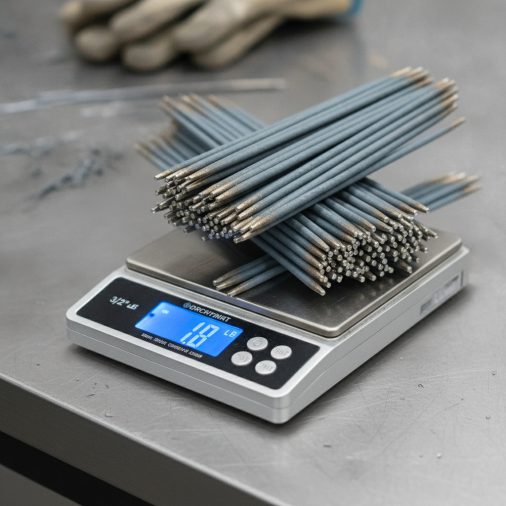
If you’re buying stick electrodes by the pound and trying to figure out how many rods you’re actually getting, the 3/32 size is one of the more common points of confusion — especially since rod count varies by electrode type and coating thickness.
A one-pound package of 3/32 inch (2.4mm) stick electrodes typically contains between 25 and 45 rods, depending on the electrode classification. Common 6013 rods in 3/32 usually run around 36–42 rods per pound, while 6011 rods in the same diameter tend to be slightly fewer — closer to 28–35 — due to a heavier flux coating. E7018 in 3/32 generally falls between 30 and 38 rods per pound.
Why the Rod Count Varies Between Electrode Types
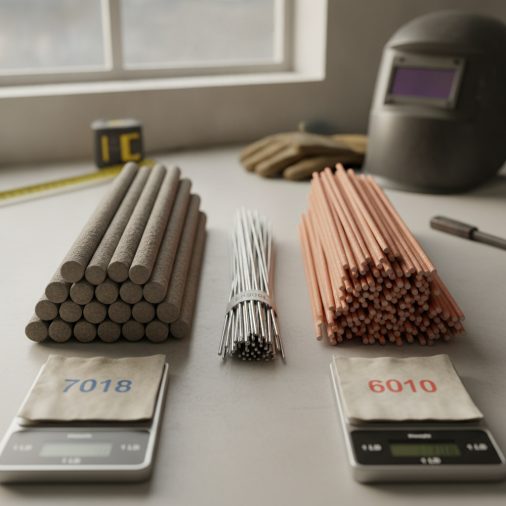
The number of rods per pound isn’t a fixed number — it changes based on coating thickness and electrode composition. Heavier flux coatings mean more weight per rod, so you get fewer rods per pound even though the wire core diameter is identical.
Here’s how the major electrode types compare at 3/32 inch:
Electrode
Rods per Pound (Approx.)
Coating Weight
E6010
28–34
Heavy
E6011
28–35
Moderate-Heavy
E6013
36–42
Lighter
E7018
30–38
Moderate (iron powder)
E7024
22–28
Very Heavy (iron powder)
These are approximate ranges. Different manufacturers and even different production batches can shift the count slightly.
What 3/32 Rods Are Typically Used For
The 3/32 diameter is a general-purpose size well-suited for thinner material. It runs on lower amperage — typically 40–80 amps depending on electrode type — making it popular for sheet metal repairs, auto body work, and light fabrication where a larger rod would burn through.
Knowing how amperage relates to metal thickness helps you confirm whether 3/32 is the right choice for your job before you commit to buying a whole box.
It’s also a common learning rod. Many instructors start beginners on 3/32 E6013 because it produces a stable arc and is forgiving with technique.
Standard Package Sizes and What to Expect
Electrodes are sold in several package configurations. Here’s how rod count scales across typical package weights for 3/32 inch E6013 as a reference:
Package Size
Approximate Rod Count (E6013 3/32)
1 lb
36–42 rods
5 lb
180–210 rods
10 lb
360–420 rods
50 lb
1,800–2,100 rods
For E7018 in 3/32, scale those numbers down by roughly 10–15%.
In practice, manufacturers usually print the rod count on the package. If you’re ordering online, the listing will often include it in the specifications. Always verify against the actual product rather than assuming the count.
How Rod Length Factors In
Standard 3/32 stick electrodes come in a length of 12 inches. Some specialty suppliers offer 9-inch lengths, which weigh less per rod and therefore yield a higher rod count per pound.
If you’re getting more rods per pound than expected, check whether you received 9-inch rather than 12-inch rods. They’re both available, and the confusion comes up more often than people expect. The shorter rods are common in classroom and training settings.
Calculating Consumption Before You Buy
If you’re planning a larger job, you can estimate rod consumption before purchasing. For stick welding, a rough rule of thumb is that a 3/32 electrode deposits approximately 0.03–0.06 lbs of weld metal per rod depending on efficiency and technique.
For a detailed approach to estimating how many rods a job will require, the method for calculating welding rod consumption covers deposition rates, stub loss, and joint geometry in a systematic way.
This matters most when budgeting for production welding or large repair jobs where over-ordering gets expensive and under-ordering causes delays.
Common Mistakes When Buying 3/32 Rods by the Pound
Assuming all rods weigh the same. A 3/32 E6010 and a 3/32 E6013 feel similar in your hand, but the coating difference creates a meaningful weight gap. Comparing rod counts between types without accounting for this leads to miscalculations.
Confusing wire diameter with electrode diameter. The 3/32 designation refers to the core wire. The actual outside diameter including flux coating is larger. Electrodes labeled 3/32 from different manufacturers may have slightly different coating thicknesses.
Ignoring stub loss. Every rod leaves a short stub that gets discarded — typically around 1.5 to 2 inches. On a 12-inch rod, that’s roughly 15% of the material you paid for. Higher skill levels and proper rod angle reduce stub length, but some stub loss is unavoidable.
For those still developing their technique, reviewing a stick welder settings chart can help reduce errors that lead to rod waste, including sticking, burn-through, and excessive restarts.
FAQ
How many 3/32 E6013 rods are in a 5-pound box?
A 5-pound box of 3/32 E6013 electrodes typically contains between 180 and 210 rods. E6013 has a relatively light flux coating, which means you get more rods per pound compared to E7018 or E6010 in the same diameter. The exact count varies slightly by manufacturer, so check the package label when precision matters.
How many 3/32 E6011 rods come in a 1-pound pack?
Expect approximately 28 to 35 rods per pound for 3/32 E6011 electrodes. The E6011 coating is heavier than E6013, which reduces the rod count per pound. E6011 is designed for AC and DC welding on dirty or rusty steel, and the thicker coating contributes to its versatility but adds weight per rod.
What amperage should I use for 3/32 stick electrodes?
For 3/32 inch electrodes, typical amperage ranges from 40 to 80 amps depending on electrode type. E6013 in 3/32 usually runs well at 45–75 amps, while E7018 in the same diameter may need 65–80 amps. Always start within the manufacturer’s recommended range and adjust based on puddle behavior and penetration.
How many 3/32 E7018 rods are in a 10-pound box?
A 10-pound box of 3/32 E7018 electrodes generally contains 300 to 380 rods. E7018 uses an iron powder low-hydrogen coating that adds weight per rod, keeping the count on the lower end compared to E6013. Many welders use Lincoln Electric Excalibur 7018 MR in this size, which is a widely available and consistent option.
Do all brands have the same rod count per pound for 3/32?
Not exactly. While counts are similar across major brands, coating thickness varies slightly by manufacturer and product line. Two brands of 3/32 E6013 might differ by 2–4 rods per pound. The difference is usually minor, but if you’re estimating for a large job, weigh a sample rod from your actual package to improve accuracy.
Can I use 3/32 rods on a small 90-amp stick welder?
Yes. Most 3/32 electrodes fall within the capacity of a 90-amp stick welder, especially E6013 and E6011. These rods run comfortably at 50–75 amps, which is well within range. The Lincoln Electric AC-225 is a common machine used with 3/32 electrodes in home shop and light fabrication settings.
Is 3/32 the right rod size for thin sheet metal?
Generally, yes — 3/32 is one of the smallest common stick electrode sizes and works well on metal from around 1/8 inch down to 16 gauge in the right hands. For thinner material, technique becomes critical. Even so, many welders prefer MIG welding for thinner sheet metal because it offers better heat control and a smoother arc at low amperages.
Getting the Right Quantity for Your Job
The honest answer is that a pound of 3/32 electrodes goes faster than most beginners expect. On a small repair, a single pound might be more than enough. On a project with multiple passes or longer weld runs, that pound disappears quickly.
Buy enough for the job plus a reasonable buffer, account for stub loss, and match the electrode type to the application rather than just grabbing whatever’s on the shelf. The rod count per pound is useful for planning, but the quality of the weld depends on the right electrode for the base metal and position — not just how many rods fit in the box.