304 stainless steel shows up everywhere — kitchen equipment, handrails, exhaust components, food-grade fabrication. It welds differently than mild steel, and if you treat it the same way, you’ll end up with a warped, discolored, porous mess.
MIG welding 304 stainless steel is absolutely possible with the right setup. You need ER308L stainless wire, a tri-mix shielding gas (typically 90% helium / 7.5% argon / 2.5% CO₂), and dialed-in settings to manage heat input. The process rewards patience and clean prep — rush it or cut corners on gas, and the weld will show it immediately.
Why 304 Stainless Behaves Differently Than Mild Steel
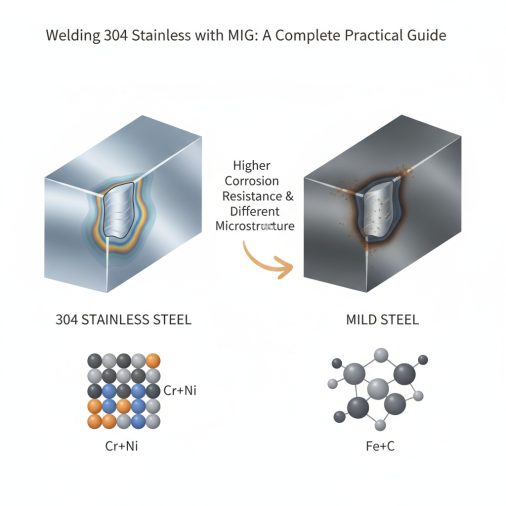
304 is an austenitic stainless steel, meaning its chromium-nickel composition makes it corrosion resistant but also thermally problematic. It has roughly 50% lower thermal conductivity than mild steel, so heat builds up and spreads slowly. That leads to warping, distortion, and carbide precipitation if you push too much heat into the joint.
Carbide precipitation — sometimes called sensitization — happens when you let the heat-affected zone sit too hot for too long. Chromium carbides form along grain boundaries, stripping the surrounding area of corrosion resistance. The weld looks fine, but the metal becomes vulnerable to rust exactly where it shouldn’t.
304 also expands more than mild steel when heated, which magnifies distortion on longer runs. This is why heat management, joint fit-up, and tacking strategy matter more on stainless than on carbon steel.
Choosing the Right Wire for 304 Stainless
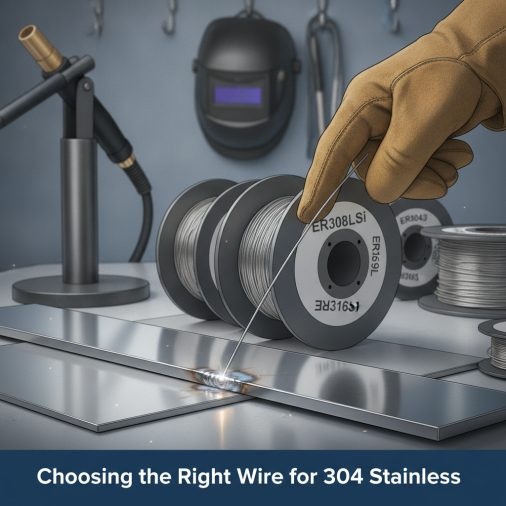
The standard filler metal for MIG welding 304 stainless is ER308L. The “L” means low carbon, which directly reduces the risk of carbide precipitation during welding. This is the wire to use for most 304 applications.
A few common wire sizes and their typical use cases:
Wire Diameter
Best For
0.023" (0.6mm)
Thin sheet metal, under 16 gauge
0.030" (0.8mm)
General purpose, 16–10 gauge
0.035" (0.9mm)
Heavier material, structural welds
0.045" (1.2mm)
Thick sections, high deposition work
For most shop work on 304, 0.030″ ER308L is a practical all-around choice. If you’re unsure about wire selection, choosing the right MIG wire diameter depends on material thickness and machine capacity.
Avoid using standard mild steel ER70S-6 wire on 304. It won’t provide the correct alloy composition, and the weld’s corrosion resistance will be compromised. using regular MIG wire on stainless steel is a common shortcut that causes real problems in service.
Shielding Gas: The Right Mix Matters
This is where most beginners get it wrong. Standard C25 (75% argon / 25% CO₂) — which works great on mild steel — creates too much oxidation on stainless. It burns off the chromium at the surface and produces a rough, heavily discolored bead.
The industry standard for MIG welding stainless is tri-mix gas: approximately 90% helium / 7.5% argon / 2.5% CO₂. This blend provides a stable arc, good fusion, and a cleaner bead compared to high-CO₂ mixes. Some shops use 98% argon / 2% CO₂ or 98% argon / 2% oxygen as alternatives, which also work well for short-circuit transfer.
For a deeper look at how gas selection affects stainless welds, the right gas choice for MIG welding stainless is worth understanding before you start.
A quick comparison of common stainless MIG gas options:
Gas Mix
Arc Stability
Bead Appearance
CO₂ Level
Notes
90/7.5/2.5 Tri-mix
Excellent
Very clean
Low
Industry standard
98% Ar / 2% CO₂
Good
Clean
Very low
Budget-friendly option
98% Ar / 2% O₂
Good
Clean
None
Good for spray transfer
75% Ar / 25% CO₂
Good
Rough/oxidized
High
Not recommended for stainless
100% Argon
Poor
Variable
None
Not ideal for MIG stainless
Machine Settings for MIG Welding 304
Getting the settings right on 304 comes down to voltage, wire speed, and travel speed working together. The goal is consistent penetration with minimum heat input.
General starting points for ER308L on 304 stainless:
– 0.030″ wire, short-circuit transfer:
– Voltage: 17–20V
– Wire speed: 200–300 IPM
– Shielding gas flow: 20–25 CFH
– 0.035″ wire, short-circuit transfer:
– Voltage: 18–22V
– Wire speed: 180–260 IPM
– Shielding gas flow: 20–25 CFH
Travel speed should be faster than you’d use on mild steel. Moving quickly reduces heat input, which is the right instinct on stainless. A slow, lazy travel speed on 304 causes heat buildup, discoloration, and distortion.
For a more complete breakdown of dialing in your machine, MIG welding stainless steel settings covers voltage, amperage, and wire speed in more detail.
If your machine supports it, pulse MIG is worth considering for 304. Pulse transfer gives better control over heat input and dramatically reduces discoloration. pulse MIG welding settings for stainless work especially well on thinner gauge material.
Prep Work: Clean Metal Is Non-Negotiable
Stainless steel is unforgiving about contamination. Oils, fingerprints, mill scale, and even residue from carbon steel contact can ruin a weld or cause porosity.
Before welding 304:
1. Degrease thoroughly — use acetone or a dedicated stainless cleaner. Wipe in one direction to avoid spreading contamination.
2. Use stainless-only tools — wire brushes, grinding discs, and clamps that have touched mild steel will embed iron particles into the stainless surface, causing rust.
3. Keep a dedicated stainless brush — label it and don’t use it on anything else.
4. Remove any mill scale from the weld zone with a flap disc rated for stainless.
5. Fit the joint tightly — gaps cause heat concentration and burn-through.
Stainless contamination from carbon steel contact is more common than most beginners realize. Even resting your workpiece on a dirty steel table can cause surface contamination that shows up as rust weeks later.
Welding Technique: How to Run a Clean Bead on 304
Travel direction: Use a push (forehand) technique. Pushing the gun ahead of the puddle reduces heat input compared to dragging, which is particularly useful on stainless.
Travel speed: Move steadily and faster than you would on mild steel. Don’t linger.
Gun angle: Keep the gun at 10–15 degrees from vertical in the direction of travel. Excessive angles reduce shielding gas coverage.
Tacking strategy: Tack more frequently than you would on mild steel. On longer seams, backstep weld — work in short overlapping segments moving away from the direction of travel — to minimize distortion.
Cooling: Don’t quench 304 with water after welding. Let it air cool. Forced rapid cooling can cause cracking in some stainless alloys. Copper backing bars or heat sinks are acceptable to draw heat away without damaging the weld.
Interpass temperature: Keep interpass temperature below 150°C (300°F) for most 304 applications. If the metal is too hot to hold your hand near comfortably, let it cool before the next pass.
Common Problems When MIG Welding 304 Stainless
Discoloration and heat tint
Some color is normal on stainless — a light gold or straw color is acceptable. Dark blue, gray, or black indicates excessive heat input. Fix it by increasing travel speed, reducing voltage slightly, or using pulse MIG.
Warping and distortion
304’s low thermal conductivity concentrates heat aggressively. Use more tack welds, weld in shorter runs, clamp the workpiece firmly, and use backstep welding technique on longer seams.
Porosity
Usually caused by gas contamination, a dirty surface, or inadequate shielding. Check your gas flow rate, inspect the hose for leaks, and clean the base metal more thoroughly.
Sugary or rough weld surface
This typically means oxidation from insufficient shielding gas coverage or the wrong gas mix. Ensure your CFH is set correctly and your gun-to-work distance is consistent (generally 3/8″ to 1/2″ contact tip-to-work distance).
Burn-through on thin material
Stainless conducts heat poorly, so it burns through faster than mild steel at the same settings. Drop your voltage, increase travel speed, or switch to a smaller wire diameter.
For a broader look at keeping your beads clean and spatter-free on any material, reducing spatter during MIG welding covers technique and settings adjustments that apply here too.
After the Weld: Finishing and Passivation
Welding 304 creates a heat-affected zone where the chromium oxide layer has been disrupted. To restore full corrosion resistance:
– Wire brush the weld with a stainless steel brush to remove loose scale.
– Pickling paste (phosphoric or nitric acid-based) chemically cleans and restores the passive layer. Use with proper PPE — it’s corrosive.
– Electrochemical weld cleaning using a machine like the Fronius Cleantech or Walter Surface Technologies Surfox 204 offers a faster, more controlled option for shop use.
– Mechanical polishing with stainless-rated abrasives can be used for aesthetic finishing.
Passivation matters most on food-grade, medical, or outdoor applications where corrosion resistance is the whole point of using 304 in the first place.
MIG vs. TIG on 304 Stainless: When to Use Which
MIG is faster and easier to learn, but TIG produces cleaner, more precise welds with less heat input and better cosmetic results. Here’s how they compare on 304:
Factor
MIG
TIG
Speed
Faster
Slower
Heat input
Higher
Lower
Distortion risk
Higher
Lower
Weld appearance
Good
Excellent
Skill required
Moderate
High
Ideal use
Production, structural
Thin sheet, cosmetic, precision
For structural 304 work, production environments, or heavier sections, MIG is perfectly appropriate. For thin-wall tubing, visible decorative work, or anything under 18 gauge, TIG is generally the better process. choosing between TIG and MIG for stainless exhaust work illustrates this tradeoff clearly in a real-world context.
Safety Considerations
Welding stainless produces hexavalent chromium fumes — a known carcinogen. This is a more serious fume hazard than mild steel welding, and it demands proper ventilation. the real health risks of MIG welding apply at an elevated level when stainless is involved.
Use local exhaust ventilation directly at the source, not just general shop ventilation. A supplied-air respirator or P100 respirator with OV cartridges is appropriate for enclosed spaces or sustained stainless welding.
FAQ
Can I use a standard MIG welder for 304 stainless steel?
Yes, most MIG welders capable of running 0.030″ or 0.035″ wire can weld 304 stainless. You need a machine with enough voltage range to handle your material thickness, and you’ll need to switch to ER308L wire and tri-mix shielding gas. Check that your drive rolls are stainless-compatible — U-groove rolls designed for solid wire are recommended to avoid deforming soft stainless wire.
What’s the difference between ER308L and ER316L wire for 304 stainless?
ER308L is the standard choice for welding 304 stainless. ER316L contains molybdenum, which provides better resistance to chloride pitting and is designed for welding 316 stainless. Using ER316L on 304 is technically acceptable but unnecessary and more expensive. Stick with ER308L for 304-to-304 applications unless specific chemical resistance requirements dictate otherwise.
Why does my stainless weld turn black or dark blue?
Dark discoloration means excessive heat input or inadequate shielding gas coverage. Check that your gas flow rate is set to 20–25 CFH, your gun-to-work distance is consistent, and you’re not pausing or moving too slowly. Increasing travel speed and reducing voltage are the quickest fixes. A light straw or golden color is acceptable; dark blue and black indicate oxidation.
Do I need to back-purge when MIG welding 304?
Back purging — filling the inside of a tube or pipe with argon to protect the weld root — is required for full corrosion resistance on pipe welds where the root bead is exposed to the service environment. For solid plate welds, brackets, or structures where the root isn’t exposed, back purging is generally not necessary. It’s critical for sanitary piping, food-grade tubing, and any application where internal corrosion is a concern.
Can I weld 304 stainless to mild steel with a MIG welder?
Yes, dissimilar metal welds between 304 and mild steel are done regularly. Use ER309L filler wire, which is specifically designed for stainless-to-carbon steel joints. The weld zone will not carry the same corrosion resistance as the 304 parent metal, so consider the service environment carefully. The mild steel side will still rust normally.
How do I prevent warping when MIG welding thin 304 sheet?
Use more tack welds spaced closely together before running full beads. Weld in short backstep segments rather than long continuous runs. Clamp the workpiece to a flat surface or use copper backing bars to draw heat away. Reduce your heat input by increasing travel speed and dropping voltage slightly. Pulse MIG is particularly effective for thin 304 sheet because it naturally limits heat buildup per weld cycle.
Is MIG welding 304 stainless approved for structural or food-grade applications?
MIG welding 304 can meet structural requirements when performed to the applicable code (AWS D1.6 covers structural stainless). For food-grade applications, the weld quality, finish, and post-weld treatment (passivation or electropolishing) matter as much as the process. Always verify the specific standard or regulatory requirement for your application rather than assuming process alone determines compliance.
MIG welding 304 stainless is straightforward once you respect what makes the material different — low thermal conductivity, sensitivity to contamination, and the need for correct wire and gas. Get those three things right, manage your heat input, and 304 is a very workable material. The payoff is a strong, corrosion-resistant joint that holds up in demanding environments where mild steel would fail.