
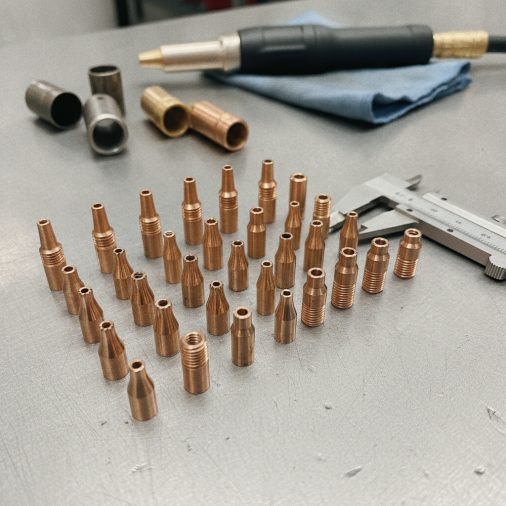
If you’ve ever run out of contact tips mid-project and wondered whether you could grab one from a different brand or gun, you’re not alone. It’s one of the most practical questions in MIG welding — and the answer is more nuanced than a simple yes or no. Getting this wrong can cause poor arc performance, wire feed problems, or premature tip failure. This article breaks down exactly when MIG welding tips can be swapped, what specifications actually matter, and how to avoid the compatibility mistakes that quietly ruin welds.
Quick Answer
MIG welding contact tips are not universally interchangeable. Compatibility depends on three key factors: thread size, tip bore diameter, and the gun or torch brand they’re designed for. Tips from different manufacturers may share the same thread pitch but differ in length or bore size, making them technically incompatible even when they appear to fit.
What Makes a Contact Tip Compatible — or Not
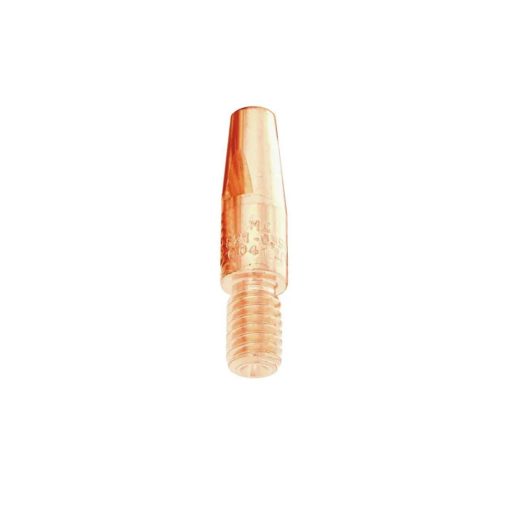
A contact tip looks simple — it’s a small copper or copper-alloy tube that guides the wire and transfers electrical current. But several specifications must align for it to work correctly.
Thread size and pitch is the first checkpoint. Most MIG guns use one of a handful of standard thread sizes — M6, M8, or threads specific to North American guns like 10-32 or 1/4-28 UNF. A tip that threads in but doesn’t seat properly will arc erratically or overheat.
Bore diameter must match your wire diameter. Common bore sizes include 0.023″, 0.030″, 0.035″, 0.040″, and 0.045″. Using a bore that’s too tight increases friction and causes wire burnback. Too loose, and you lose current transfer efficiency, which leads to an unstable arc and inconsistent bead quality.
Tip length affects how far the wire extends from the nozzle. Even if thread and bore match, a tip that’s 2mm shorter or longer than the original changes your contact-to-work distance and can throw off your welding parameters.
Brand-Specific vs. Standard Tips: What the Market Actually Looks Like
Some MIG gun manufacturers design their torches around proprietary tip geometries. Others use widely adopted standards that allow cross-brand compatibility.
| Gun Brand | Tip Standard | Cross-Compatible? |
|---|---|---|
| Lincoln Electric Magnum | Lincoln-specific thread | Limited — some aftermarket options |
| Miller M-Series | Miller-specific thread | Limited — some aftermarket options |
| Bernard BTB / Q-Gun | Bernard standard | Widely compatible aftermarket |
| Tweco No. 1–4 | Tweco standard | Widely compatible aftermarket |
| Binzel MB Series (Euro) | Euro standard (M6/M8) | Broadly compatible across brands |
| Hobart Handler guns | Hobart-specific | Limited compatibility |
Euro-style torches using the Binzel MB15, MB25, or MB36 standard have the broadest cross-brand compatibility. Aftermarket tip manufacturers like Trafimet, Abicor Binzel, and others produce tips that fit these torches reliably.
North American OEM guns from Lincoln and Miller tend to use proprietary designs, though reputable aftermarket suppliers like Tregaskiss, Bernard, and Weldcraft produce compatible replacements that meet or exceed OEM specs.
Wire Diameter and Tip Bore: The Pairing That Matters Most
Even when the thread fits perfectly, using the wrong bore size is one of the most common causes of MIG welding problems. Here’s how bore size should match wire diameter:
| Wire Diameter | Recommended Tip Bore |
|---|---|
| 0.023″ (0.6mm) | 0.025″ (0.7mm) |
| 0.030″ (0.8mm) | 0.032″ (0.9mm) |
| 0.035″ (0.9mm) | 0.037″ (1.0mm) |
| 0.040″ (1.0mm) | 0.042″ (1.1mm) |
| 0.045″ (1.2mm) | 0.047″ (1.3mm) |
The bore is intentionally slightly larger than the wire to allow smooth feeding while maintaining solid electrical contact. In practice, field welders sometimes run a 0.035" wire through a 0.030″ tip when they’re out of the right size — this works briefly but causes accelerated tip wear and erratic feeding.
When Tips From Different Brands Actually Work Fine
There are real-world scenarios where swapping tips across brands causes zero problems.
If both guns use the same Euro-standard thread (M6 for lighter guns, M8 for heavier ones), tips are generally interchangeable as long as bore diameter and length match. Many professional welders keep a stock of Euro-standard tips precisely because they work across multiple torches.
Aftermarket tip manufacturers often produce tips labeled as compatible with specific OEM guns. These are typically manufactured to the same thread pitch and length specifications as the original, sometimes using higher-conductivity copper alloys that outlast the OEM version.
The key is verifying three numbers before swapping: thread size, bore diameter, and tip length. If all three match, the tip will work regardless of brand.
Signs You’re Using the Wrong Contact Tip
Problems caused by tip incompatibility often get misdiagnosed as wire feed issues or shielding gas problems. Watch for these symptoms:
– Erratic arc or spatter spikes — often caused by poor electrical contact from a mismatched thread or oversized bore
– Wire burnback into the tip — frequently caused by a bore that’s too tight, increasing resistance
– Tip overheating faster than normal — can indicate poor seating or a tip material that doesn’t match the amperage range
– Inconsistent wire stick-out — a tip that’s the wrong length shifts your contact-to-work distance without any visible change
– Tip threads stripping easily — a sign the thread pitch doesn’t match the gun’s diffuser
If you’ve recently changed tip brands and any of these symptoms appeared, the tip is the first thing to check.
Tip Materials: Standard Copper vs. Specialty Alloys
Not all contact tips are made from the same material, and this affects both performance and interchangeability decisions.
Standard electrolytic copper tips are the most common and work well for general MIG welding at moderate amperages. They’re inexpensive and widely available.
Chrome-zirconium copper (CrZr) tips handle higher heat better and resist spatter adhesion more effectively. These are worth using in high-duty-cycle applications or when running flux-core wire, which runs hotter than solid wire.
Silver-coated tips offer reduced spatter adhesion and slightly better conductivity, though the performance difference is marginal for most applications.
When swapping tips across brands, the material choice is secondary to dimensional compatibility — but if you’re upgrading, choosing a CrZr tip from a reputable aftermarket supplier often outperforms the OEM copper tip it replaces.
How to Check Compatibility Before You Buy
Rather than guessing, take these steps to confirm tip compatibility:
1. Remove the current tip and note the thread size — use a thread gauge or compare against a known standard (M6, M8, 10-32, 1/4-28 UNF are the most common)
2. Measure tip length with calipers — record this in millimeters for precision
3. Check the bore size — it should be stamped or etched on the tip itself (e.g., “0.035” or “0.9mm”)
4. Cross-reference with the gun’s manual — most manufacturers list acceptable tip part numbers
5. Check the aftermarket supplier’s compatibility chart — reputable suppliers like Tregaskiss, Bernard, and Abicor Binzel publish detailed cross-reference guides
This process takes less than five minutes and prevents the frustration of ordering tips that technically fit but perform poorly.
FAQ
Can I use a Miller contact tip in a Lincoln MIG gun?
Generally, no — Miller and Lincoln guns use different thread specifications and tip geometries. While some dimensions may appear similar, the thread pitch or tip length often differs enough to cause poor seating or arc instability. Aftermarket suppliers sometimes produce tips compatible with both brands, but always verify thread size, bore diameter, and length before substituting.
What happens if I use a contact tip with the wrong bore size?
A bore that’s too small increases friction, causes wire feed resistance, and can lead to burnback — where the wire fuses to the tip. A bore that’s too large reduces electrical contact quality, producing an unstable arc and excessive spatter. Either way, tip life drops significantly and weld quality suffers noticeably.
Are Tweco and Bernard contact tips interchangeable?
Tweco and Bernard tips use different thread standards and are not directly interchangeable, despite both being common North American brands. However, some aftermarket manufacturers produce tips listed as compatible with both. Always verify the specific thread pitch and tip length rather than assuming compatibility based on brand reputation or physical appearance.
Do contact tip sizes change when switching from solid wire to flux-core wire?
The bore size should still match your wire diameter regardless of wire type. However, flux-core wire runs hotter and produces more spatter, so many welders switch to chrome-zirconium copper tips when running flux-core to extend tip life. The dimensional specifications — thread size, bore, and length — remain the same selection criteria.
How often should MIG contact tips be replaced?
Tip life varies widely based on amperage, wire type, and duty cycle. In general, inspect tips every few hours of welding and replace them when the bore shows visible elongation, spatter buildup that can’t be cleared, or signs of overheating like discoloration near the tip end. Running a worn tip longer than necessary causes inconsistent welds and can damage the diffuser.
Can I use a 0.035″ tip with 0.030″ wire in an emergency?
Technically yes, but only as a very short-term workaround. The larger bore reduces electrical contact efficiency, which destabilizes the arc and increases spatter. Wire feeding may also become erratic because the wire has more room to wander inside the tip. Replace it with the correct bore size as soon as possible — the weld quality difference is noticeable.
What’s the difference between standard and tapered contact tips?
Standard tips have a consistent cylindrical bore, while tapered tips narrow slightly toward the end to improve wire guidance and electrical contact. Tapered tips generally perform better at higher wire feed speeds and are more common in semi-automatic and robotic welding applications. They are not interchangeable with standard tips even when thread and bore dimensions match.
Final Thoughts
MIG welding contact tips follow enough variation across brands and gun designs that “interchangeable” is never a safe assumption. Thread size, bore diameter, and tip length are the three numbers that determine whether a tip will work — and all three need to match. Euro-standard torches offer the most flexibility, while OEM North American guns are more restrictive. Keep a thread gauge and calipers in your shop, cross-reference specs before ordering aftermarket tips, and you’ll avoid the arc problems that come from a tip that almost fits.
Meta Description: Wondering if MIG welding tips are interchangeable? Learn which specs actually matter — thread size, bore, and length — and when swapping brands is safe.


