
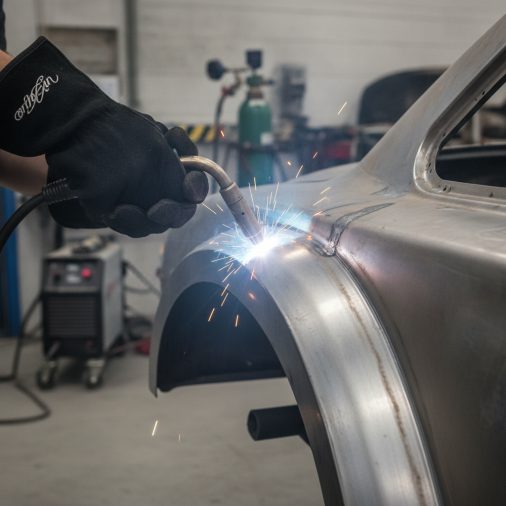
Choosing the wrong MIG welder for panel work is one of the most common and costly mistakes in automotive restoration. Thin sheet metal is unforgiving — too much heat warps it, too little leaves cold welds that fail under stress. This article walks you through exactly what to look for in a MIG welder for car bodywork, which machines consistently perform well, and how to match a welder to your actual skill level and workshop setup. Whether you’re patching a sill or replacing a full quarter panel, the right machine makes a measurable difference.
Quick Answer
The best MIG welder for car bodywork is one that delivers precise, low-amperage control — typically in the 30–130A range — with gas shielding (CO₂/Argon mix), a smooth wire feed, and fine voltage adjustment. For most home restorers and semi-professional shops, the Lincoln Electric 140MP, Miller Millermatic 141, and Hobart Handler 140 are consistently rated as top performers on thin automotive sheet metal.
Why Thin Sheet Metal Demands a Specific Type of Welder
Car body panels are typically 0.6mm to 1.2mm (18–22 gauge) steel. That’s dramatically thinner than structural steel, and it responds to heat very differently.
A welder that’s excellent for fabricating brackets or roll cages can destroy a door skin in seconds. Burn-through, warping, and distortion are the real enemies when working on bodywork — not lack of penetration.
MIG welding (Metal Inert Gas, technically GMAW — Gas Metal Arc Welding) is the preferred method for automotive bodywork because it offers:
– Lower heat input compared to stick welding
– Precise control over wire speed and voltage
– Clean welds with shielding gas, reducing porosity
– Speed for tacking and stitch welding panels
Flux-core MIG can work in a pinch, but the spatter and higher heat make it harder to manage on thin panels. For bodywork, always use solid wire (typically ER70S-6, 0.023″ or 0.6mm) with a 75% Argon / 25% CO₂ shielding gas mix.
The Key Specs That Actually Matter for Bodywork
Not all MIG welders are created equal. Here’s what to evaluate before buying:
| Specification | Ideal Range for Bodywork |
|---|---|
| Amperage range | 30–140A minimum |
| Wire diameter compatibility | 0.023″ (0.6mm) capable |
| Shielding gas | Gas-capable (not flux-core only) |
| Duty cycle at low amps | 20–30% at 90A is typically sufficient |
| Voltage steps or adjustment | Infinite or fine-step preferred |
| Wire feed speed control | Smooth, consistent, adjustable |
| Input power | 110V/120V for home shops; 220V for heavier use |
Wire diameter is often overlooked. Many budget welders only handle 0.030″ wire as their minimum. For thin automotive panels, 0.023″ wire is noticeably easier to control and reduces burn-through risk significantly. Always confirm this spec before purchasing.
Infinite voltage adjustment (a continuous dial rather than fixed taps) gives you more precise tuning, which matters when you’re dialing in a weld on a 0.8mm panel versus a 1.2mm section.
Top MIG Welders for Car Bodywork — Compared
These machines are consistently recommended by professional panel beaters, restoration shops, and serious hobbyists. Each has a distinct strength depending on your budget and use case.
| Welder | Input Power | Amperage Range | 0.023″ Wire | Best For |
|---|---|---|---|---|
| Lincoln Electric 140MP | 120V | 30–140A | Yes | Versatile home shop use |
| Miller Millermatic 141 | 120V | 30–140A | Yes | Smooth arc, professional results |
| Hobart Handler 140 | 120V | 25–140A | Yes | Budget-friendly, reliable |
| ESAB Rebel EMP 215ic | 120/240V | 20–200A | Yes | Shop/professional dual-voltage |
| Eastwood MIG 135 | 120V | 25–135A | Yes | Automotive-specific design |
Lincoln Electric 140MP — The multi-process capability (MIG, flux-core, DC TIG, stick) makes this a strong long-term investment. The arc is stable at low amperages, and it handles 0.023″ wire without issue. A solid choice if you want one machine that grows with your skills.
Miller Millermatic 141 — Miller’s arc quality is often described as “butter smooth,” and that reputation holds on thin sheet metal. It’s slightly more expensive than the Lincoln, but the wire feed consistency and arc stability at low settings are genuinely better than most competitors in the 120V class.
Hobart Handler 140 — Built by the same parent company as Miller (Illinois Tool Works), the Hobart offers comparable build quality at a lower price point. It uses voltage taps rather than infinite adjustment, which is a minor limitation, but in practice most users find the available settings cover bodywork needs well.
ESAB Rebel EMP 215ic — This is the step up for semi-professional use or anyone doing high-volume restoration work. Dual-voltage input, wider amperage range, and exceptional arc control make it the go-to for shops that need reliability across a range of panel thicknesses.
Eastwood MIG 135 — Designed with automotive work specifically in mind, the Eastwood includes settings charts tailored to common panel gauges. It’s a practical choice for home restorers who want a purpose-built machine without paying premium brand prices.
110V vs 220V — Which Input Power Do You Actually Need?
For most home garage bodywork, a 110V/120V machine is entirely sufficient. Panels rarely require more than 90–100A, and 120V machines comfortably deliver that.
220V machines offer higher duty cycles and handle thicker metal, but they require a dedicated circuit and are overkill for pure panel work. If your projects ever extend to frame rails, subframes, or structural components, a 220V machine gives you headroom.
A practical rule: if 90% of your work is body panels, buy a quality 120V machine and spend the saved money on shielding gas and good consumables.
Settings That Make or Break Thin Panel Welding
Even the best MIG welder produces poor results with wrong settings. For automotive bodywork, the general starting point is:
– Wire speed: Lower than you think — typically 150–250 IPM for 0.023″ wire on 18–22 gauge steel
– Voltage: 14–17V for most panel thicknesses
– Technique: Stitch welding (short bursts, not continuous runs) to manage heat
– Travel speed: Consistent and slightly faster than structural welding
Always run test welds on scrap metal of the same gauge before touching the car. Adjust wire speed first, then voltage. If you’re getting porosity, check your gas flow (typically 15–20 CFH for bodywork).
Burn-through is almost always caused by too much heat, not too much wire speed. If you’re blowing holes, reduce voltage before reducing wire speed.
Common Mistakes When Welding Car Body Panels
Field experience shows these errors come up repeatedly, even with good equipment:
– Using 0.030″ wire when 0.023″ is available — the thicker wire deposits more metal and increases burn-through risk on thin panels
– Skipping shielding gas and using flux-core — the extra spatter and heat make clean panel welds much harder to achieve
– Running continuous beads instead of stitching — heat accumulates fast on thin metal; short tacks with cooling time between them are standard practice
– Not cleaning the metal first — rust, paint, and primer contaminate the weld pool and cause porosity; grind back to clean bare metal before welding
– Ignoring duty cycle — budget machines can overheat during extended sessions; know your machine’s limits
FAQ
What wire size is best for welding car body panels?
For most automotive sheet metal (18–22 gauge), 0.023″ (0.6mm) ER70S-6 solid wire is the standard recommendation. It deposits less metal per pass, reduces heat input, and gives you more control over thin panels. Some experienced welders use 0.030″ on heavier gauge sections, but 0.023″ is the safer starting point for bodywork.
Can I use a flux-core MIG welder for car bodywork?
Technically yes, but it’s not ideal. Flux-core wire runs hotter, produces more spatter, and creates a slag coating that requires cleaning. On thin panels, the extra heat makes burn-through and warping more likely. If you’re doing occasional repairs and don’t want to buy gas, flux-core can work — but gas-shielded MIG produces noticeably cleaner, more controllable results on body panels.
Is a 110V MIG welder powerful enough for automotive bodywork?
Yes, for the vast majority of body panel work. Panels typically weld at 70–100A, which 110V machines handle comfortably. You’d only need 220V if you’re regularly welding structural components, frame sections, or metal thicker than 3mm. A quality 110V machine like the Miller 141 or Lincoln 140MP is more than capable for full restoration work.
What shielding gas should I use for welding car panels?
The standard mix for automotive MIG welding is 75% Argon / 25% CO₂ (commonly called C25 or 75/25). This blend provides a stable arc, good penetration, and minimal spatter on thin steel. Pure CO₂ is cheaper but produces a rougher arc and more spatter. Pure Argon is used for aluminum, not steel panels.
How do I prevent warping when MIG welding body panels?
Stitch welding is the primary technique — weld short tacks (1–2 seconds each), then move to a different area of the panel and allow the metal to cool between passes. Never run a continuous bead along a panel seam. Some restorers use a damp rag or compressed air to cool tacks between passes. Clamping the panel flat before welding also helps control distortion.
What’s the difference between a MIG welder and a spot welder for bodywork?
Spot welders replicate factory resistance welds and are ideal for overlapping panel joints — they’re fast, clean, and produce minimal heat distortion. MIG welders are more versatile and handle butt joints, patch panels, and areas where spot welding isn’t practical. Many professional shops use both: spot welders for seams and MIG for patches and repairs.
Do I need an auto-darkening helmet for MIG welding body panels?
It’s strongly recommended, especially for bodywork. Auto-darkening helmets let you position the torch precisely before the arc starts, which matters when you’re tacking small patches in tight spaces. Fixed-shade helmets work but make accurate torch placement harder. For bodywork specifically, the improved visibility during setup reduces the chance of misaligned welds.
Final Thoughts
The best MIG welder for car bodywork isn’t necessarily the most powerful — it’s the one that gives you precise, repeatable control at low amperages with 0.023″ wire and shielding gas. For home restorers, the Miller Millermatic 141 and Lincoln Electric 140MP represent the sweet spot of quality and value. Spend as much on your technique and settings knowledge as you do on the machine itself — a mid-range welder used correctly will consistently outperform an expensive machine used wrong.
Meta Description: Looking for the best MIG welder for car bodywork? Compare top machines, key specs, and settings that prevent burn-through on thin panels. Find the right welder for your shop.


