Stainless steel exhaust systems are common on performance builds, daily drivers, and restoration projects alike. When a pipe cracks or a joint fails, the question comes up fast — can you MIG weld it, and what does it take to do it properly?
Yes, you can MIG weld stainless exhaust pipe, but it requires the right wire, the correct shielding gas, and careful heat management. Use ER308L or ER316L stainless wire, a tri-mix shielding gas (typically 90% helium, 7.5% argon, 2.5% CO₂), and keep heat input low to avoid warping, discoloration, and corrosion loss in the heat-affected zone.
Why Stainless Exhaust Is Harder Than It Looks
Standard exhaust pipe is often made from 409 or 304 stainless steel, with wall thicknesses typically ranging from 1.2mm to 2mm on most automotive applications. That’s thin enough to warp badly if you push too much heat into it.
Stainless also conducts heat differently than mild steel. It holds heat longer and distributes it unevenly, which means the metal around your weld can stay hot long enough to oxidize, discolor, and lose some of its corrosion resistance if you’re not controlling your technique.
For a quick repair weld on a cracked flange or pipe section, MIG is practical and fast. For a full custom exhaust build with tight bends and thin-wall tubing, TIG welding gives cleaner, more consistent results — but that doesn’t mean MIG is off the table.
Wire Selection: ER308L vs ER316L
The wire you choose matters more than most beginners expect.
Wire Grade
Best Use Case
Key Benefit
ER308L
304 stainless exhaust pipe
Most common, good corrosion resistance
ER316L
Marine, high-temp, or molybdenum alloys
Better resistance to pitting and heat
ER309L
Joining stainless to mild steel
Bridges the gap between dissimilar metals
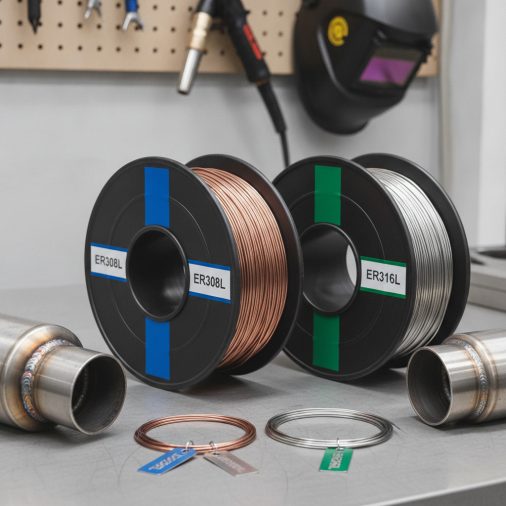
For a typical 304 stainless exhaust, ER308L is the standard choice. The “L” designation means low carbon, which reduces carbide precipitation during welding — the process that weakens corrosion resistance near the weld. ER316L is worth using if the exhaust runs extremely hot or if the system is on a vehicle exposed to road salt and moisture regularly.
If you’re welding stainless exhaust pipe to a mild steel component — like a mild steel flange or collector — ER309L is the correct wire. Using standard mild steel wire on stainless joints creates a weak, porous weld that won’t hold up under heat cycling.
Shielding Gas for Stainless MIG Welding
This is where most DIYers go wrong. Standard C25 (75% argon / 25% CO₂) works fine for mild steel, but it creates excess spatter and oxidation when used on stainless.
The correct option for MIG welding stainless is tri-mix gas, typically:
– 90% helium / 7.5% argon / 2.5% CO₂
This blend improves arc stability, reduces oxidation, and produces a flatter, cleaner bead profile on stainless. The helium component also adds energy to the arc, which helps fusion on thin material without requiring excessive voltage.
Some welders use 98% argon / 2% CO₂ as an alternative when tri-mix isn’t available. It’s not ideal, but it performs better than standard C25 on stainless. Choosing the right gas for MIG welding stainless steel has a direct impact on bead quality and corrosion performance.
Pure argon is generally not recommended for MIG on stainless because the arc becomes erratic and fusion can be inconsistent across thin tubing.
Machine Settings for Thin-Wall Stainless Exhaust
Exhaust pipe wall thickness drives your settings more than anything else. At 1.5mm to 2mm wall thickness, you’re working in sheet metal territory.
Typical starting settings for 1.5–2mm stainless exhaust:
– Wire diameter: 0.023″ (0.6mm) or 0.030″ (0.8mm)
– Voltage: 16–19V
– Wire feed speed: 150–220 IPM (depending on wire diameter)
– Travel speed: Keep the arc moving — don’t linger
– Contact tip to work distance: 3/8″ to 1/2″
Thinner wire (0.023″) gives you more control on thin material and reduces the risk of burn-through. The Lincoln Electric Weld-Pak 140 HD is a solid option for this kind of work — it handles thin material well and accepts 0.023″ wire without modification.
For more detailed guidance on dialing in your machine, MIG welding stainless steel settings covers the full range of adjustments for different thicknesses.
Preparing the Exhaust Pipe Before Welding
Clean metal is non-negotiable on stainless. Contamination causes porosity, discoloration, and weld failure under thermal cycling.
1. Degrease thoroughly — use acetone or a dedicated stainless cleaner. Avoid anything that leaves a residue.
2. Remove rust, scale, or carbon deposits — use a dedicated stainless wire brush. Never use a brush that’s been used on mild steel; it will embed carbon particles.
3. Fit the joint tightly — gaps cause burn-through on thin stainless. Aim for less than 0.5mm gap on pipe joints.
4. Tack weld before running a full bead — 3–4 tack welds spaced evenly around the pipe will hold alignment and reduce distortion.
In practice, the biggest mistake people make at this stage is skipping the dedicated stainless brush. Cross-contamination from a mild steel brush is subtle but causes surface rust and porosity that shows up weeks or months later.
Welding Technique on Round Exhaust Pipe
Welding around a round pipe is different from flat plate work. You’re constantly changing your position, and heat builds up fast on a closed diameter.
Key technique points:
– Weld in short segments rather than trying to complete the full circumference in one pass. Allow brief cooling between segments.
– Use a stringer bead, not a weave. Weaving increases heat input and warp on thin stainless.
– Watch the backside color — if the inside of the pipe is turning dark gold or blue, heat is building up too fast.
– Work in a consistent direction — start at the bottom of the pipe and work toward the top, or divide the pipe into quarters and alternate sides.
Tacking opposite sides evenly before welding out helps prevent the pipe from pulling and distorting as the weld cools. How to weld exhaust pipe with a MIG welder goes deeper into pipe-specific technique for different joint configurations.
Heat Discoloration: What the Colors Mean
Stainless steel changes color with heat. On exhaust systems, some discoloration is expected, but excessive color change during welding signals too much heat input.
Color
Temperature Range
What It Means
Straw / Light Gold
~300–400°C
Normal, minor heat tint
Dark Gold / Brown
~450–550°C
Elevated heat, acceptable in exhaust contexts
Blue / Purple
~600–700°C
High heat, reduced corrosion resistance
Gray / Black
700°C+
Excessive heat, potential weld quality issue
On an exhaust system that runs hot by nature, some discoloration at the weld zone is normal in service. The concern is excessive discoloration during welding, which suggests poor heat control rather than normal operating temperature.
MIG vs TIG on Stainless Exhaust
MIG is faster and more accessible for repairs and functional welds. TIG produces cleaner, more precise results and is preferred for show-quality exhaust systems or thin-wall tubing under 1.2mm.
If you’re deciding between the two, whether exhaust welding uses TIG or MIG depends largely on wall thickness, appearance requirements, and available equipment. For most practical repairs — cracked flanges, split seams, cracked joints — MIG gets the job done reliably.
TIG becomes the clear choice when you’re building a full custom stainless exhaust from mandrel bends, working with 321 or 316 stainless at thin wall, or when weld appearance matters for an exposed exhaust.
Common Problems and How to Fix Them
Burn-through on thin pipe
Reduce voltage, increase travel speed, or switch to 0.023″ wire. Use short tack welds instead of continuous passes on very thin sections.
Porosity in the bead
Almost always a contamination issue or shielding gas problem. Check for drafts disrupting your shielding gas, clean the base metal again, and verify your gas flow rate (typically 15–20 CFH for stainless MIG).
Excessive spatter
Wrong gas mixture is the most common cause. Verify you’re using tri-mix or argon/CO₂, not straight CO₂ or C25.
Cracking along the weld
This usually indicates too much heat causing carbide precipitation or a mismatch between the base metal and filler wire. Confirm your wire grade matches the base material.
Distortion / warped pipe
Tack weld more frequently, reduce heat input, and weld in alternating short segments. On very thin stainless, a copper backing bar can help absorb excess heat and reduce distortion.
FAQ
Can I use flux-core wire to MIG weld stainless exhaust?
There are stainless flux-core wires available, such as the Blue Demon E308LFC-O, which is designed for gasless stainless welding. They work as a field repair option when gas isn’t available, but the bead quality is rougher and spatter is higher compared to solid wire with proper shielding gas. For exhaust applications, gas-shielded solid wire gives better results.
What’s the minimum wall thickness where MIG is still practical on stainless exhaust?
In most cases, MIG with 0.023″ wire is manageable down to about 1.2mm wall thickness with careful settings. Below that, burn-through becomes very difficult to control, and TIG welding is a much better choice. Most standard automotive stainless exhaust pipe is 1.5mm or thicker, which is well within MIG’s practical range.
Do I need back purging when MIG welding stainless exhaust?
Back purging — flooding the inside of the pipe with argon to prevent oxidation on the back bead — is standard practice in TIG welding stainless. For MIG repairs on exhaust systems, it’s often skipped. If appearance and full corrosion resistance on the inside weld surface matter, back purging improves the result, but most practical exhaust repairs proceed without it.
Can I weld 409 stainless exhaust pipe with ER308L wire?
Yes, ER308L is generally acceptable for welding 409 stainless, which is a ferritic grade commonly used in OEM exhaust systems. Some fabricators prefer ER309L for welding 409 stainless because of the composition difference between ferritic and austenitic grades. Both work in practice, with ER309L providing a slightly better metallurgical match.
Why is my stainless weld turning black after welding?
Black oxidation on the weld surface indicates either inadequate shielding gas coverage or excessive heat input. Check your gas flow rate, look for drafts or leaks in your gas hose, and reduce your voltage or travel speed. A properly shielded stainless weld should show straw to light gold coloring, not black or dark gray.
Is it safe to weld exhaust pipe indoors?
Welding stainless indoors requires strong ventilation. Stainless welding produces hexavalent chromium fumes, which are a known health hazard with repeated exposure. Always weld in a well-ventilated space, use respiratory protection rated for welding fumes, and position yourself upwind of the arc whenever possible.
Can a small 110V MIG welder handle stainless exhaust pipe?
For typical exhaust pipe in the 1.5–2mm range, a 110V machine running 0.023″ wire is capable of producing solid welds with proper settings. The Lincoln Electric Weld-Pak 140 HD handles this thickness well. Heavier flanges or collectors over 3mm may push the limits of a 110V machine, where a 220V unit gives more consistent results.
Welding stainless exhaust with a MIG welder is entirely practical when you match the wire grade to the base material, use the correct shielding gas, and keep heat input controlled. The most common failures come from using the wrong gas or wire, not from any fundamental limitation of the process itself. Get those two variables right, take your time with tacking and short passes, and MIG will produce a weld that holds up to the thermal stress of normal exhaust cycling.