
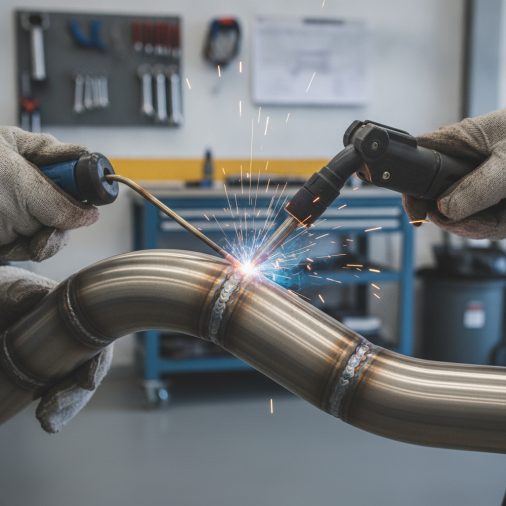
Both TIG and MIG welding are used on exhaust systems, but for different reasons. TIG welding is preferred for stainless steel, thin-wall tubing, and high-quality fabrication work. MIG welding is faster and more practical for mild steel exhausts, repairs, and production environments. The right choice depends on the material, wall thickness, and the quality standard required.
Choosing the wrong welding process for exhaust work can mean cracked welds, leaks, or welds that simply won’t hold against heat and vibration. Whether you’re patching a rusted section, fabricating a custom exhaust system, or replacing a collector on a race car, the process you choose matters. This article breaks down exactly when TIG welding and MIG welding are used on exhaust systems, why each method suits different situations, and what factors should guide your decision.
Why Exhaust Welding Is More Demanding Than It Looks
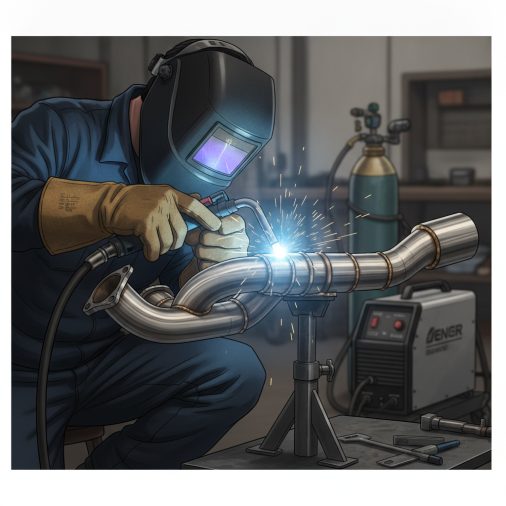
Exhaust systems operate in one of the harshest environments a weld can face. Temperatures can swing from ambient to over 800°C (1,472°F) repeatedly, and the system is constantly exposed to vibration, road debris, and corrosive gases.
A weld that looks clean on the outside can still fail if there’s porosity, incomplete fusion, or excessive heat distortion. This is why exhaust welding requires more care than welding structural brackets or body panels.
Thin-wall tubing — typically 1.2mm to 2mm for most passenger car exhausts — is particularly unforgiving. Too much heat and you burn through. Too little and you get cold lap or lack of fusion. Both failures show up quickly under thermal cycling.
TIG Welding on Exhausts: Where It Excels
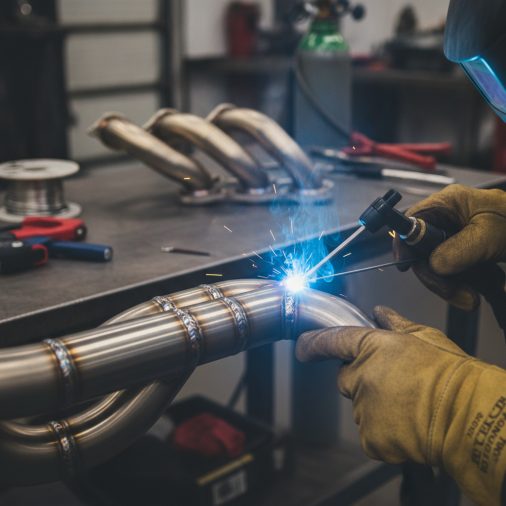
TIG (Tungsten Inert Gas) welding, also called GTAW, gives the welder precise control over heat input and filler metal deposition, so understanding tig weld different thickness metals can make the next step clearer. That control is exactly what thin-wall exhaust tubing demands.
TIG is the standard choice when:
– Working with stainless steel (304, 321, or 409 grades commonly used in exhausts)
– Tubing wall thickness is under 2mm
– The finished weld will be visible and aesthetics matter
– The system needs to pass inspection or meet motorsport regulations
– Welding titanium exhaust components (increasingly common in performance applications)
In practice, a skilled TIG welder can produce a consistent, clean bead on 1.5mm stainless with minimal distortion. The weld quality on stainless is also critical because stainless relies on its chromium oxide layer for corrosion resistance — excessive heat can cause oxidation (sugaring) on the back side of the weld if back purging isn’t used.
Back purging with argon gas on the inside of the tubing is standard practice for stainless exhaust TIG welding. It prevents the internal weld surface from oxidizing, which would otherwise weaken the joint and accelerate corrosion from the inside out.
Limitations of TIG on exhausts:
– Slower than MIG — a full custom exhaust system takes significantly more time
– Requires a higher skill level to execute consistently
– Equipment cost is higher
– Less practical for field repairs or high-volume production
MIG Welding on Exhausts: Where It Makes Sense
MIG (Metal Inert Gas) welding, or GMAW, is faster and easier to learn. For mild steel exhaust systems — which still make up the majority of OEM and budget aftermarket exhausts — MIG is a completely legitimate and widely used process.
MIG is commonly used when:
– The exhaust material is mild steel or aluminized steel
– Wall thickness is 2mm or greater
– Speed matters more than cosmetic appearance
– Performing repairs in a shop environment
– Working on trucks, vans, or commercial vehicles with heavier exhaust components
Production exhaust manufacturers often use automated MIG or even resistance welding for consistent, repeatable joints at volume, and mig welding square tubing expert can help narrow down the right approach. In an independent repair shop, a technician patching a cracked flex pipe or welding in a replacement section will almost always reach for the MIG welder — it’s faster, requires less setup, and the results are more than adequate for the application.
Where MIG struggles on exhausts:
– Thin stainless steel is difficult to MIG weld without burn-through or excessive spatter
– Heat input is harder to control precisely compared to TIG
– Weld appearance is generally less refined
– Porosity risk increases if shielding gas coverage is inconsistent
TIG vs. MIG for Exhaust Welding: Side-by-Side Comparison
| Factor | TIG Welding | MIG Welding |
|---|---|---|
| Best material | Stainless steel, titanium | Mild steel, aluminized steel |
| Wall thickness suitability | 1mm–3mm (thin-wall) | 2mm+ (medium to heavy wall) |
| Heat control | Excellent | Moderate |
| Weld appearance | Clean, precise | Functional, less refined |
| Speed | Slower | Faster |
| Skill requirement | High | Moderate |
| Back purging needed | Yes (for stainless) | Rarely |
| Typical use case | Custom fabrication, performance | Repairs, OEM mild steel systems |
| Equipment cost | Higher | Lower |
What Professional Fabricators Actually Use
Custom exhaust fabricators building performance systems — headers, full turbo-back systems, race exhausts — almost universally use TIG. The combination of stainless or titanium materials, tight tolerances, and high visibility of the finished product makes TIG the only practical choice at that level.
General repair shops handle a very different workload. The majority of exhaust repairs involve mild steel or aluminized steel systems on everyday vehicles. MIG welding handles those jobs efficiently and cost-effectively.
Some fabricators use both processes on the same system. For example, a custom stainless system might use TIG for all visible joints and collector welds, while MIG tacks are used for initial fitment before final welding. This hybrid approach is common in professional shops where time management matters.
Common Mistakes That Cause Exhaust Weld Failures
Understanding where welds fail helps clarify why process selection matters.
Sugaring on stainless steel — This happens when the back side of a stainless weld oxidizes due to air exposure during welding. It weakens the joint and creates a rough internal surface that traps corrosive gases. The fix is proper back purging with argon. This is a TIG-specific concern.
Burn-through on thin tubing — Applying too much heat on 1.2mm or 1.5mm wall tubing causes holes. TIG allows the welder to reduce amperage instantly using a foot pedal. MIG makes this harder to manage, which is why thin stainless and MIG are a poor combination.
Cold welds on mild steel repairs — Rushing a MIG repair without proper prep or using incorrect wire/gas combinations leads to welds that look solid but have poor fusion. These fail quickly under vibration.
Skipping joint fit-up — Gaps in exhaust tubing joints are harder to bridge cleanly with either process. Good fit-up before welding is non-negotiable. A gap of more than 10–15% of the wall thickness significantly increases the chance of a weak or porous weld.
Wrong filler wire for stainless — Using mild steel MIG wire on stainless exhaust components is a mistake that still happens in general repair shops. The weld may hold initially but will corrode rapidly. ER308L or ER316L TIG rod, or 308L MIG wire, are appropriate for most stainless exhaust grades.
FAQ
Can you MIG weld stainless steel exhausts?
Technically yes, but it’s not ideal. MIG welding stainless requires the correct wire (308L or 316L) and a tri-mix shielding gas (argon, helium, CO2). Heat control is harder to manage, and the results are generally less clean than TIG. For thin-wall stainless tubing under 2mm, most professionals choose TIG to avoid burn-through and poor aesthetics.
What gas is used for TIG welding exhausts?
Pure argon is the standard shielding gas for TIG welding stainless and mild steel exhausts. For back purging stainless tubing, argon is also used inside the pipe to prevent oxidation on the weld root. Some fabricators use argon-helium blends for titanium exhaust welding to improve heat input and travel speed.
Is flux core welding suitable for exhaust repairs?
Flux core (FCAW) can be used for mild steel exhaust repairs in field situations where shielding gas isn’t available. The results are functional but not clean — spatter is significant and weld appearance is rough. It’s a last-resort option, not a recommended process for exhaust work. Never use flux core on stainless exhaust components.
Why do TIG welds on exhausts look like stacked dimes?
The stacked dime appearance comes from the rhythmic, controlled way TIG welders add filler rod and move the torch — dipping the rod, advancing slightly, dipping again. Each “dime” represents one filler addition. It’s a sign of consistent technique and is widely associated with quality TIG work, though a smooth continuous bead can be equally strong.
How thick does exhaust tubing need to be before MIG becomes practical?
In general, 2mm wall thickness is a reasonable threshold where MIG becomes more manageable on exhaust tubing. Below that — particularly on stainless — the heat control advantages of TIG become important. Mild steel at 1.6mm can be MIG welded by an experienced operator, but it requires careful technique and proper machine settings.
Does the type of exhaust material affect which welding process to use?
Absolutely. Mild steel favors MIG for speed and simplicity. Stainless steel (304, 321, 409) strongly favors TIG for heat control, appearance, and corrosion resistance. Titanium requires TIG with full argon shielding and back purging. Aluminized steel is typically MIG welded, though the aluminum coating burns off near the weld zone and the area should be treated to prevent rust.
What wire or rod size is typically used for exhaust welding?
For TIG welding stainless exhausts, 1.6mm (1/16″) filler rod is most common for tubing in the 1.5mm–2.5mm wall range. For MIG welding mild steel exhausts, 0.6mm or 0.8mm wire is standard. Heavier exhaust components like flanges or manifolds may use 0.9mm MIG wire or 2.4mm TIG rod depending on the joint size and heat requirements.
Final Thoughts
The short version: TIG for stainless and performance fabrication, MIG for mild steel repairs and production work. Neither process is universally superior — they serve different needs. A professional fabricator building a custom stainless system won’t reach for a MIG welder, and a repair technician patching a mild steel pipe won’t set up a TIG rig when a MIG will do the job in a fraction of the time. Match the process to the material, the wall thickness, and the quality standard the job demands, and you’ll get a weld that holds up.


