MIG welding outdoors sounds straightforward — more space, better ventilation, and no cramped garage. But there’s a reason most welders prefer to work inside when they can.
Yes, you can MIG weld outside, but wind is your biggest enemy. Even a light breeze can blow away the shielding gas that protects your weld puddle, causing porosity, weak joints, and poor bead appearance. With the right precautions — wind barriers, proper gas settings, and the correct wire choice — outdoor MIG welding is absolutely achievable.
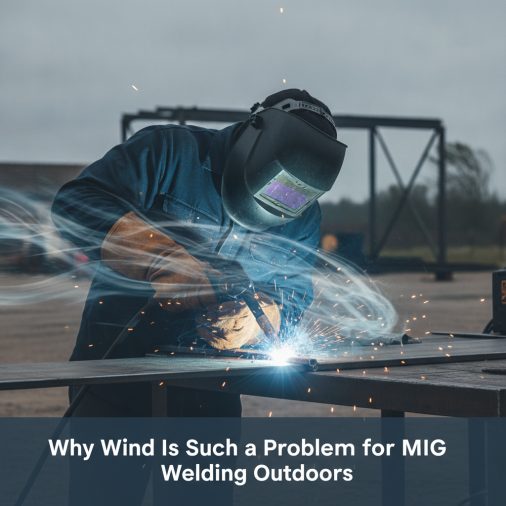
Why Wind Is Such a Problem for MIG Welding Outdoors
Standard MIG welding relies on a steady flow of shielding gas — typically a 75/25 argon/CO₂ mix — to protect the molten weld pool from atmospheric contamination. That gas creates a localized shield around the arc zone. Wind disrupts that shield almost instantly.
Even at wind speeds as low as 4–5 mph, shielding gas can be blown away before it fully covers the puddle. The result is porosity (tiny gas pockets in the weld), an uneven bead, and a structurally weaker joint. In some cases, the weld looks fine on the surface but is riddled with internal defects.
The problem compounds in gusty or variable wind conditions, where the disruption is inconsistent and harder to compensate for.
How to MIG Weld Outside Successfully
With the right setup, outdoor MIG welding produces quality results. The key is controlling the environment as much as possible before you strike an arc.
1. Build a wind barrier
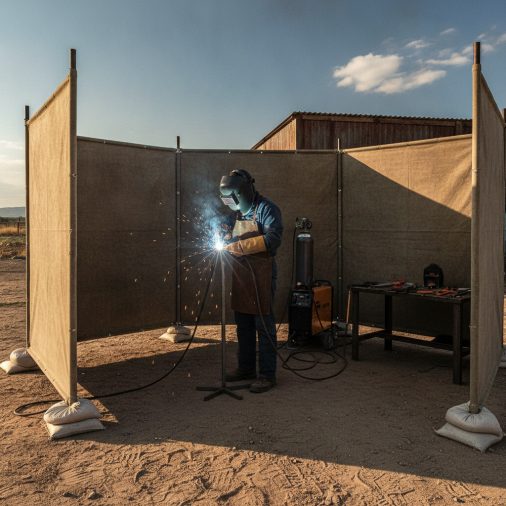
Position panels, plywood sheets, tarps, or welding curtains around your work area. Even a three-sided enclosure dramatically reduces air movement at the weld joint. Position the opening away from the prevailing wind direction.
2. Increase your gas flow rate
Indoors, a gas flow of 20–25 CFH (cubic feet per hour) is typically sufficient. Outdoors, bumping that up to 30–35 CFH helps compensate for minor air movement. Avoid going much higher — excessive flow can create turbulence that pulls in atmospheric air around the nozzle.
3. Use a larger nozzle
A wider nozzle increases the coverage area of the shielding gas envelope. In outdoor conditions, this gives you a slightly better chance of maintaining protection, especially on wider joints.
4. Reduce your travel speed
Moving slower gives the shielding gas more time to protect the puddle. It also lets you watch the puddle more carefully for signs of contamination.
5. Check your contact tip and nozzle for spatter
Outdoor work often means you’re pushing your setup harder. Spatter buildup inside the nozzle restricts gas flow, making wind problems worse. Clean the nozzle frequently during long sessions.
Switching to Flux-Core Wire for Outdoor Work
When wind conditions are too strong to control with gas adjustments alone, switching to flux-core wire is the most practical solution most welders use.
Flux-core wire is self-shielding — it generates its own protective gas cloud from flux compounds inside the wire as it burns. There’s no external shielding gas required, so wind has no effect on arc protection. whether you need gas for MIG welding depends largely on the wire type you’re using, and flux-core eliminates that dependency entirely.
Self-shielding flux-core wire like Lincoln Electric Innershield NR-211-MP is a popular choice for outdoor structural and fabrication work. It handles wind, dirty base metal, and thicker material well.
The trade-off is that flux-core typically produces more spatter, leaves a slag layer that needs to be chipped off, and generally doesn’t match the clean bead appearance of solid wire with gas shielding. For visible or aesthetics-critical welds, that matters.
What Conditions Make Outdoor MIG Welding Impractical
Some outdoor situations make MIG welding with shielding gas genuinely difficult, even with preparation:
– Sustained winds above 15 mph — barriers become hard to maintain and gas coverage is unreliable
– Open, exposed locations — fields, rooftops, or elevated structures with no natural windbreak
– Rain or high humidity — moisture introduces hydrogen into the weld zone, increasing the risk of cracking and porosity
– Extreme cold — wire feed issues become common, and base metal may need preheat to avoid cold cracking
In these conditions, flux-core wire is the better technical choice rather than fighting the environment with increased gas flow.
Safety Considerations Specific to Outdoor Welding
Outdoor welding introduces hazards that are different from indoor shop work.
UV and arc flash exposure — outdoors, there are no walls to contain the arc flash. Anyone nearby without proper eye protection is at risk. Use welding screens or curtains to protect bystanders.
Fire hazard — dry grass, leaves, and other combustible materials can ignite from spatter. Clear a safe radius around your work area and keep a fire extinguisher within reach. Never weld over dry vegetation.
Electrical safety — moisture on the ground or equipment increases shock risk significantly. Keep cables off wet ground and inspect your equipment before each session.
Fume dispersal — outdoors, fumes disperse more naturally than indoors, which is genuinely an advantage. However, don’t let this make you careless — welding galvanized steel outdoors still requires a proper respirator because zinc fume exposure is dangerous regardless of location.
Gas-Shielded MIG vs. Flux-Core for Outdoor Use
Factor
Gas-Shielded MIG
Self-Shielding Flux-Core
Wind resistance
Poor without barriers
Excellent
Bead appearance
Clean, smooth
More spatter, slag
Portability
Requires gas cylinder
No cylinder needed
Material thickness
Better for thin material
Better for thicker material
Post-weld cleanup
Minimal
Slag removal required
Best use case
Calm or sheltered outdoor areas
Open, windy, or field conditions
Practical Tips From Field Experience
A few observations that don’t always make it into beginner guides:
– Position yourself so your body acts as a wind block when possible. It’s surprisingly effective for light breezes.
– Work in the morning or evening when wind speeds are typically lower, especially in open areas.
– If porosity appears in your welds and you can’t identify the cause, wind contamination is usually the first thing to rule out.
– A quality auto-darkening helmet like the Lincoln Electric Viking 3350 makes it easier to quickly check your setup between passes without repeatedly flipping a standard lens — useful when you’re managing a wind barrier setup as well as welding.
– knowing what a good MIG weld looks like helps you catch wind-related contamination early before it compounds into a structural problem.
FAQ
Can I MIG weld outside without a wind barrier?
In very calm conditions — light air movement under 3–4 mph — some welders manage without barriers, especially with slightly increased gas flow. In practice, it’s inconsistent. Even subtle breezes cause contamination you may not notice until you inspect the weld. A simple plywood or tarp barrier is worth the few minutes it takes to set up.
What’s the minimum wind speed that affects MIG shielding gas?
Most welding standards and field experience suggest that wind speeds above 4–5 mph begin to noticeably affect shielding gas coverage. AWS D1.1 structural welding specifications typically prohibit open-arc welding when wind exceeds certain thresholds unless protective measures are in place. Always check the applicable standard for critical structural work.
Can you MIG weld in the rain?
No. Welding in active rain is dangerous — it introduces moisture directly into the arc zone, causes hydrogen cracking in the weld, and dramatically increases electrical shock risk. Light mist or humidity is manageable with care, but direct rain exposure should stop work entirely.
Is flux-core wire as strong as MIG with shielding gas?
Generally, yes — self-shielding flux-core wire produces welds with comparable tensile strength to solid wire MIG on appropriate base materials. The structural integrity is sound for most applications. The main differences are in bead appearance and the need for slag removal, not strength.
Does outdoor welding require a different machine setup?
The machine itself doesn’t change, but your parameters often do. Slightly higher voltage and wire speed settings can help compensate for heat loss from wind-cooled base metal. If you’re MIG welding thin sheet metal outdoors, heat management becomes even more important since wind can cool the base metal faster and affect fusion.
Can I use 100% CO₂ shielding gas outdoors instead of a mixed gas?
Some welders prefer 100% CO₂ outdoors because it’s slightly denser than argon mixes and may hold up marginally better in light wind. In practice, the difference is small and does not replace physical wind protection. It also produces more spatter than 75/25 mixes, so it’s a trade-off rather than a solution.
What’s the best wire for outdoor MIG welding on mild steel?
For calm to lightly breezy conditions with a barrier, ER70S-6 solid wire with 75/25 gas works well. For open or windy outdoor work, Lincoln Electric Innershield NR-211-MP self-shielding flux-core wire is widely used and performs reliably without shielding gas.
Getting It Right Outdoors
Outdoor MIG welding is practical with preparation, but the environment actively works against you in ways that don’t exist in a shop. Wind management is the single most important factor — solve that, and most other challenges become manageable. When conditions are too unpredictable, switching to self-shielding flux-core wire is the most reliable decision, not a compromise.